
Mrs Geraldo is tidily stretched out on the bed, fully and immaculately dressed in a tartan bolero jacket, frilly white blouse with a rope of pearls around the ruff, corduroy skirt, thick black stockings and black court shoes, her hands neatly folded over her tummy, her legs crossed, her head supported by two crisply laundered pillows. It’s a double bed, the right side taken up with a collection of unusual cuddly toys – a horned goat, an octopus, a snail and so on. The room itself is as immaculate as Mrs Geraldo, bright paintings, silk drapes, silver framed photographs, richly coloured rugs on a polished wooden floor. It was one of these rugs that tripped her up a few days ago, which is why her hair is a little wild; the abrasion on the back of her head needs some undisturbed time to fully heal.
Standing at the foot of the bed is Gillian, her carer.
‘He wants to talk to you,’ she says, handing me the phone.
Mrs Geraldo’s son, Peter is calling from Darmstadt. I tell him how his mother is, what her observations are today, what the plan is. He takes all this on board then asks me how I got access.
‘Oh – erm – Gillian happened to be here. I phoned earlier to agree a time but no-one answered so I came round on spec. I’ve got a record of the keysafe but no-one seems to know the number.’
‘That’s right. You’re not supposed to know. That number is for the emergency services only.’
‘Okay.’
‘I don’t want any old person traipsing through the house stealing things.’
‘Right.’
‘If you need to visit my mother you make an appointment with Gillian. She must be there at all times.’
I glance at Gillian. She can’t hear the conversation, but from the face she pulls – essentially the eek emoji – I can see she understands.
‘That’s fine,’ I tell him. ‘Obviously it makes it more difficult for the nurses and therapists to come in and help your mother. Generally speaking we’d be using the keysafe in the same way as the emergency services – because that’s kind of what we are, too…’
‘Let me stop you there. If mother falls over and needs picking up – fine, the ambulance need to know the number. Everything else is to go through Gillian. Is that understood?’
‘Absolutely. Let me hand you back to her, Peter. Good to speak to you.’
Gillian takes it from me and talking very quickly and earnestly carries it off into the kitchen.
‘Was that Peter?’ says Mrs Geraldo.
‘Yes. All the way from Germany.’
‘He does worry.’
‘I can see that.’
‘Oh dear!’ she says, reaching up with her right hand to pat her hair. ‘You must forgive me. I look an absolute fright.’
Author: jim clayton
emmerich knows
this is not a rehearsal, sheeple / this is Operation Too Many People / Wanting Too Much Stuff / the bail bond version of The World is Not Enough / because at the end of the day / the cost is WAY more than unlimited texts / a fancy new handset / it’s about limited natural resource to share / it’s the wind in your thinning hair / it’s muddy waters and smoggy air / it’s that polar bear / there / wobbling by on what’s left of the Larsen B / C / or D / or whatever / sweating in the unseasonably balmy weather / underfed, indisposed / balancing on the last of the floes / to melt beneath its hairy toes / watching as you pose with your extended family / at the end of a selfie stick / instagram slick & super quick / on the luxury deck / of the good ship Charlie Darwin / saying everything’s charming, charming / & wondering why attenborough was quite so alarming / but you only give it three stars on Trip Advisor / because you’re three thousand down and none the wiser / the weather was shit / you were sea sick / the dramamine didn’t take care of it / but anyway / hey / you’re basically okay / you’re an optimist at heart / I mean – where do you start? / nothing’s impossible / you’ve just got to be philosophical / it’s not as if none of this happened before / I mean – look at the dinosaurs / the original baby boomers / you can’t tell me they weren’t big consumers / admittedly mostly ferns and cones / in the more temperate zones / supersize meat eaters / on a scale / that would make whittingstall pale / running helter skelter / through muddy swamps and river deltas / leaping pronto back of a brontoburger / with a side order of allosaur / volcanoes and asteroids permitting / I mean – c’mon – they never thought of quitting / moaning about how hot it was getting / no – they clacked their jaws / and waggled their claws / and let dinosaurs be dinosaurs / I mean – when all’s said and done / the earth was always going to fall into the sun / so why not relax and have a little fun? / did you ever see that film from the 1950s / (bear with me on this, please) / the Incredible Shrinking Man? / I think / anyway / basically / it’s about this guy who shrinks – A LOT / because he sunbathes on his yacht / through a cloud of radiation / and without any explanation / finds his clothes are too loose / till he ends up sneaking around in a doll’s house / playing cat and mouse / with a cat / (true dat) / reducing in increasingly tiny increments / cleverly utilising household implements / until he ends up in a fight to the death / with a spider on a window ledge / on the prowl for spider snacks / but he catches it good in the cephalothorax / with a sewing needle / covering our resourceful indiveedle / in acky spider goo / but when it’s eat or be eaten, what d’you do? / then he walks outside through a vent / looks up at the starry firmament / and thinks about his existential position / in light of his chronically minimising condition / and he says: ‘The unbelievably small and the unbelievably vast eventually meet, like the closing of a gigantic circle’ / (or that’s what he says according to google)
anyway, point is
films will always have something to say about this shit / take roland emmerich / cgi king of apocalyptic schtick / he predicted all this / with a cute, self-cleansing, Gaia kind of twist / (mark my words – we’ll be quoting from him / in years to come when the news is grim / already do – to give it some context / look at Chicago and the polar vortex)
for instance – my favourite scene from his oeuvre? / (a small thing, true but it hits a nerve):
Ian Holm is giving the team some broody looks / then he pulls some whiskey from out behind a bunch of science books / and you know exactly what adrian lester’s thinking / can this really be the last shit I’ll ever be drinking? / while / miles away / on that apocalyptic day / after tomorrow / on the way / to Balmoral / a fleet of royal helicopters start popping & dropping / rotor blades stopping / the pilots so many helmeted icicles / airworthy as a frozen bicycle / while inside, unseen / poor Elizabeth, our very own snow queen / is suddenly just so much royal frosting / illustrating what climate change was really costing
because trust me – EMMERICH KNOWS / how the world is only just so / until uh-oh / where’d it all go? / the greenland ice sheet & the Tibetan plateau / the indus & the ganges / vanisheees / c02 & methane exponential / rains torrential / wildfires residential / territorial & water wars potential / while the politicians & presidents / & sundry other residents / get it too late / why attenborough was so awesomely great / why he’d shake his head and close his eyes so sadly / and talk about how we were fucking things up so badly
but – my bad / there’s always comfort to be had / in blinkered denial / waving our hats rodeo style / as we ride flaming into the chasm / on the poor earth’s dying spasm / this shrink-wrapped, oil-tapped, carbon clapped / flaming cinder we called home / it’ll be alright – now leave me alone

alice in careland
If Gerald was anything he’d be the caterpillar.
He’s sitting very, VERY upright, hands placed just-so on the arms of his riser-recliner, which, with the addition of a pressure-relieving contour mattress, does look a bit like some enormous, super-squashy mushroom. He’s not smoking a hookah, unfortunately, although he does have a Ventolin inhaler amongst his things on the cantilever table to his right. The long years of his illness have given him a pale and haughty appearance, so that when he leans forwards a little, staring at me over the rim of his glasses, and says ‘Who are you?’ I’m tempted to put my hands behind my back and curtsy.
None of this would’ve occurred to me were it not for the fact that his wife, Judy, is obviously both an artist and an Alice in Wonderland fan. She’s made stuffed hares in trippy, paisley fabric; pottery plates and vases with motifs of cards, clocks, mallets, falling Victorian girls; a carved wooden flamingo with a hedgehog at its feet; a couple of dioramas, silvered twigs for a forest or an intricate parlour scene, with a large or a small Alice doll in various dramatic postures; a marionette Jabberwocky, and so on and on, placed all around the room or hung on the wall, so that the whole house feels like a collector’s shrine to Lewis Carroll.
Judy herself makes an adult and very careworn kind of Alice. She’s sitting in the opposite chair, absent-mindedly tearing a tissue to pieces in her lap as we go through what’s been happening lately and what we can do to help. There are so many issues to bear in mind – the specifics of Gerald’s illness, the way the house is set-up (or not), the practical difficulties of making all the follow-up appointments at the hospital, the level of care they currently have and whether that could be increased, the stress all this is having on the family, primarily Judy, of course – but essentially it boils down to whether Gerald has reached the point where he needs to go into residential care. It’s such a dreadful and difficult decision to make, and I can quite understand the desire – conscious or otherwise – for someone else to make it for them. More often than not these things edge forward with sadistic increments of stress until something snaps and the whole thing changes at a clip. The best you can do is to support as best you can, be available to clarify and facilitate, and step in to pick up the pieces.
I wish it were easier. I wish I could just lean forwards, snap a piece off either side of the mushroom chair and hand them to Judy.
‘This will make you taller, this will make you smaller,’ I would say, and then smiling enigmatically, shuffle off with all my bags into the undergrowth.
feresteh and the big blue owl
Feresteh tells me about a recurring dream that’s been troubling her.
‘I think it’s because of the drugs they pumped into me in ITU,’ she says, tentatively shifting her position in the bed so she’s more upright against the pillows. Her face looks scooped, her eyes preternaturally large. ‘I was very ill,’ she says.
‘I’m sorry to hear that.’
‘But you know the worst thing about it all is the dream. It comes to me most nights, even sometimes during the day if I sleep a little. It is always the same thing. I am in the hold of sailing ship, with hundreds of girls all my age. And I realise I am being trafficked, about to be taken away across the sea to some faraway place, a place no-one will ever be able to find me. There are heavy pieces of furniture there, too, gaudy, richly decorated. And I come to see that this is how they intend to smuggle us out of the ship – inside the furniture, locked in the chests and the cabinets. I see my father and my uncle looking down at me from the hatch, silhouetted against the light. I call out to them but all they do is wave sadly, and withdraw slowly, and the hatch slides shut, and everything goes quiet. And then the worst thing. From out of the darkness comes a big blue owl. It flies low over our heads, its eyes wide – like THIS – its claws out. And it is so terrifying I put my hands up and I say No! NO! And if I am lucky, I wake up.’
She raises her chin to track the invisible bird, her left arm straight with the fingers of that hand spread, the right arm bent so the hand is level with her face. Her mouth is slightly parted, her breath coming quickly, and her eyes – her eyes are shining.
the walkers
Norman and Diane have walked a very long way. They’ve walked the Pennine Way, Glyndwr’s Way, The Pilgrim’s Way and The Ridgeway. They’ve walked Hadrian’s Wall and the coast of Devon & Cornwall. They’ve walked the length of the Thames from Trewsbury Mead to estuary. They’ve walked from Land’s End to the other end, and they’ve got journals filled with watercolours and photographs to prove it. But today Norman faces one of the most challenging journeys he’s ever undertaken – the short ride in a hoist from chair to bed.
‘Don’t worry, darling. It’s okay,’ says Diane, stroking the backs of his hands as the hoist rises up a little and the sling straps tighten. Norman wriggles anxiously from side to side and kicks out his legs. ‘Try just to relax and go with it,’ she says.
It’s a manual handling dilemma. Norman isn’t so debilitated that bed care is the only option – which would lead to further deconditioning, the risk of pressure damage and so on – but then again, after his recent illness, neither can he transfer safely with just a zimmer frame and the assistance of two. A stand-aid would be the only other option, and that’s certainly on our minds as we try to reassure him before we lift him out of the chair. If it fails, we’ll be forced to get him back to bed by some other means, and then try to build up his strength and confidence over time with a home exercise programme. For now, the hoist is the best option.
‘It’ll help when he has regular carers, a routine and so on,’ says Brigit, the Occupational Therapist. ‘They’ll be a lot slicker than us.’
‘I think there’s just been a lot going on today, hasn’t there, darling?’ says Diane. ‘I think you’re just exhausted.’
He looks up at her, his legs sticking out, his hands gripping the brightly-coloured straps in front of him.
‘Where are we off to now?’ he says.
room for a couple
The place looks more like a film set than a family home.
There are two men struggling to unload an enormous new fridge from their van; a man in a woolly hat re-glazing a shattered front door; a woman with a giant poodle arguing with the builder about glass on the floor whilst the dog barks and hops excitedly from paw to paw; a woman with a kettle in her hand trying to get everyone’s drink order right; a woman with an armful of clean sheets excusing her way from the linen cupboard to the bedroom; a woman arguing with someone on her phone, turning on the spot from left to right, her other hand over her ear to block all the noise; a young girl idly swiping her phone with her legs up on the sofa – and then Jean, the woman dying of cancer, sitting upright on her hospital bed in the centre of it all, as watchfully imperious as an Egyptian mummy roused by tomb raiders.
‘Busy, isn’t it?’ she says as I pick and excuse my way past all the chaos further into the room. ‘If it gets too much, just do what I do and bathe your eyes in the garden.’
It’s certainly a wild and lovely view. A small front garden with an elaborate bird-feeder, an ancient apple tree, an overgrown hedge, and beyond it, uninterrupted miles of misty downland.
‘Tea?’ says the woman with the kettle, looking in after me.
I say thanks but no.
‘Right then. So…’ She heads for the kitchen, staring at the splayed fingers on her right hand, rehearsing the tally. The dog barks. The sound of more shattering glass. Somewhere nearby a beeping van reverses.
I’d been told the story before my visit, of course. How Jean’s twin sister had died unexpectedly. How the ambulance crew had had to smash through the front door to get in – to no avail, unfortunately. Friends and family had converged on the house to help – including re-fitting the front door – at the same time as the kitchen appliance people arrived with the new fridge, and I arrived to supervise moving Jean from the bed so a more suitable mattress could be installed.
‘I’m no weight, but it’s not just you, is it?’ says Jean.
‘No. I’m expecting two more.’
‘Ah!’ says Jean. ‘Well. That should prove interesting.’
jurassic pork
ladies & gentlemen / if I could have your attention / first of all, apologies for the heavy security regimen / but as you can see we’re a pretty serious bunch / and anyway, I’ve got what you might call a hunch / that when it comes to the crunch / you’d rather not end up some other fucker’s lunch / so – hands inside the car at all times please / whilst I run you out to the compound beyond the trees / the first stop on our little tour today / so when y’all ready back there? well, then – okay!
the park was opened two thousand and sixty / the world’s first megafauna facility / comprising five artificial islands of stunning complexity / viable biodomes of staggering convexity / where DNA diversity / is pursued with seismic scientific activity / and detailed dexterity / facilitating productivity / resistance to adversity / and of course the biggest prize / sheer motherfucking SIZE! / I know, I know – that’s a lot to swallow / are y’all managing to follow? / good / I thought you would / now – if you just shield your eyes from the glare / there! that’s BD 1 / that’s where all the fun / begun / back when we started having all that trouble with the sun / and it looked like the human race was – well – run / but I don’t need to tell you good folks that / I’m sure y’all got the t-shirt ‘n the lead-lined hat …
[radio suddenly squawking / someone frantically talking]
what the fuck?
[he stops the truck]
just a minute folks / whyn’cha pass round the smokes / whilst I talk to my ol’ pal Pablo / used to ride in the rodeo / y’know / but the silly ol’ so-and-so / he gets a bit twitchy / jes ‘cos the electric fence can be glitchy / so please excuse me, woncha? / we’ll soon be back on our wild adventure
Hey there, Pablo? / Wha’d’ya know? / Como estas? / Quiero respuestas no preguntas! / Okay. Uh-hum. I see. No shit! / Call out the choppers and we’ll make a run for it….
Ladies and Gentlemen! / can I have your attention again? / Could I ask y’all to buckle up / while I jes’ swing around and head back to the lockup / please ignore / the roaring / and the meaty rumble up through the flooring / it’s nothing to worry about / jes’ a few of the stock got out / but you’re perfectly safe in this lil’ ol’ car / and remember, objects in the mirror look closer than they are
thinkers, feelers, doers & believers
Well here I am, slogging across a muddy field taking Lola for her morning walk. It’s January, and really quite effing cold. Not the inspirational, sharp-edged kind of cold that zings you up and makes everything clearer. No – it’s a sapping, neurasthenically damp kind of cold, the kind of cold that makes you pull your hat down hard over your eyes and make you wish you were back in bed.
Lola runs on. I push my hat back up to watch her go.
But I’m not thinking about how dogs live completely in the moment and that Lola is probably as happy in January as she is in June. What I’m thinking is: I could really do with a Guru.
You can’t blame me. As M. Scott Peck so memorably put it: ‘Life is difficult.’ (The Road Less Traveled, 1978). Filled with frustrations, confusions, complications, prevarications. And I don’t know, but maybe he should have added: ‘Especially in January’.
Because if December is the big-footed, boozy-eyed, cake-bellied, Sanctified Santa of all the long year’s graft, January is the hollow-cheeked wraith rising from the cold ashes in the grate to stare at you as you lie so pathetically on the sofa making yet another list: What I Need To Do With My Life – And This Time It’s Serious. (Underlined three times, drawing of a little skull, in a flowery hat, smoking a cigarette… see how easily you’re distracted…?)
It’s such a typical thing this time of year it’s worse than a joke, along with the increase in divorce applications and Gym membership. Google could probably quantify it nicely; a cheery animation illustrating the increased volume in search criteria: ‘courses to learn Spanish’ or ‘choir local to (insert postcode)’ or ‘questionnaire to help you find the right job’ or ‘questionnaire to help you find the right questionnaire’. Which is to say: I’m like a lot of people this time of year, feeling the urge to make a change but not actually getting on and doing much that’s practically useful about it.
Which is where the Guru comes in. Stepping lightly through the door surrounded by an intense white light & hummingbirds. Laughing generously with expensive teeth. Wiping their sunglasses on a filthy T-shirt that bulges dangerously but you can still make out the slogan: Stop Me and Ask the Secret. A Bentley idling round the corner.
Despite all my misgivings, still it’d be such a relief to just surrender everything to them, all the existential angst. Especially if it WAS everything – work life, social life, spiritual life, (sexual life, probably, almost inevitably, depending on the guru). A one-stop drop for all your disaffection needs! Meet new friends! Stick to that diet! Discover Your Purpose! Realise your Potential! Everything with a smile and an exclamation point! All you need is the will to believe (and a current account).
Because, let’s face it: Gurus are a fascinating and powerful phenomenon. Have been for centuries. And that’s not surprising, given the commonality of human experience. People have felt this ache for years. And if they didn’t ease it with drugs, alcohol or cave paintings (or the modern equivalent – Netflix), your Guru is your next best thing.
Gurus aren’t necessarily bad, of course. But they often feature in the same context as ‘cult’, which definitely IS a bad thing. The trick is to spot the honest, genuinely enlightened guru from the destructive, predatory, poisonous kind. Joe Navarro, who worked in the FBI for 25 years lays it all out in a 50-point checklist to help identify the pathological cult leader (Dangerous Traits of Cult Leaders, Psychologytoday.com 25/08/12). Number one is someone who:
‘…has a grandiose idea of who he is and what he can achieve.’
and number fifty, someone who has:
‘… isolated the group physically (moved to a remote area) so as to not be observed.’
The other forty-eight points read like the kind of basic primer they might hand out to novice devils in Hell. A set of laminated fob cards you can hang off your fork.
Steven Hassan brilliantly explores the subject of destructive cults in his book Combatting Cult Mind Control. (Park Street Press, 1988). Early on in the book he describes his experiences in the Moonies. He says when they were ‘fishing’ for new recruits they tended to categorize them into 4 groups: Thinkers, Feelers, Doers or Believers, and would finesse their approach
“…we saw believers as people searching for God, or looking for spiritual meaning in their lives. They typically would tell us about their spiritual experiences – dreams, visions, revelations. For the most part, these people were ‘wide open’, and really recruited themselves….. With them it was simply a matter of sharing our ‘testimonies’ with them to convince them they had been led to us by God.” (p.42)
Me, basically. But what happened when they came up against a ‘Thinker?’ (which could also be me, depending if I’m at work or not).
I imagine it might go like this:
THINKER: Ooooh no! No, No, No. They’d never get me. What – that bunch of crusty, flute-playing bastards? With their crooked teeth and cheap extensions? Me and my education? I’ve got a background in corporate finance! I’ve won awards! C’mon! I can hear the crunch of their granola a mile away. I mean – just look at these clowns! Jumping up & down, clapping like the meds finally kicked in. Good grief! Well look. I feel sorry for them, I really do, but they deserve all they get. They’re just GULLIBLE. And when it comes down to it, my friend, I’m afraid the weak are just there to feed the strong. It’s nature’s way of netting the weed out the gene pool. Just try putting it over ME. They wouldn’t come close. Wouldn’t even TRY. They know whose ripe and who’s not. Five seconds, a handshake and they’re on to the lower fruit. It’s how you carry yourself. The look in your eye. That unshakeable confidence in what you HAVE. No, sir. I’m not your average mark. Even though my name IS actually Mark. Scrub that. We’ll edit that later.
GURU: Hey. Yeah. Okay – Mark? Anyone can see you’re a five-sided Son of a Governor. An independent free-thinker who looks at the facts, weighs them up, tosses them in the trash or pops ‘em in their pocket for later. And I respect that. But – you know as well as I do the world is full of people who’ll tell you one thing and do another. They’ll deal out half-truths mixed in with damned lies, and then ice the whole damn shit cake with a layer of FAKE NEWS FROSTING. They’ll distract you, try to bully you (good luck with THAT, am I RIGHT?), then flatter you into making some rookie error! The world is full of Snake oil salesmen, as you know, Mark. Journos and Democrats, basically. You know it. I know it. We all know it! But c’mon! If you’re REALLY as strong as you say you are, you’ll be able to look this pamphlet over and know in a heartbeat if you think it’s of any value or not. Am I right? Yeah? C’mon! I LIKE you, Mark. You and your superman dimple. Let’s sit down and chat some more. And just for the record, what size robe d’ya flavour…?
Because of course, more often than not, that rigid stance of invulnerability says more about a need to see the world as a rational place, something predictable, that can readily be controlled. And as Steven Hassan points out, it’s a stance that makes them as vulnerable to exploitation as the Believer. Whilst he says that most of the people they recruited were more from the Doers and Feelers than the Believers – the Thinkers…? Well, apparently they: “…eventually became leaders within the organization.”
Can’t blame them.

the assistant coordinator
I wasn’t out on visits today. Instead I was on the rota as Assistant Coordinator.
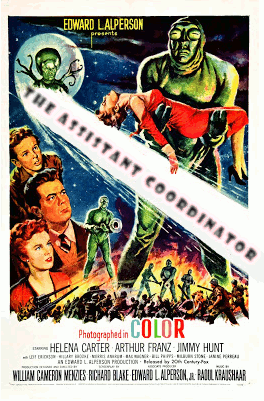
It always makes me feel I should be wearing a shiny foil suit, frantically working a console of levers, buttons and dials, whilst sparks fizz up and down a V-shaped wire and a theramin plays in the background. And up on a gold & tinsel draped dais behind me, The Coordinator, a pulsating brain in a bottle, where the plasma bubbles a soothing green when They are pleased, and boils red when They are Not.
Actually what it means is riding shotgun on the computers and phones at the operational heart of a madly busy community health team. It means being able to troubleshoot a hundred things at once, each as important as the next. A better analogy would be the floor of the Stock Exchange. Although, to be fair, that’s as removed from my experience as the sci-fi scenario I started with – and if there’s anything at all you can take from any of this, it’s that I watch too many films. In a Stock Exchange (I imagine), you’d be surrounded by people shaking bits of paper in your face shouting buy, buy, buy, or sell, sell, sell. So the only difference I can see between ‘Assisting the Coordinator’ and ‘The Floor of the Stock Exchange’ is that the latter has some money behind it. Here in the NHS, despite hospital avoidance teams being at the sharp and potentially very effective end of health care – and definitely the place you’d want to invest in if you were at all serious in freeing-up space in our overcrowded hospitals – well, apparently there isn’t even the money to put enough sockets in the room so everyone can charge their laptops at once, and there’s a sign up in the kitchen asking for donations for a new kettle.
So anyway. Assistant Coordinator.
It means taking a phone call from a tearfully furious daughter who is telling you their mother turned the carer away yet again this morning despite everything that had been said about it in the past and despite all assurances, because although she’s very convincing she actually has dementia you know and needs those medications (it’s the first you’ve heard of it) … whilst three people stand behind your chair, one with a folder, one with a sheet of paper, one with laptop … whilst someone the other side of the desk divide shakes their head with their eyes closed and waves a phone in the air for the second time like that’s all I need to leap over and grab it like a salmon responding to a cleverly manipulated fly … whilst fifteen other people around you are having conversations at an unhelpfully loud volume … and you suddenly remember you were supposed to ring that doctor back … and you haven’t saved the last information you inputted on the database … or have you? … and, great, your pen runs out.
Skills required: Communicator, Counsellor, Clinician, IT whizz, Diplomat, Strategist and Life Coach. But more than any of this you need to be able to look the Coordinator straight in the boiling brain and say WTF? Shall I make us some tea?
And when you get back, gently tip it in their bottle.
character lines
Ellie is a clinician with years of experience in hospitals, hospices and the community. Everything she does comes from a simple love of humanity, in all its mess and interest. And like all people skilled in their art, she practises it with a glorious kind of flow, intuitively adapting her stance to events, almost like a dance, making it look effortless and free. I’ve never seen her lose her temper. I’ve never seen her fail.
Which is why I’m glad we’re visiting Mr Coulsdon together.
There are so many exclamations, warning triangles and block caps on Mr Coulsdon’s record, it would be tidier if they simply replaced them all with a picture of a snarling beast and the words Here be dragons. Mr Coulsdon is notoriously, emphatically, tirelessly bad-tempered – a situation exacerbated by ill health, both mental and physical, of course, and his social situation. But it has to be said the starting point was maybe never that propitious.
Mr Coulsdon’s lounge window is just to the right of the entrance to the block. He has a tatty sheet permanently taped across it, bowed down in the middle. The TV is on full volume – Formula One, by the sound of it. We ring the bell a couple of times, but nothing happens.
‘He’s definitely at risk, so we’d better go in and see he’s okay,’ says Ellie. ‘A quick in and out. I’ll do the obs, you do the typing. How’s that?’
‘Fine by me.’
We let ourselves in using the ‘tradesmen’ button. His flat door is always open – taped up, dented, the scars of many forced entries in the past.
‘Hellooo? Mr Coulsdon? It’s Ellie and Jim – from the hospital. Come to see how you are…’
Other than a plain leather sofa in the far corner, the room is surprisingly, resonantly bare. No carpet, shelves or decorations, no pictures or home comforts. Mr Coulsdon is sitting in the middle of the room in an office chair, his bandaged, ulcerated right leg up on a stool. Just beyond it is the TV, cars screaming round a track. His foot is right in the middle of the screen, and you’d think Mr Coulsdon would angle things – the telly or the foot – so he could get a better view. But it’s hard to shake the idea that like a dodgy off-peak boiler, Mr Coulsdon will find a way of keeping the needle in the red.
‘Mind that!’ he snaps. I’m not sure what he means, because there’s really nothing to mind. ‘These people!’ he says, and links his fingers across his belly.
‘We won’t keep you long’ says Ellie, standing where he can see her, tilting her head on one side as if he’s the most fascinating thing she’s seen so far this morning. ‘How’re you feeling?’
‘How d’ya think I’m feeling?’ he says. Then he flicks me a sly glance and waggles his fingers in the air. ‘With my hands!’
‘Oh – that old chestnut’ says Ellie, putting her bag down. ‘Now then Mr Coulsdon. First things first. Can we turn the TV down a touch, please? Only I can’t hear myself think’
‘Who’s taken the bloody remote?’ he says, scratching his enormous beard as if he thinks it might feasibly be in there. He catches me watching him.
‘What’ve you done with it?’ he snaps.
‘Found it!’ says Ellie, picking it off the floor beside him and flourishing it in the air. The furious yowling of the racing cars eases up.
‘There! That’s better!’
‘For you!’ says Mr Coulsdon. ‘How long’s this nonsense going to take?’
‘Oh not long. Of course – you don’t have to have it at all if you don’t want.’
‘Well I don’t want it! All these people coming round here, messing me about. And nothing ever gets done!’
‘About what?’
‘This!’
‘What – the foot or your flat?’
‘The flat! The flat!’
‘What’s the matter with the flat?’
‘It’s a dump. A trash heap. I wouldn’t keep a dog here.’
‘It looks pretty tidy to me. Do you have people come round to help?’
‘If you can call them people.’
‘Well – look. That’s another matter. I can have a word with one of our social workers about it if you’d like?’
‘Social workers? Scum of the earth.’
‘I’m sorry you feel like that. I think they do a great job under difficult circumstances, Mr Coulsdon.’
‘Do you?’
‘Yes. Absolutely. But look – I’m not here for that. I’m here to do your obs and make sure your leg is okay. That’s it. I won’t if you don’t want me to, but I have to know you understand the consequences of saying no before we leave. Do you follow me?’
‘Jesus Christ! Just get on with it, will you? I haven’t got all day.’
‘All right, then. Thank you. Jim’s here to write the facts and figures down.’
‘Hi’ I say, perching on the edge of the sofa and opening the laptop.
‘I did wonder,’ he sniffs, his chair creaking dangerously as he shifts position. ‘I can see it wasn’t for his looks.’
‘No – you see? That’s what they call character lines,’ I tell him.
‘Oh is that right?’ says Mr Coulsdon. ‘I thought it just meant you were old.’

