the big lumox

Once upon a time there was a friendly giant. He wasn’t actually a giant, it was just that everyone else was very small. The giant lived in a nice house in a lovely area on the outskirts of town. He had a good job, working for a company that made pillows, duvets and comforters. His job was quality control, plumping the pillows, sniffing the comforters, stuff like that. He’d worked there from young adulthood and was now coming up to retirement. He was happy with his lot. He had plans to travel when he took that final cheque and the big card (that would no doubt look very small in his hands) covered in signatures saying ‘All the Best’ or ‘Missing you already’ or ‘Farewell ya big Lumox’ and so on. He looked forward to getting in his gigantic van, the one he’d carefully adapted to take a bed in the back, along with a small stove, a portaloo and an awning for sleeping outside when the weather was fine, and just heading off down the road with no particular place to go. He wanted to see more of the island. He wanted adventure. 

Unfortunately this story was one of those stories that marked a major change of pace with the word unfortunately. In the giant’s case, the mole on the top of his head that he hadn’t paid enough attention to over the years turned out to be malignant melanoma. It had spread everywhere, too advanced for treatment. The retirement card turned out to be a Get Well Soon card. But he didn’t get well. He died a year after diagnosis. Everyone (or at least a good majority) of the people he worked with came to the funeral. His coffin was strapped on the back of a flatbed truck, his grave dug by a JCB. 

It rained. 

supermarket herbs

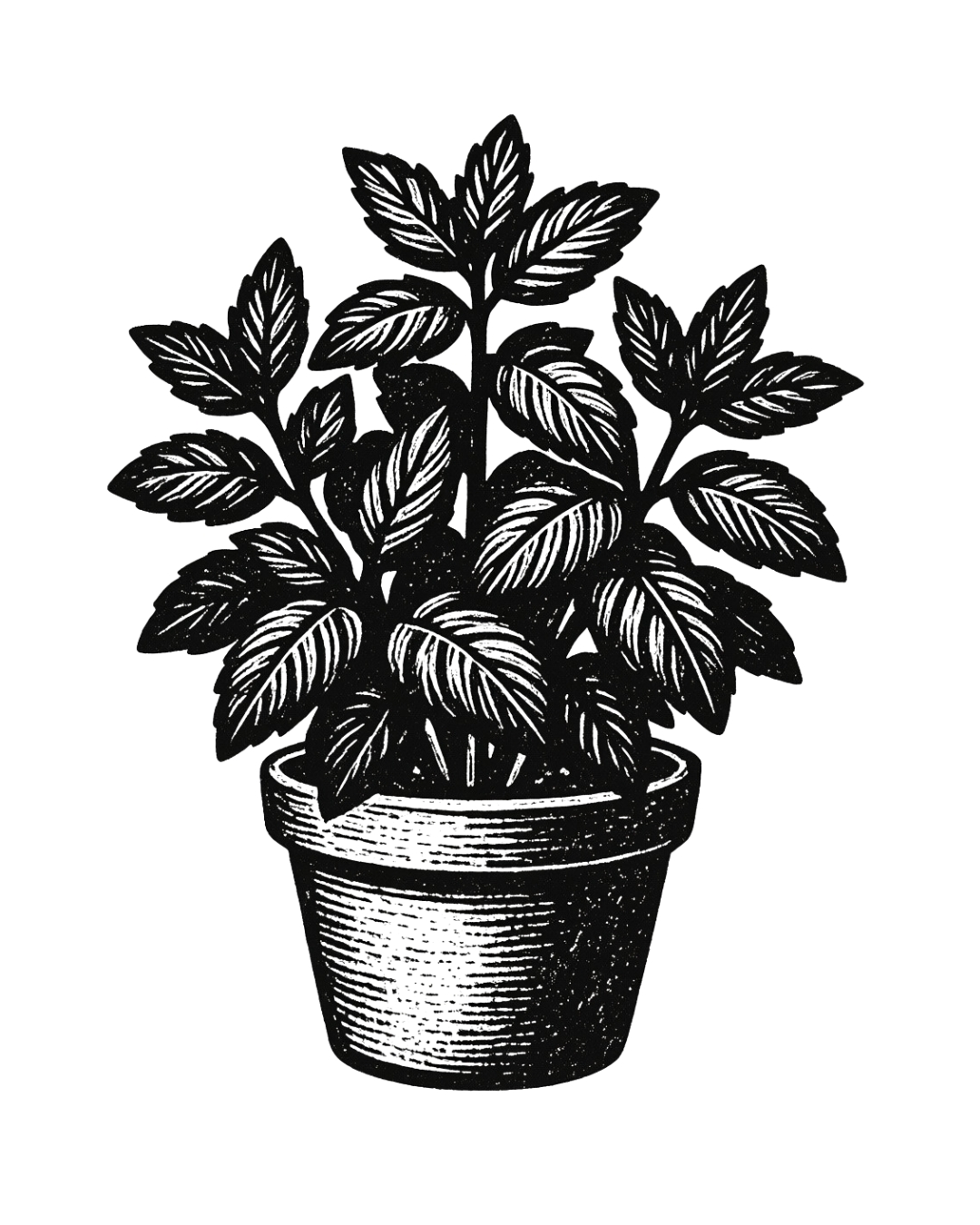
Supermarket mint was still mint, wasn’t it?

He was suspicious – but honestly, what could they do to it? 

I mean, obviously they’d use the most basic compost in minimal quantities. They’d tailor the whole process, origination, cultivation, distribution – you name it. Cutting margins. Using whatever came to hand (cheaply) to maximise profits and minimise disruption. A great network of growers, buyers, movers, managers. Till here you were, with this thing, a leggy mint plant in a thin plastic tub, lolling desperately off the shelf in the vegetable section, crying out for salvation. 

So you take it home, find a nice ceramic pot, use the potting compost you have left over from the last intervention. Water it, spray it. Establish it on a nice sunny windowsill in the kitchen, in a micro-climate with three other refugee plants. And look at it now! Vibrantly green! Turning its ribby leaves to the sunlight, sucking it all in, spreading its roots, thrusting out shoots! The fullest expression of itself. A minty marvelousness! 

But of course – you could never plant it out. 

It would take over. All the world would be mint. The supermarket would be mint. The houses of parliamint for the governmint. Mint on the television. Mint streaming. Mint where the ocean used to be. Planet Mint. Give me a momint. 

Would they spare me, as I spared them?

Of course not. They’re mint. 

Pitiless.

The Choco Leibniz Killer

They stopped off at the minimart for some specific things – bananas, muesli and a sweet treat after a visit to a local park. They spent some time looking at different things, but it took a while. For example, they thought they might go for an almond croissant each. But there were tiny flies crashing around in the warm pastry display, so they passed on that. They thought they might get something dairy, a fancy yogurt maybe. But they didn’t have a great selection in the chiller cabinet, and anyway, that felt more like an evening thing. You can go too fancy too early. In the end they thought they’d get a chocolate biscuit to have with a cup of tea. They found the cracker and biscuit aisle, and eventually settled on a packet of Choco Leibniz – Swiss, they thought. European anyway. Classy rectangles of thin butter biscuit with a generous slab topping of milk chocolate. 

On the way home he thought about the name. Choco Leibniz. It was perfect. He thought that if he decided to become a serial killer (because it would be a decision – every serial killer had, at some point and pretty early on, decided to stop being a regular citizen and move instead into the murderer category, which was by no means a small change, one that would require a great deal of planning), if he absolutely committed himself to become a serial killer, not only would he need to buy lots of equipment like gloves and maps and nightvision goggles and maybe a gun or the very least a knife, then he would also – if he had a mind to make a splash in the papers and really get a buzz going – then he would absolutely be advised to choose a catchy serial killer name. One with a hook. Something weird, both homey and perverse. Something sweet undercut with the controlled violence of a baked buttery biscuit. An everyday name, something you saw all the time but never really thought about – but would then become obsessed with the moment it all became public. 

The Choco Leibniz Killer.

The reporters would demand of the Chief of Police at the press conference if the murderer was a foreign national. A confectioner. Amongst a fury of lights and waving hands, the Chief would appeal for calm. 

‘Please! Please! We have no other information about this suspect at present. All we know is that they have adopted the name of a popular German biscuit. Our team are liaising both with the supermarkets and the manufacturer, pursuing every feasible line of enquiry to apprehend this individual and bring them to justice….’

Choco Leibniz. 

He’d feel a twinge of awkwardness that the brand would be ruined for the manufacturer. Supermarkets and other stockists would be forced to pull their stock from the shelves, return it to the distributor, who would no doubt make a fuss because it wasn’t their fault, there was nothing wrong with the product, it was still in saleable condition, etcetera. But you couldn’t associate a premium product biscuit that had become so linked in the media and the public’s eye with a serial killer – whose signature, by the way, was to leave a single Choco Leibniz biscuit on the victim’s forehead, like a calling card. It would signal the end of the Choco Leibniz brand. And years later, on antique roadshows, when a pack was drawn out of a tote bag, the valuations expert would say that an unopened box in mint condition would – for insurance purposes – be worth X number of thousands, and the person who brought it along would raise their eyebrows and say ‘Really?’ but follow it up with ‘Of course we’d never sell it.’ 

jean & michael

They caught the bus back from the park. One of those single-decker, no-nonsense vehicles. A long, blockish tractor of a thing. They scanned their passes and made their way to the back. It wasn’t a route they’d been on before. It took a different way back to the centre, meandering through narrow streets and thoroughfares they’d never even guessed were there. Halal shops, arch mechanics. Dilapidated old church buildings repurposed as community centres. A stack of containers that had doors cut out of them and turned into a market. It was good to see this place, they said. A whole other place. ‘You only see this sort of thing on the bus,’ they said. 

The bus stopped and a large middle-aged woman wheezed on. With her bleach white hair, her pale complexion, her white tracksuit top and white shopping bags, she looked like the sketch outline of someone who’d spent an exhausting morning spending money she didn’t have. The most defining thing about her was her face – a downward-curving, double-folded, toothless grump of a mouth, the kind of grimace that cried out for a pipe and a sailor’s cap. She distributed disdain right and left as she shuffled her way down, falling back into her seat with her feet in the air as the bus lurched forwards. 

Once she’d settled herself, she called someone on the phone. She had it on speaker so everyone heard it. He couldn’t understand why anyone would do that – have a private conversation in public. At full volume – like the two of them were sitting next to each other talking through bullhorns. 

‘Hello? Michael?’

‘Jean?’

‘It’s Jean, Michael.’

‘I know I know, you said.’

‘How are you?’

‘What?’

‘I say how are you?’

‘I just woke up.’

‘You woke up?’

‘Yes. You woke me up.’

‘How are you anyway? In yourself?’

He sighs – a long, back of the throat thing, full of the suffering of the world.

‘Y’know,’ he says, eventually. ‘Y’know about all that.’

There’s a pause, which extends into a silence. The bus grinds on. 

Have they finished? Did Michael ring off and leave Jean clutching her phone, staring out of the window? They couldn’t possibly turn round to look – it would be too obvious. 

‘Did you watch the football?’ says Michael, suddenly. 

‘No. Did you?’

‘I did.’

‘How was it.’

‘Awful. Until it wasn’t.’

‘They won though.’

‘They won. They didn’t deserve to.’

‘Still they won.’

He sighs again. It sounds more like a death rattle.

‘God I hope this weather breaks,’ he says. 

truth hits

Stories are not the truth. Stories get honed over time, losing truth like a wooden figure loses the wooden block that held them. The story depends on the person wielding the chisel as much as the wood, of course. You start out wanting to get to the truth and end up lost in an extended metaphor about whittling. 

Doesn’t that prove my point? 

Stories get practised, condensed, made more streamlined for the telling. And how well the story is received over time ends up influencing which features get emphasised and which get dropped altogether. Stories are like jokes, in other words. The punchline is supposed to be some great insight, some cute revelation, but really ends up a travesty of justice. Something big happens and everyone sees it differently. Me? I might highlight the colour blue. Someone else drags in yet another fishing reference. The only way to get to the real truth is to throw all the stories in a blender, pulse-blitz for a minute, then push the mess through a sieve. Boil this off till you’re left with a residue you can dessicate, purify and then pound into a fine powder. Then snort. Feeling dizzy? Euphoric? 

Push on. 

You’re close. 

a walk thru st johns

A Filipino woman is singing karaoke by a street planter. She has all the gear – a portable speaker and mic, a tripod for her iPhone, a camping chair. She’s dressed in tight purple lycra trousers and a gilet top, and her hair is sensibly tied back at the nape of her neck. She’s singing The Wind Beneath My Wings, leaning into the notes, tilting her head back and throwing her free hand wide. Everyone ignores her – until a glitch on the sound system makes a terrible grating sound and everyone flinches. She carries on singing, a true pro.

A man buys a bottle of toilet duck in B&M. He puts it on the conveyor belt and watches it slide towards the woman on the till, who also watches it. It looks so isolated there on the belt it seems to stand for something. The woman lets it come on, then stops it – no doubt by stamping on a button on the floor. The man looks at her and smiles; the woman doesn’t break eye contact with the duck.
‘One pound fifty,’ she says, swiping it through.
‘Hardly seems worth it,’ he says.
She blinks, slowly.
‘Receipt?’
‘No. Thanks.’
He takes his toilet duck and carries it outside. Stands in the bright morning sunshine, cradling it for a while. Then slips it in his bag.

A jazz guitarist is busking outside a shoe shop. He has a strange, double-necked electric guitar. He plays intricate base and rhythm notes with his right hand whilst his left taps across the wide fretboards like a hyperactive spider. Dressed in baggy sequin trousers and a fancy embroidered waistcoat, his expression is one of complete boredom. Like a court musician from a fairytale who’s been cursed to play in a strange new world of shoe shops and street drinkers. A woman comes up to speak with him but he doesn’t stop playing. He will never stop playing. Even when he sleeps he plays, one hand hanging outside the bed, running scales, playing jazz.

A woman is crouching beside an inert street drinker, lying on the pavement outside Superdrug. A small crowd has gathered to watch, either thrilled by her good samaritan act, or just morbidly curious to know what happens next. The woman is wearing a white blouse and scarlet slacks. She looks like she’s on her lunch break. If that’s true it makes the whole scene doubly surprising; if she works locally, she must know you can see a dozen street drinkers sprawled on the pavement, on benches or in doorways, any time or day of the week. For whatever reason (she found god? had a dream?) the woman is crouching by this figure and shaking him gently by the shoulder.
‘What’s the matter?’ she says. ‘Are you alright?’
After appearing dead for a few minutes, the man rolls over, groans, swats the air between them.
I carry on into Superdrug to buy some Tea Tree Spot Gel.
When I come out, the woman and the crowd have gone. The street drinker is sitting up, pulling a can out of his pocket. The noise when he opens it: Skerrplock!

There’s another street drinker sitting against a wall on the approach to St Johns shopping centre. He looks like a cosplay Captain Birdseye, with a sailor’s cap and bushy white beard. I glance down at him as I pass. He puts a thumb up to me and sights along the line of it, saying: ‘God Bless ‘ee, sir! You have a lovely day, y’hear?’
‘Thanks!’ I say. ‘You too.’
I feel very brave and ‘street’.
I don’t give him any money.

There’s an elderly guy formerly dressed in a grey three piece suit, his bald pate fringed with a wild splurge of grey hair, standing outside a boarded-up shop. The ranting noise I’d heard as I walked along turns out to be him. He’s holding a crappy microphone and speaking too closely into it, distorting what he says so it’s difficult to make out. Something about the Gospels? A choice to be made?
Suddenly a woman steps in front of me. She looks, by her dress and demeanour to be something to do with the guy. They’re on a mission to save souls. His job’s to preach, hers is to reach (with a leaflet).
‘Take this!’ she says to me, smiling. ‘You might find it interesting.’
‘Thanks!’ I say, in exactly the same voice I used with Captain Birdseye.
It’s like I’ve taken a vow.
I put the leaflet in my back pocket.
I wonder if she notices, and wonders how long I’ll leave it before I take it out and drop it in a bin.
But it stays in my pocket all the way home. After I’ve unpacked the toilet duck and the spot cream, I make a cup of tea and settle down to have a look.
It’s glossy, no bigger than my hand, folded in a triptych. The front is black, the blue curve of the Earth at the bottom, the space above it crowded with mathematical formulas and diagrams. The heading is ‘Accident or Design?’ in bold white lettering; the author, Professor Something or Other, at the bottom. In fact the whole leaflet is black, with emphatic white text that asks the question ‘How did we get here?’ and goes on to say that it surely can’t be accident, the bible is proof of God, the dinosaurs were fake, miracles are real, Jesus turned water into wine and so on. Apparently, 2000 years ago Jesus was supernaturally born of a virgin, and lived without doing wrong OF ANY KIND. Then God gave him up as a sacrifice for the sins of others, which you’d have to think hasn’t worked. It seems like a waste.
And another thing: Why put Mary through an immaculate birth? If your magic is that strong, why not simply land Him on Earth in a blaze of wonder? It would’ve spared her blushes and made everything much more straightforward, like aliens landing and saying hi rather than zooming about in deserted forests being mysterious and probing farmers and so on. Why not announce your divine premiership with dramatic flair (which – according to the Bible – He has done many times before). Something with a bit more tact and sensitivity than a virgin birth. What was Mary supposed to do with that information?
Still, the man in the grey suit might say, these things shouldn’t be taken at face value. We need to reach with blind faith to the great mystery beyond. But according to this leaflet. Professor Something or Other seems pretty sure about things, in a black and white, professorial way. The Prof says dinosaurs were fake. God is the creator. And that’s why he’s ranting with a bad microphone in the shopping mall, and that’s why the woman gave me this leaflet.
‘You might find it interesting,’ she’d said.
True.