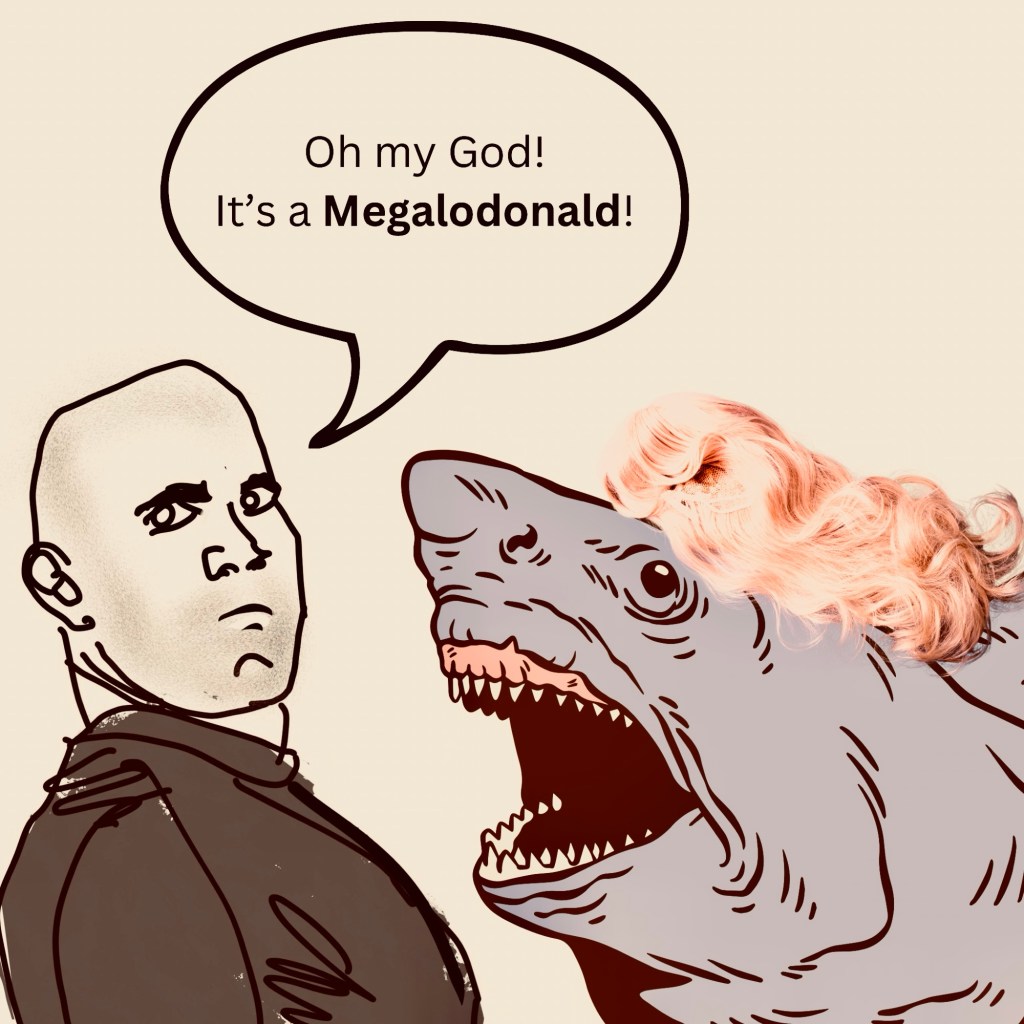
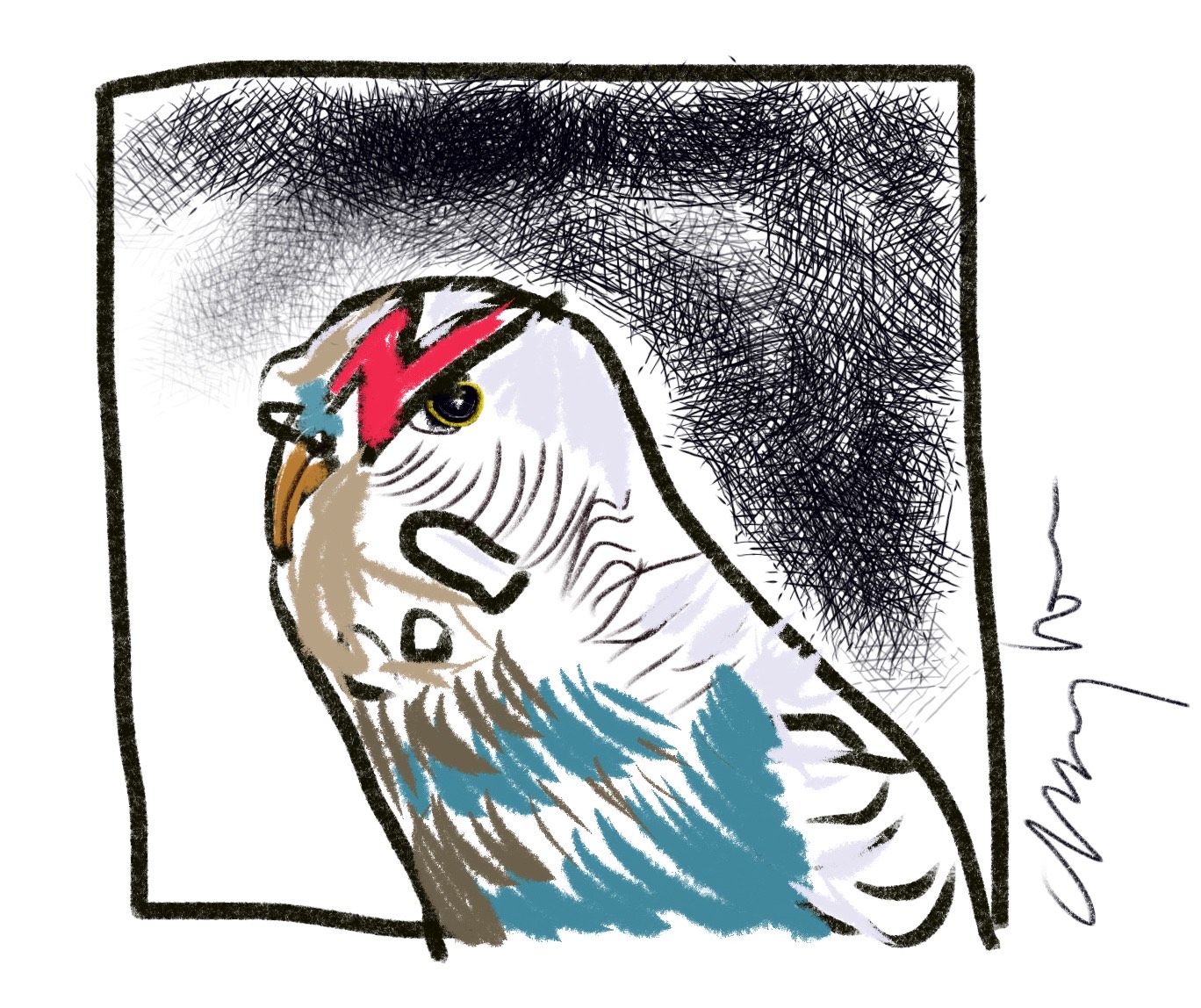
I don’t know who looks grumpier, Donald or his dog, Kevin. If it wasn’t for the size difference – Donald being a lumpish middle-aged man, Kevin a lumpish middle-aged staffie – they could swap hats and be done. As it is, they turn into the lane about the same time as me and Stan, so we all walk down together, me making the conversational weather, Donald being grumpy about it. That is, until we get onto his favourite subject: the ongoing dramas he’s been having with his elderly next door neighbour, Jean.
‘You never know what’s coming next with Jean,’ he grumps. ‘First it’s her legs, then it’s her central heating. The other day I got a panicked call. Donald! Donald! Come quickly! It’s horrible. And then the line went dead. So me and Kev went hurrying round there thinking the worst, but what happened was, her cat had brought a rat in. Only the rat wasn’t dead. It was just laying on the floor in the kitchen looking depressed, all of us standing round looking down at it, wondering what to do. Including the cat. Kev didn’t seem overly bothered. So I thought that’s it, I’ll have to kill it. But how? No way was I gonna stamp on it, I mean – urgh. I thought I might use one of the brass bed pans on the wall. But then the rat seemed to wake up. It gave itself a shake and made a dive for the organ.’
‘The organ?’
‘The old pump organ Jean’s got in the living room. It’s a horrible old cottage, Jim. Falling to pieces, you know. Hardly room for her and the cat, let alone an organ. Anyway, I said to Jean, I said well, that’s your rat gone where no one’s getting it. And Jean said well what if I play a B flat? Would that shift it? And I said I don’t know about music, and I’m not sure the rat’d does, either. It’s not as if it was one of them big church organs you play with your elbows and everything comes blasting out the pipes. So I poked around – with a poker, funnily enough – but nothing doing, and in the end I said she’d have to get the specialists in or let the rat come out of their own accord. Maybe the cat could finish it off then.’
‘And did that happen?’
‘Well I don’t know if it was the cat or maybe the rat couldn’t stand the racket. Not the organ, the TV. She has it on so loud I’m surprised the cottage is still standing. But either way she called me to say could I go round and dig a hole because the rat was lying out on the kitchen step and she couldn’t go outside to get to the shops.’
The lane branched off in two directions, so we said goodbye, Donald with the kind of heavy expression you might see on the face of a camel before it set off back across the desert. And when I looked down at Kevin, he was exactly the same.
I’m at the front door of Michael’s house, struggling to get the keys out of the key safe, when a man shouts to me from across the street.
‘You! Yes – YOU! I’m talking to YOU!’
I straighten up and turn to look as a man staggers across the road at a tangent, somehow avoiding the traffic, and ends up draped across the railings in front of the house, hugging them with both arms through the gaps, like he’s the only thing keeping the street from spinning out of control. After he’s got his breath he finds me in his sightline again, and gives me a lop-sided snarl, like the old MGM lion, but drunk. With no hair. Or teeth.
‘Oh – so NOW I’ve got your attention,’ he says.
He’s ragged, knuckle-headed. The kind of guy life rolled over and left furious in its wake.
‘Yah think yah so wunnerful,’ he says.
It’s a bright, blue day in April and I’m feeling optimistic, so I smile and say: ‘Hi! How are you?’
‘What’s it to you?’
‘Nothing. Just saying hello. Anyway – have a great day!’
And I give him the thumbs up.
‘Have a great day!’ he spits, like it wasn’t my thumb but a middle finger. ‘Have a great day! Ya know they wrote that on the side of the bomb when they dropped it?’
‘Did they?’
‘Yeah – they DID! So wha’ d’ya think o’THAT?’
‘I think that’s a bit… I don’t know… cynical?’
‘Are you takin’ the PISS, man? Are you havin’ a GO?’
‘Me? No. Just passing the time.’
‘Passin’ the time!’ he says. ‘Right! I’m comin’ over there…’
Jesus Christ but this key safe will not open. It’s an old one, some weird, masonic design, like it’s not a simple code I need so much as an incantation. I glance back at the guy. He’s managed to untangle himself from the railings, and is concentrating everything he has on hauling himself along, fist over fist, using the spikes like the rungs on a ladder. He’s almost at the gate – and me.
I turn back to the key safe.
By some miracle of panicked tapping and button flicking, the front panel suddenly loosens and flips open. I grab the keys – a bunch of them.
He’s on the threshold of the broken mosaic path now, only pausing to check the building’s the right way up before he carries on.
I flap around with the keys. Of course it HAS to be the last one on the bunch that opens the door. I snatch up my bag, dodge inside and slam it shut, just as he shuffles haphazardly up the steps. After a pause, I see a slack, liverish eye press against one of the stained glass panels, rolling around like a whale at the port of an Edwardian submarine. Then the eye pulls back, and he’s gone.
‘Michael?’ I call out into the silent house. ‘It’s Jim. From the hospital.’
And head up the stairs.
Beauchamp Close looks like a set from Lord of the Rings. Maybe if I had a cloak and a long clay pipe instead of my obs kit we could shoot Episode 3: The Return of the Non-Injury Faller. (in which Sauron rucks the carpet for Bilbo to catch his toes in). It does seem a strange choice of styling for a retirement complex. Maybe the architects thought using all these weathered oak beams and narrow red bricks in the Tudor style would make the old folk feel at home, cosplaying their way into senility. Although I wouldn’t have so much of a problem with it if the place were designed to look like the set from Aliens 2, so maybe it’s not so bad.
I’m met at Gracie’s door by Leila, the carer. She’s got earbuds in her ears and a phone in her hand held out flat like she wants me to take a bite. It’s a little disconcerting how she switches from talking to me to the phone and back again without any change in pace or tone. I keep getting it wrong, interrupting or not answering. Whichever way, Leila looks increasingly annoyed – red-faced, distracted, twitching her ponytail like – well – a pony. A pony that needs to get on.
‘She’s through here,’ says Leila. ‘She fell on the floor but didn’t hurt herself. One minute she was chatting to me, the next – BOOMF! I helped her up and onto the sofa. She hasn’t been right since I came in, though.’
‘What do you mean, not right?’
‘She was wearing three hats.’
‘Three?’
‘One on top of the other… Gracie? It’s the man from the hospital…’
Gracie also has a ponytail, but this one is longer and thicker than Leila’s (which must have helped with the hats). It sprouts up from the very top of her head, bound at intervals with black rubber bands – the kind of umbilicus that tethers deep sea divers to their diving bell (or whatever it is divers go down in to explore deep sea living rooms). Despite the heat, Gracie is wearing heavy flannel pyjamas with a pair of black knickers stretched to bursting point over the top, Superman-style.
‘Where’s your cloak?’ I say.
‘What did he say?’ says Gracie.
‘He says where’s your cloak?’
‘Your cloak!’ I say, louder. ‘You’re wearing your pants over your trousers. So.. you know… like Superman!’
She frowns up at me.
I mime being Superman.
‘Ooh,’ she says to Leila. ‘Who IS this?’
‘Superman,’ says Leila, ‘Apparently.’
I check Gracie over. My best guess is that she’s suffering from an infection somewhere and it’s making her confused. I ask Gracie questions and she sings me snatches of music hall songs, although none that I’ve heard before, with lyrics she makes up on the spot:
Gracie my Gracie the dog it was that died
the pills that you want are on the kitchen table dah di dah …
There’s a lurid green oil painting on the wall opposite: a labrador retriever sitting up on its haunches, surrounded by puppies. The labrador has a ridiculously human expression on her face, looking off to the side with its eyebrows raised, as if to say: ‘Oich – What am supposed to do with THESE?’
The puppies themselves are pretty odd, too. They look more like tardigrades under a microscope, scrambling over each other.
I discuss the options with Leila. There’s no one available – no family or friends – who could stay with Gracie and keep her safe. The only option is to call for an ambulance and do further tests in hospital. It’ll be a two hour response, but Gracie doesn’t seem to mind. She listens to my explanation with a clownish expression, her lips pursed and her eyebrows raised, then she cackles, and bats the air between us.
‘Don’t be so soft!’ she says. And tries to get up, only to fall backwards again.
I’m in the process of righting her when Leila leans in to touch my arm. She seems five degrees redder than the last time I looked, fit to blow.
‘I’m ever so sorry but I’ve just GOT to get on’ she says. ‘I’ve got like SO many people to see. There’s no one can come and sit with Gracie from the office ‘cos we’re short today.’
‘Don’t worry,’ I tell her. ‘Thanks for taking care of things up till now. I’ll sort something out.’
She squeezes Gracie’s hand, gives me a grimace emoji in red, then hurries out.
I ring the office to ask if any of the care team might be available to come and relieve me. They say they’ll do their best.
‘It’s you and me, Gracie!’ I say, leaning back in a Windsor chair and folding my hands in my lap. The chair snaps and creaks alarmingly, so I lean forwards again.
‘So – Gracie,’ I say, thumbing at the picture, nodding at her. ‘Tell me about these dogs.’
I’m obsessed with Blanche’s hair. It looks like a golden octopus swam up from behind and slapped its tentacles over her scalp.
‘How much did that cost?’ I ask as we park up.
‘Sixty pounds.’
She sucks her teeth with a clicking noise.
‘I am not so sure I would ever do it again. It’s a lot of work just for one month.’
‘It looks amazing, B. I’ve never seen such hair.’
‘My God!’ she laughs. ‘Seriously? Well – when it comes to hair, you should know.’
It’s true. I decided to shave my head a few months ago. I could see I was beginning to thin on top, and I didn’t want to be ‘that guy’, so opted for a basin of cold water and a razor. (The clinical measures I’ll take to avoid being ‘that guy’).
‘Sigourney Weaver chic,’ I tell her.
‘Who?’ she says.
‘Aliens’
‘What?’
We’re at the door so there’s no time to explain. She rings the bell and we wait.
It’s a beautiful, semi-detached house – semi-detached in that perfectly realised, herbs in planters, careers in banking or higher education. Hydrangeas pulsing into bloom. A neighbour nodding and smiling, watering his SUV.
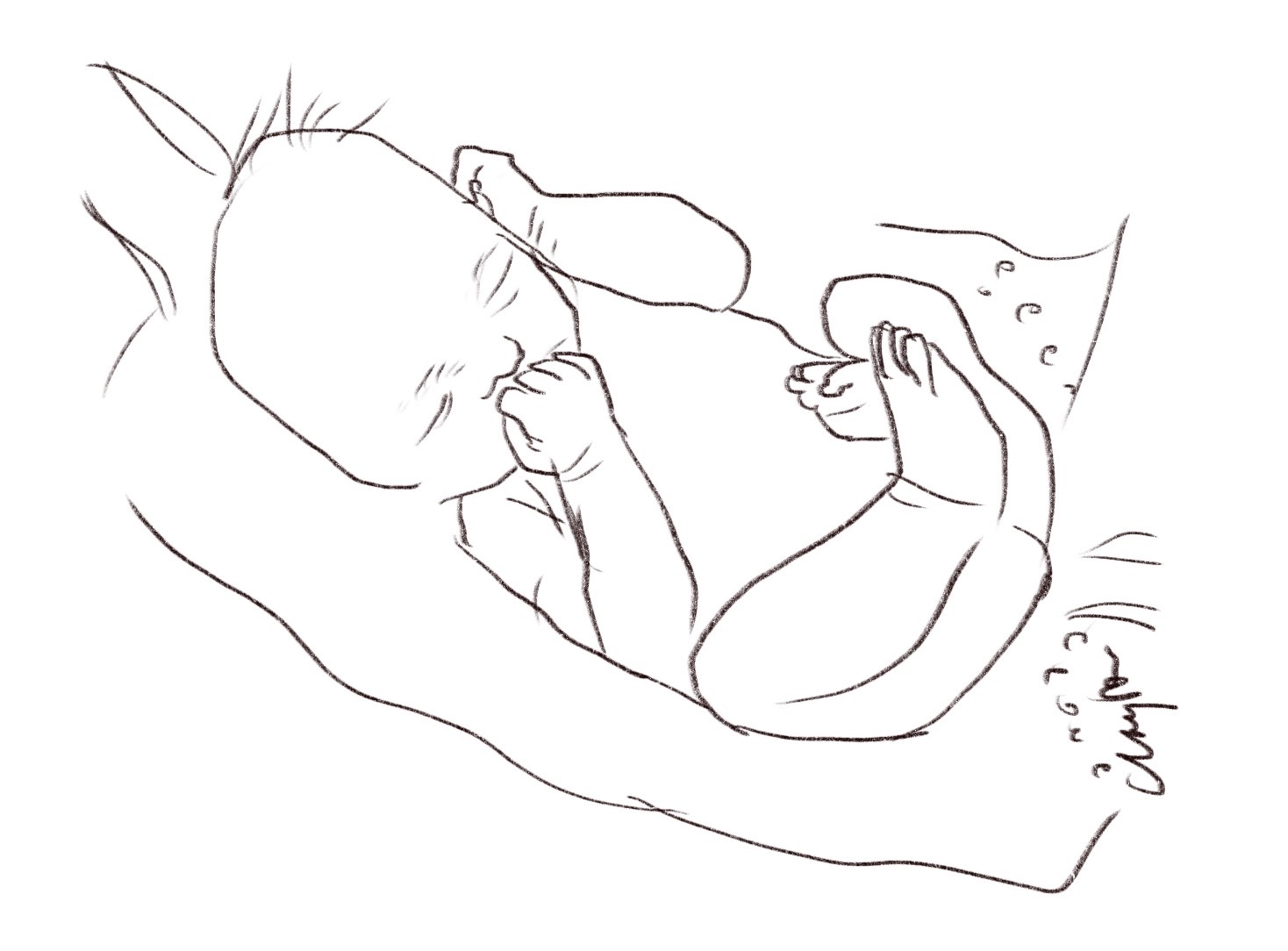
Emma opens the door. She has a tiny baby in her arms, scrawling its face and arms, protesting the disturbance.
‘Thank you so much for coming!’ says Emma. ‘We do appreciate it. We’re all in the lounge…’
She leads us through the house into a broad, brightly-lit room. Anthony is sitting in a wheelchair, absently holding a white linen handkerchief to his lips. His wife Maureen stands beside him ready to take it.
Emma describes what’s been happening. Her dad is palliative and suddenly much worse. They’d managed to dress him and get him down the stairs, but it took a long time, it wasn’t safe, and they have no idea how they’re going to get him back up again.
‘The OT from the palliative team offered us a hospital bed downstairs earlier in the week but Daddy said no,’ she says.
The equipment company we use has a same day delivery service, but only if the order goes in before midday. It’s already a quarter to, and I’m almost sure they won’t agree. We talk about other options – if they have a cot bed we could put up for them, or even a normal bed we could dismantle and reconstruct. But they don’t have anything we can use temporarily, and all of the beds upstairs are antique, king-sized items. And even if that was feasible, whatever bed Anthony goes into now will need to be adjustable for height so the carers can manage his last days safely and comfortably. He absolutely needs a hospital bed to avoid admission.
Emma and I go into the kitchen so I can make a few calls; Blanche stays with Anthony and Maureen.
Luckily, when I phone the equipment company, Lauren answers. I’ve spoken to her lots of times before, so I take that as some kind of omen. I throw myself on her mercy, describing the situation, apologising for the late order and so on. It’s a desperate move – the equivalent of running outside in a storm, throwing my arms wide, tipping my head back and surrendering to the elements in one great, big, cosmic PLEASE.
‘Get the order in right now,’ sighs Lauren. ‘Should be fine.’
After I’ve called the office, asked them to send the order through with immediate effect, I go back into the lounge with Emma. Everyone’s so relieved. Even the baby seems more settled, hanging onto Emma as suckered as Blanche’s hair. It seems to fall instantly asleep the moment she takes her place in the armchair to the right of her father.
The only person untouched by any of this is Anthony. He sits absolutely upright and still, his waxy, swollen feet placed just-so on the footrests, his eyes half closed under a weight of opiates. Every now and again he dabs at his mouth with his handkerchief, so neutrally it’s like someone else is reaching up to do it. And then, just as we start to talk about what happens next, Anthony stirs a little and starts to tell a story. A funny story, I think, his voice so faint and dry and far away it’s hard to make out. Everyone in the room falls quiet, giving him space to be heard.
‘… and then … the damned phone rang….’ he whispers. ‘…. woke me up… I didn’t know who it was, of course…’
Maureen gently takes the handkerchief from him, hands him a beaker of water, helps him take a sip.
‘… but that’s enough from me…’ he says, after a long pause. ‘Emma must take up the story…’
Emma smiles – blurry, exhausted.
‘Someone rang and woke Daddy up,’ she says, helplessly.
We all laugh – and the sudden noise wakes the baby. It shudders in her arms, throwing out its hands, kicking up its legs. The Moro Reflex, I think they call it. A vestigial spark, a million years in the making. Something about falling.
We’ve had some carers go sick so I’m helping out with the calls this morning. I like the change. So long as everything goes to plan, I won’t be called upon to make decisions, referrals, or any of the other worries that swarm in on you when you’re medically assessing a patient. In a lot of ways a care call is therapeutic – which I realise is easy for me to say, not having to do this day-in, day-out, chasing my tail across the city, stressing about keeping ahead, making time, all for a pittance.
Geoffrey’s house is on the kind of pristine new development where everything looks fake. I wouldn’t be surprised to be met at the door by a Playmobil figure. Instead it’s June, Geoffrey’s daughter, a middle-aged woman with an aura of stress so palpable you could use it to power the neighbourhood if you only had the leads.
‘Hello,’ she says, blinking emphatically. ‘Can you put these shoe covers on?’
The interior of the house is immaculate. Which explains the shoe covers. In fact, I’m surprised June doesn’t insist on a full body suit and respirator.
‘Dad’s still in bed,’ she says. ‘I’ll come up and show you what’s what.’
I follow her up the stairs and into a room brightly lit by the sun. Geoffrey is lying on his back in bed, his hands either side of his face, gripping the covers in that cliche, ‘man lying in bed’ style.
‘This is the carer, Jim,’ says June, running up the blinds. ‘He’s come to get you ready for the day.’
‘Oh, aye?’ says Geoffrey.
June shows me into the bathroom where everything is laid out: pink flannel for the face and top half, black flannel for the bottom and legs. Creams of various kinds. A comb. Toothbrush and paste. The toothbrush is enormous, like nothing I’ve seen before, a cumbersome red plastic instrument with bristles like a carpet brush on one side and on the other, the kind of circular brush that wouldn’t be out of place snapped onto a vacuum cleaner.
‘I’ll leave you to it,’ says June, before turning on the spot and hurling herself back downstairs.
The washing and dressing goes smoothly. Geoffrey is as organised as his environment, and apart from his great age and frailty, manages everything pretty much independently. We chat about this and that. Apparently – before he retired – he used to be a dental technician.
‘Oh!’ I say. ‘That’s interesting! I know a story about dental technicians!’
‘Hmm,’ says Geoffrey. I’m putting him into his tracksuit top so he can’t do anything else but listen.
‘You know that local natural history museum? Well the professor who used to run that place also helped the police out now and again. He was such an expert on bugs and beetles and skeletons and whatnot, they used to call him in for advice.’
‘Oh, aye?’ says Geoffrey. I hand him a comb to sort his hair out.
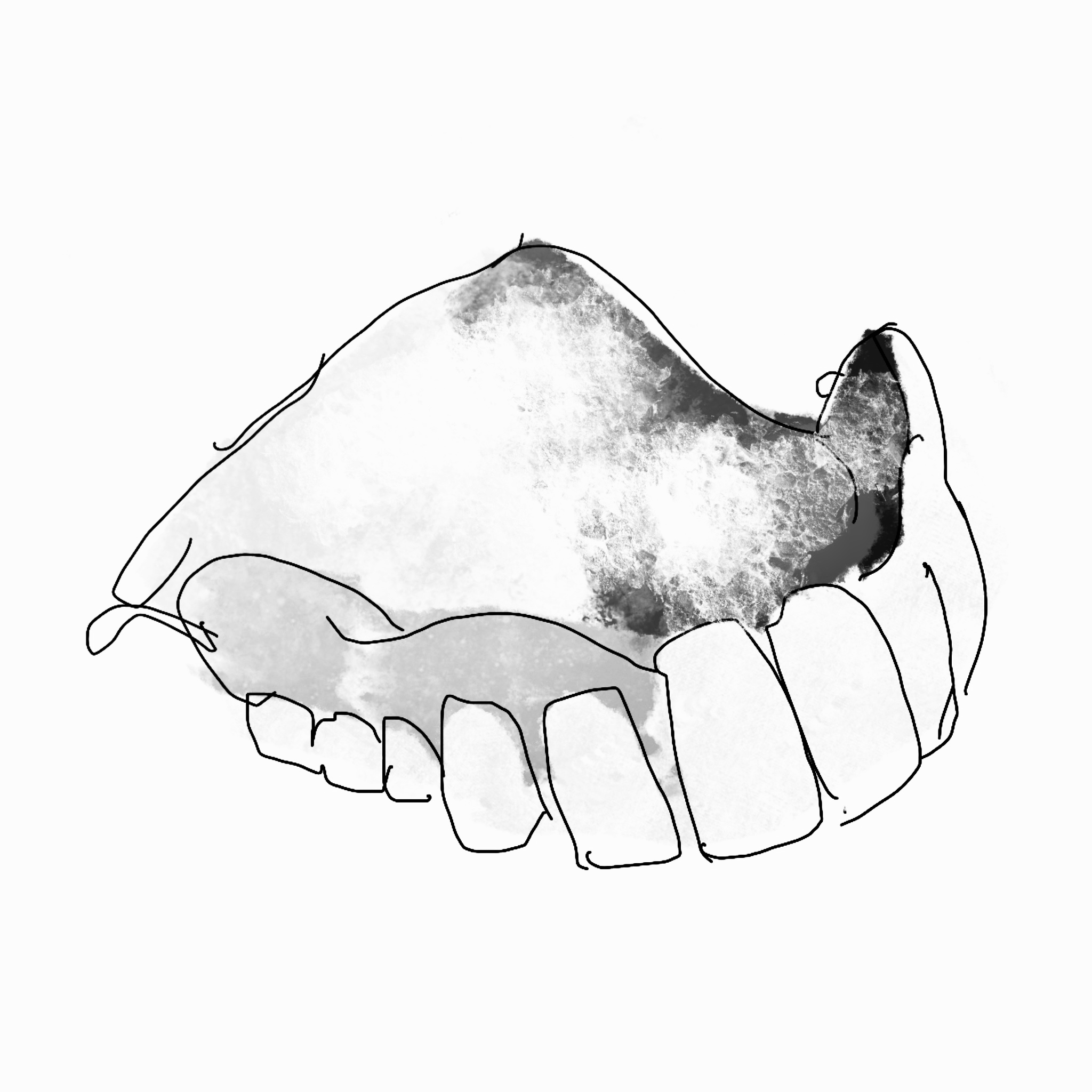
‘Well – this one time, they asked him to look at a building site. The builders were renovating an old house and they found a load of teeth in the basement, which looked suspicious. But when the professor examined them, he said it must have been the site of an old dentures workshop, and you could tell by the tiny holes near the root of the teeth, where they used to wire them together.’
‘Wire them…’ says Geoffrey. ‘Yes.’
I pass him his strange toothbrush.
‘Over to the expert!’ I say.
He carefully smothers the big brush with toothpaste, wets it under the tap, then starts busily scouring his teeth. It goes on for such a long time I’m worried he won’t have any teeth left. There’s a lot of spitting and hawking into the sink, followed by more brushing, followed by more spitting, and when five minutes have passed and I’m wondering if I should make an intervention, he unexpectedly puts the plug in the sink and starts filling the basin so full of cold water I’m worried it’ll overflow. But just as the level nears the top, he turns the taps off, then pulls out his top set, holds it under the water, and starts attacking it with the round bit of the brush. He scrubs it underwater for ages, pulling it out to inspect it occasionally, plunging it back under again to scrub some more, hawking and spitting into the basin the whole time. It’s a furious, all-elbows kind of procedure. I’ve never seen anyone clean their teeth like this before and I’m fascinated – so much so that I almost forget to catch him when he leans back unsteadily a few times.
‘There!’ he says, breathing hard, finally pulling the plug and inserting the top set back into position. ‘Now, then – what’s for breakfast?’
‘How was the holiday, Rae?’
‘It was great, Jim, thanks. Fine. Y’know? Busy! Pretty non-stop, actually…’
Rae talks like someone who’s just stepped off a ride at the fair and has to take small steps for a while because the ground doesn’t feel right.
‘We all went camping. Well it seemed like a good idea at the time. Up the east coast. Stopped at mum’s. Then on to my aunt’s. Then crossed over to Liverpool to see the other aunt. Then back down through Wales for a cousin or two. It was like we were hunting relatives. But the weather was good. Then home. Two weeks. I need a holiday to get over it.’
‘Sounds good. It’s years since I’ve been camping.’
‘I tell you one thing that happened, though. It’s so strange. There’s no way you’ll believe it.’
‘What’s that?’
She smiles at me.
‘Nah!’ she says. ‘You definitely won’t believe it.’
‘Now you’ve got to tell me.’
‘You’ll just think I’m crazy.’
I pull a face.
‘Mmm.’
‘Nah!’ she says after a teasing pause. ‘I just can’t.’
‘This better be good, Rae.’
‘Alright – I’ll tell you. But I’ll probably regret it. You’ve just gotta promise not to tell anyone else.’
‘I can’t wait to hear this.’
She sighs, pushes her glasses up into her hair, and sits down heavily on the corner of the desk.
‘I lost my phone,’ she says, folding her arms. ‘I looked everywhere. Absolutely everywhere. Turned the house upside down. Nowhere. Couldn’t find it. Great, I thought. Fantastic. I haven’t got time for this. That’s all I need. But then my husband wandered in with a handful of receipts. And I said where’n hell d’you get them from? Because I keep my receipts in my phone case. With the phone. And he said he found them – blowing round the garden.’
‘So you lost it in the garden?’
‘Not exactly, no. A fox took it.’
‘A fox?’
‘There’s one been hanging about.’
‘A fox.’
‘A fox. Yeah. Foxy Loxy. They’re terrible quick, Jim. Sexy little, furry little thieves, Jim. Anything shiny – they’re in.’
‘Yeah but… a fox? How did he take it?’
‘He must’ve dipped in my bag when we were unpacking the car. I dunno. Grabbed it in his beak and run off.’
‘A fox? Are you sure?’
‘Totally sure, Jim. Because I saw him bring it back a couple of hours later.’
‘What?’
‘Yep. I was sitting by the window, thinking bloody hell I’m gonna have to get a new phone, now. Where’s the money for that coming from? And that’s when I saw him, strolling out the bushes onto the lawn with the phone in his mouth. He came skipping over, his nose in the air, proud as anything…’
‘Maybe he was just trying to get a better signal…’
‘Then he jumped up on the decking, saw me staring at him, gave me a wink, dropped the phone and ran off.’
‘Why’d you think he brought it back?’
‘I dunno,’ she says. ‘It’s a Samsung, though, so…anything else for me, or can I shove off?’
There’s no reply on the intercom, so I ring the landline. It rings and rings, and I’m about to hang up when suddenly Ted answers, shouting above loud music in the background. I have to introduce myself three times, each time successively lounder, and in the end the door gets released but I’m not convinced he really knew who I was.
These flats always confuse me. About a hundred different entrances, each one serving a narrow concrete stairway that feeds a landing with two flat doors, both so closely facing each other if the doors opened outwards the occupants couldn’t leave at the same time. Ted lives at flat two, two floors up – and doesn’t make sense – but then nothing about this place does. They remind me of those fiddly, Rotostak hamster runs we had when the girls were small (for the hamsters, not the girls). The tubes seemed like they’d be a fun thing for the hamsters when we saw them in the pet store, but the reality was the hamster was too twitchy and traumatised to come out of its box, like I would be if I found out there was a sixth dimension or something.
Ted’s door has a mass of complicated, handwritten signs stuck to it with tape. What he will or won’t accept through the letterbox, who he does or doesn’t want to talk to, where to put parcels if he’s out, whose flat to ring if something goes wrong and so on. Knocking on the door is an act of faith, but whether I do or don’t is a moot point, because he’s playing his music so loud I’m sure he won’t hear me. (Which probably also explains why he didn’t hear the buzzer). The music is Kenny Rogers, ‘You Picked a Fine Time to Leave Me Lucille’. I’m thinking about a line in it I’ve always misheard: ‘four hundred children and a crap in the field’, when Ted opens the door.
‘Oh yes?’ he says, as if we’re already in the middle of a conversation.
Ted actually looks like a hamster, one that’s been crossed over the years with a succession of bookkeepers. He’s about four feet tall in a green tank top and corduroy slacks, tufty hair, pinhead eyes, curved back, handy pink paws, and he jabs his chin up as I speak, as if he’s sniffing the words rather than hearing them.
‘Hi Ted!’ I say, introducing myself, showing my ID. He turns around and shuffles back into the music.
Ted’s flat is exactly like a hamster’s bedding box. Piles of stuff nosed into position all around, access runs through it all that perfectly fit his body.
‘I’m having a bit of a clear out,’ he shouts, rootling around for something. ‘I know it’s a bit of a mess.’
‘Could we turn the music down a touch?’ I shout back.
‘What?’ he says.
At the far end of the room there’s an ornate birdcage, half-submerged in the mess like it’s floating away from a sinking liner.
‘Can we…oh’
He’s turned the music down to a Kenny Rogers growl, by means of an invisible knob he can reach without looking.
‘I love a bit of country,’ he says.
Beneath the surface, Kenny is singing: ‘On a warm summer’s evening, on a train bound for nowhere…’
‘Where’s the bird?’ I say, nodding at the empty birdcage.
‘Ruby? She’s there. She drops off her perch when I play my music.’
I want to say ‘same’ but don’t. Instead I wade a bit closer, and there she is – a forlorn little thing, like someone covered their thumb in glue and stuck it in a tub of feathers. She’s cowering among the seeds and shit at the bottom of the cage.
‘Ruby – like the Kenny Roger’s song?’ I say.
Ted shrugs.
‘I suppose so,’ he says. ‘Never thought of it. C’mon! Come and have a look at this.’
I follow him through everything that was ever produced in the world through to a ghastly kitchen.
‘Can you take that?’ he says.
He’s gesturing to a horror show of a microwave – probably the first of its kind ever made – an enormous metal box you probably work with pedals, up on a slant on the worktop, its door hanging open like the last gasp of a dying grease monster.
‘What d’you mean, take that?’ I say.
‘Well… take it away. Put it outside. You know. Dispose of it.’
‘I’m a nursing assistant, Ted. I’ve come to take your blood pressure, not your old appliances. The council will do that.’
‘The council!’ he snorts. ‘But if you’re not willing to do it, that’s fine…’
‘You’ve got to know when to hold ’em, know when to fold ’em…’ says Kenny.
*
Back at the office I tell Michaela all about it.
‘Don’t talk to me about budgies,’ she says. ‘I have nightmares. I went to see a patient who had a budgie. It was sitting watching us on its perch the whole time, and just as I was about to go, it rolled backwards off the perch and landed feet up in the tray. I didn’t know what to do! I’ve done CPR before, but on a budgie? How would you even do the beak?’
She mimes doing compressions on the palm of her hand.
‘Oh my god! So what DID you do?’
‘I took the budgie out of the cage, wrapped it in a hankie and gave it to her. I asked her if there was anything I could do, anyone she wanted me to call. She said no, she just wanted to be alone. So that was it. I left. I felt terrible.’
‘That’s awful!’
She nods.
‘I can still hear the sound if I close my eyes. A little feathery thunk.’
We’re both silent for a second or two, imagining the sound. Then Michaela brightens again.
‘Not a great look. A nurse walks in, your budgie has a cardiac arrest. But what can you say – I’m a nurse, not a vet. Anything else to handover?’
A Hammer Horror kind of night. Dismal and dank and positively soupy with adjectives. Instead of my Mini I should be visiting patients in a Victorian hansom cab, the candle lamp guttering, the horse stamping restively as I step out of the carriage and grimace in front of the house that rises up before me.
‘Wait here, driver’
‘Right you are, sir’
I tap my top hat firmly on my head, twirl my cape, stride across the pavement.
Sofia’s son Diego is waiting for me, silhouetted against the light from the hallway. A quick, stooped figure, he bounds up the stairs behind him, leading me to his mother’s bedroom.
Sofia is sitting enthroned in a high-backed chair, imperial flannel dressing gown, granite velcro shoes, graven smile.
‘Come in,’ she says. ‘Please.’
‘I’ll leave you to it,’ says Diego, backing away.
‘Ah!’ says Sofia. ‘He cannot BEAR to see me walk.’
I’ve only come for a care call. One of the carers has had to go home sick, and I’m the only one available to cover her evening visits. I was expecting to give medications, make Sofia something to eat, get her ready for bed – but apparently Diego can do everything except the personal care, and Sofia says she’ll do this herself. Instead she wants me to stay with her whilst she gets out of the chair, walks with the frame to the landing, and then walks back again.
‘Okay,’ I say. ‘Shall we do it?’
She screws up her face.
‘Are you sure you have the time? I don’t want to keep you…’’
‘Of course!’ I say, lying. Mentally I’ve priced the job – Sofia’s condition, weight, the distance from the chair to the landing and back again. ‘No rush. I’m here to help however I can.’
To say it’s a painful process for Sofia is to vastly underestimate the challenge she faces. Her joints are so arthritic I can feel them creaking through the floor. It’s like watching an ancient tree uproot itself, extend two branches down to use as walking sticks, and then lumber imperceptibly forwards, one knotty inch at a time.
It gives me plenty of time to glance around the bedroom. It seems more like a shrine with a bed in the middle. All round the walls are ancient photographs, formal, black and white family portraits of austere looking men leaning in to austere looking women holding stupefied babies, the prints so faded that mostly all you can make out is hair and eyebrows.
‘What do you think of what’s happening in Ukraine?’ says Sofia, pausing to catch her breath about a hundred miles from the landing.
‘Absolutely dreadful,’ I say. ‘Putin’s a madman. I wish someone would knock him off.’
‘They’d never get close enough,’ she says. ‘His tables are long for a purpose.’
She starts forward again.
‘I know about these things,’ she says.
‘Oh?’
‘I was just a little girl when my father was killed in the civil war,’ she says. ‘Franco! Pah!’
‘That’s terrible!’
‘He went away, we never saw him again. My poor mother! Four children to look after. If it wasn’t for my grandmother we would never have survived. Backwards and forwards, like this. Backwards… and then forwards. So you see – I have some feelings for the subject.’
She carries on towards the landing.
Diego comes halfway up the stairs and stands there uncertainly, one hand on the bannister. ‘Oh!’ he says. ‘You’re up!’
‘Por la gracia de Dios’
He nods, turns, and hurries back down again.
Sofia shakes her head and slaps the crossbar of the zimmer frame.
‘Okay, my friend!’ she says – whether to me or the frame I’m not too sure – ‘I’m afraid the time has come for us to return to the chair.’
Donald hadn’t sounded enthusiastic on the phone.
‘I’m not well’ he said ‘Come tomorrow’
‘It’s because you’re not well I should see you right away. That’s what the GP has said. I promise I won’t keep you long, Donald.’
A pause, long and weighty as a freight train at a stop light.
‘Come if you’re coming,’ he said at last. ‘There’s a keysafe. Use it.’
*
As soon as I put a hand to the little black box on the side of the house, a big dog starts barking. The notes had mentioned that Donald had a small, active dog, so either it’s a small dog with a big personality or the person who wrote the warning was a giant. Either way I decide to just go for it. I’m good with dogs. Which’ll make an ironic quote for the gravestone.
The dog goes eerily quiet, but I can tell it’s just on the other side of the door as I put the key in the lock. I imagine it holding its ear to one of the panels, frowning.
‘Good boy,’ I say. ‘Who’s a good boy. Or girl…’
I open the door a crack. Immediately a snuffling nose jams itself out as far as possible.
‘There you are!’ I say, uncertainly.
I remembered reading something about how you must never loom over an aggressive dog. Bring yourself down to their level – a little at a slant, mindful of your throat – and say soothing, non-threatening things. Don’t glare at them and make them worse. And if you must hold your hand out, keep your fingers curled.
I push the door open and assume the position.
A dalmatian. An elderly one. Portly and a bit rickety, like a bad taxidermist knocked it off about twenty years ago, and forgot the wheels.
‘Who’s a good boy? Hey? Who’s a good boy?’
The dog gives me a comprehensive sniffing, followed by a contemptuous kind of sneeze, then turns and hobbles back inside.
‘Up here,’ shouts Donald. ‘And shut the door when you come.’
Donald must be a career smoker because the house is as black and drawn as an old kipper shack. If it were only a little lighter I would probably see clouds of smoke and ash rising up around my feet as I climb the stairs, following the corrupted sound of Donald’s coughing to the little back bedroom where he mostly lives.
‘Hello!’ I say. ‘Nice to see you!’
He glares at me from the depths of his flap-eared hat.
‘It wasn’t my bloody idea,’ he gasps.
The Dalmatian wanders in, collapses in its basket, then looks up at me with the saddest eyes, like it wasn’t so long ago it would’ve torn me to shreds, and isn’t ageing a terrible thing?
‘Good girl, Ange,’ says Donald.
They stare at me with the same expression.
At first Donald won’t allow me to do anything. I can see he’s struggling, but either through fear or cussedness, he bats away any attempt to win him round. I decide to get to him via the dog.
‘I love Dalmatians, ‘ I say.
‘Have you got one?’
‘No, but…’
‘So there you are.’
I try again.
‘What’s that thing about Dalmatians?’
‘What thing?’
‘Don’t they suffer with their eyes? Colour blind…?’
‘Deaf,’ he shouts. ‘They tend to go deaf. It’s genetical.’
‘That’s it! Deafness!’
I bend down and stroke Ange’s head, which she allows with a very gracious bow.
‘They’re beautiful dogs. Didn’t they used to run alongside mail coaches as well? Something like that?’
Donald leans toward me out of his chair.
‘It carried over to America,’ he says. ‘Back in the eighteen hundreds every yankee firehouse had a Dalmatian or two. Yeah. They used to run alongside the horse and distract any street dogs what might come out and bother ‘em.’
‘Wow!’
‘Yeah. And they used to keep the place clean of rats, too.’
‘That’s a handy dog to have around.’
He settles back in the chair.
‘That’s why you’ll often see Dalmatians in American firehouses. It’s a tradition.’
‘I never knew that,’
‘Yeah? Well you do now.’
I stand up again. Ange gives a grumpy sigh and curls up.
‘So – Donald. How about I run a few tests, then?’
He pushes his cap up a little, and sucks his teeth.
‘Go on, then,’ he says, bunching up his sleeve and stretching out his arm. ‘But for God’s sake be quick!’
‘Why? Where are you off to?’
‘Sleep, with any luck,’ he says. ‘Jesus H…’