willard the exception

Lolly and Richard slot around each other like two old spoons. Or two pieces of an antique jigsaw (maybe ‘Seaside View’ or ‘A Day at the Races’). Everything they do is coordinated. The way they move, for example. Even though it’s a big house they seem to continually be in each other’s way. When Lolly starts up the stairs, Richard wants to come down. When Lolly heads for the sitting room, Richard comes out. When Lolly goes into the kitchen to fetch something, Richard goes with her, so that when she turns round, she has to put her hands on his shoulders and manoeuvre past him in something that – from a safe distance – looks suspiciously like a dance. Their conversation is slotted, too. Their sentences run into each other. They finish what the other was saying. They snipe, but in such a practised and good-natured way, they’re like two elderly vaudevillians whose routine is domestic war and loving irritation. They’ve been touring this show for so long now and they know their parts back to front. It’s a job to see where one performer ends and the other begins.

They’ve got a dog, too. Willard – a Golden Retriever.

To begin with, I think it’s Willard who answers the door when I ring. It’s the way he paws it to one side, with such an open and happy expression I half-expect him to say Good Morning and How may I help? Instead, the door opens even wider and I see Lolly standing there.
‘You’re the nurse are you?’ she says. ‘Good. Maybe you can take him away. He’s driving me mad. ‘
‘Who is it Lolly? Who’s there?’
‘It’s the nurse. Come to give you a brain transplant.’
‘A brain transplant? Excellent. Ask him if he’ll give you a heart at the same time.’
‘Where do you want him?’ says Lolly, sighing and looking back at me. ‘I could give you a couple of suggestions.’
In the meantime, Richard has come halfway down the stairs.
‘I’m easy,’ I say. ‘Wherever he’s most comfortable.’
‘He wants you in the bedroom,’ says Lolly, putting a hand on the balustrade, as if she’s going to stop him coming any further by main force.
‘I’m glad somebody does.’
‘Oh dear God,’ says Lolly. She sighs. ‘He’s been a bit – you know – since the op.’

It’s one of the reasons I’ve been asked to visit, to check the wound and make sure he hasn’t got an infection. The GP has already given him some antibiotics, delivered remotely, as they often are these days. I wouldn’t be surprised if next year they started using drones. Although – to be fair – looking at myself reflected in the hallway mirror – it looks like they already are.

Lolly starts up the stairs. There’s a battle royale, Richard wanting to come down, Lolly telling him to reverse. I say I don’t mind where. Richard says he wants the sitting room. Okay I say. No says Lolly. Reverse. Lie on the bed. Willard is right behind me, smiling broadly. The four of us continue up the stairs in one well-coordinated bundle.
‘He’s been hallucinating,’ says Lolly, as Richard lies back on the bed.
‘I have not,’ he says.
‘Yes you have, darling.’
‘When?’
‘This morning.’
‘Why? What happened?’
‘There!’ says Lolly, nodding at me. ‘Even his memory’s going.’
‘No, no!’ says Richard, quite happily, adjusting the pillows behind his head and then folding his hands on his tummy. ‘I’m simply disputing your version of events.’
‘You said there was a big orange fish behind the telly.’
‘Not was, darling. Is. There IS a big orange fish behind the telly.’
‘You see,’ says Lolly. ‘D’you think it’s serious?’
‘Have a look for yourself!’ says Richard.
‘Oh for goodness sake.’
I go over to the telly.
‘I hate to say this, Lolly – but there is actually a big orange fish down there.’
‘Not you too… oh!’
We’re both looking down at the gap behind the telly. There’s a cuddly toy lying on the cables – a Finding Nemo clown fish.
‘Well who put that there?’ says Lolly.
Willard looks up at me with a broadly innocent look on his face. I’m immediately suspicious.
‘Search me’ says Richard. ‘Look – are we going to do this thing or not? Because quite frankly, I’m hungry and I want my kippers.’
‘That’s a good sign,’ I say, turning back to the bed.
‘Is it?’ sighs Lolly. ‘Is it?’

*

‘All our dogs have started with a W,’ says Lolly, as I tidy up my things. ‘First there was Winston. Then it was Willow.’
‘No, darling. No. It was Wilma after Winston. Then it was Willow.’
‘You’re quite right. Winston. Wilma. Willow. Willard.’
‘I like that!’ I say. ‘How did it all start?’
‘It was Lolly’s idea,’ says Richard.
‘They’ve all been rescues,’ says Lolly. ‘We didn’t like their names so we had to change them. Winston was easy, because his original was Branston.’
‘Like the pickle,’ says Richard.
‘Like the pickle,’ says Lolly. ‘We didn’t like the idea of calling out Branston and immediately thinking of pickle. Neither of us likes pickle. So we wanted a name that sounded like Branston, so the dog wouldn’t get confused. And Winston seemed to fit.’
‘So that was the first W?’
‘Yes. And after that it just became a bit of a thing.’
‘Wilma was originally Alma,’ says Richard. ‘But I didn’t fancy that. Shouting Alma! Alma! was like barking yourself.’
‘So we called her Wilma,’ says Lolly. ‘It was a bit tricky to begin with, because we had to bend the name into shape gradually, so the dog wouldn’t get confused.’
‘You should’ve seen her,’ says Richard. ‘Standing there going AAHHAUUUUWAUUHMMMAAA! Everyone must’ve thought she was mad.’
‘No darling. They thought I was a singer doing vocal exercises.’
I look down at Willard. He returns the gaze.
‘So – what about Willard?’
‘Ah!’ says Lolly. ‘Willard was the exception. Willard has always been Willard. Haven’t you, darling?’
And I have to admit, I’ve never seen a dog agree more.

the old boiler room

When I tell Mr Edwards the team is based at the old hospital, he straightens a little.
‘I know it well!’ he says. ‘I should do. I worked there all my life.’
‘Oh? What did you do?’
‘I used to keep an eye on the boilers, mostly. Other electrical stuff. A bit of everything, really.’

I’m kneeling on an inco pad on the floor. Mr Edward’s got his right leg propped up on a low padded stool so I can change the bandage. He shifts his leg to give me a little more room to work.
‘Better?’ he says, looking down at me with the gravitas of an old priest giving absolution.
‘Yeah, that’s very helpful. Thanks.’
‘That’s me, mate. Helpful to a tee.’

I’m sweating. I dab at my forehead with the back of my gloved hand. Maybe it’s the years of working in boiler rooms, or simply a function of his great age and reduced mobility, but Mr Edwards keeps his living room oppressively hot. The weather outside doesn’t help. The late October evening has drawn in, and a saturating fog billows along the street. To begin with, collecting the key from the keysafe and letting myself into Mr Edwards’ house felt like claiming sanctuary; five minutes later, I just want to curl up under the table, make a nest with his bags of creams and pads and medical supplies, and sleep.

‘That old hospital used to be a workhouse,’ he says.
‘Yeah – I heard that. It’s a fascinating place.’
‘That’s one word for it.’
‘Why? What word would you use?’
‘Haunted.’
‘Oh? Did you ever see anything?’
‘You wouldn’t believe me if I told you.’
‘Try me.’

He clears his throat; I sit back on my haunches to unwrap another bandage.

‘This is years ago, mind,’ he says, eventually. ‘Back in the sixties. That place was like a little village up on the hill then. It had everything – laundry, kitchens, workshops. All the wards of course, this and that. A self-contained village, with a big flint wall and a clock at the top of the old block by the road. When the Victorians built it they built it to last. Like a prison, really. Which in a way, of course, it was. If your crime was being poor. It’s been a few things in its time. Fever hospital. Lunatic asylum. Took in wounded soldiers from the Great War, and then after that they made it into a full time hospital. I started there when I come out of the army. I was only going to stay for a little bit till I found something better, but – you know how it goes.’
‘I certainly do.’

He fusses with his jacket, pulling it more tightly round himself.

‘The thing is, them Victorians built things sturdy. Especially the sewers. You could lose a coach and horses in the sewers under that old place. Honestly – it’s like a brick palace. I could walk you through most of it.’
‘I’d like that.’
‘If you did it on your own you’d never find your way out again. You wouldn’t like that so much.’
‘No. Probably not.’
‘Anyway. All the pipework went through these sewers along the ceiling. The boiler house they put in a kind of ante-chamber you had to access down a flight of brick steps. I didn’t mind it but some of the other guys got the heebie-jeebies. I suppose I was never much for that kind of thing – you know – worrying about ghosts and what have you. I had enough on my plate with the living! I’d be more scared by a knock on the door from the taxman, never mind some poor old fucker who had to rattle his chains and look miserable. None of that ever made much sense to me. Maybe I just never had the imagination.
‘The thing about that boiler room was – it was hot. And I mean proper hot. A kind of sticky heat that gets under your skin and makes your hands sweat. I’ve always liked a bit of heat, so I was in my element. I did my National Service in India. Loved it. Didn’t want to come back. Only I had to. So that was that. And you know what else used to like it in the boiler room?’
‘Ghosts?’
‘Cockroaches. They loved it down there. It was cockroach heaven. First thing in the morning, I’d open up the door, take a couple of steps down, put on the light. Straightaway they’d be this big, slippery, rushing kind of noise, like someone was emptying a tub of oyster shells over the floor. And you’d see them, all the cockroaches, scattering away back to the holes in the bricks that separated the room from the rest of the system.
‘One morning, just before Christmas, I had to go down the boiler room again. I opened the door as usual, took two steps down, and put on the light. This time, instead of the usual rushing sound, there was nothing, only a horrible kind of quiet, the kind you get before it snows. And standing in the middle of the room was this little boy.’
‘A boy?’
‘A tiny little thing, in a workhouse suit and cap. He was just standing there, staring up at me, with eyes half the size of his face. And before I could say anything he sort of collapsed – melted away – and there was that rushing noise again, and thousands of cockroaches running all over the floor, back into the bricks.’
‘That’s horrible!’
‘I was pretty shaken up.’
‘I bet! What did you do?’
‘I didn’t tell anyone. I said I felt ill and had to go home. They thought I was swinging the lead because it was near Christmas, but I daren’t tell ‘em the truth. I was dreading going back ‘cos I’d lost my nerve a bit. But things worked out. They’d decided to relocate the boiler ‘cos of ventilation issues. I only had to go down there a couple times more, but I never saw the kid again.’
‘Do you think he was warning you it wasn’t safe?’
‘Maybe,’ says Mr Edwards. ‘I don’t know. But like I said, it’s easy to get lost down there.’

kuba uber

The nurse Kuba was allocated to is off sick, so he’s slumming it with me. Kuba is a second year nursing student, on a placement with our team for a few weeks, this being his second day. He’s a tall, heavy guy in his twenties, placing his words as slowly and carefully as his feet.

We’ve had radically different mornings. I’ve been stuck in the office, coordinating pretty much single-handedly all morning till two, and it’s been horribly busy. I’ve done my best to look cool and in control, but mostly I’ve felt like Wile E Coyote running off the canyon edge, pedaling desperately, looking at the camera with a crooked smile as gravity takes me down.

Meanwhile, Kuba has been working through a bunch of dull, online training. So whilst I feel positively light-headed as I step outside the hospital door into the car park, the world wide and wonderful around me, and only two patients to see before I go home, Kuba is as depressed as a bear who’s been dragged out of his cave for no particular reason.
‘What a world!’
‘Yes,’ he says. ‘Is very nice.’

My car is small. I move things around to make room, but still, a bear’s a bear. He sits in the passenger seat, smooshed up against the ceiling, his paws hugging the bag on his lap, staring ahead.

I ring the first patient, an elderly woman called June who lives pretty close by. She sounds remarkably bright on the phone.
‘I look forward to seeing you both!’ she says.
I put the phone back in my pocket, both of us having to lean left and right to make room.
‘She doesn’t sound ninety-five!’ I say.
He shrugs.
‘If I didn’t know I’d say she was seventy,’ I say.
‘Seventy is old,’ he says. ‘What is wrong with this lady?’
I go through what I remember reading from the discharge summary.
‘So – exactly the kind of thing would be wrong with old lady,’ he says.
‘I suppose.’
‘And what is purpose of visit?’
‘Anyone who gets referred to us has to have a basic set of obs, including pressure area check and an up to date weight.’
‘Why?’
It’s my turn to shrug.
‘So we reassured everything’s okay.’
‘Let us go then,’ he says. And yawns, just like a bear.

*

June lives in the middle of a row of terraced houses off the main drag. There’s a water company van outside, and I wonder if something’s happened.
‘No, that’s for Margaret next door. She’s having trouble with her pipes. Come in, ducks.’
The house seems to tip towards the road as Kuba follows me inside.
‘Ooh!’ says June. ‘You’re big.’
‘I’m about average,’ I say.
‘Not you. Him.’
Kuba shrugs. Yawns behind his mask.
‘Where do you want me?’ says June.
‘Kuba? Why don’t you do the observations?’
I hand him the equipment from my bag, along with a disinfectant wipe.
‘Please give me arm,’ he says, waggling his claws towards June.
‘Be gentle,’ she says.
‘Relax, please,’ he says.

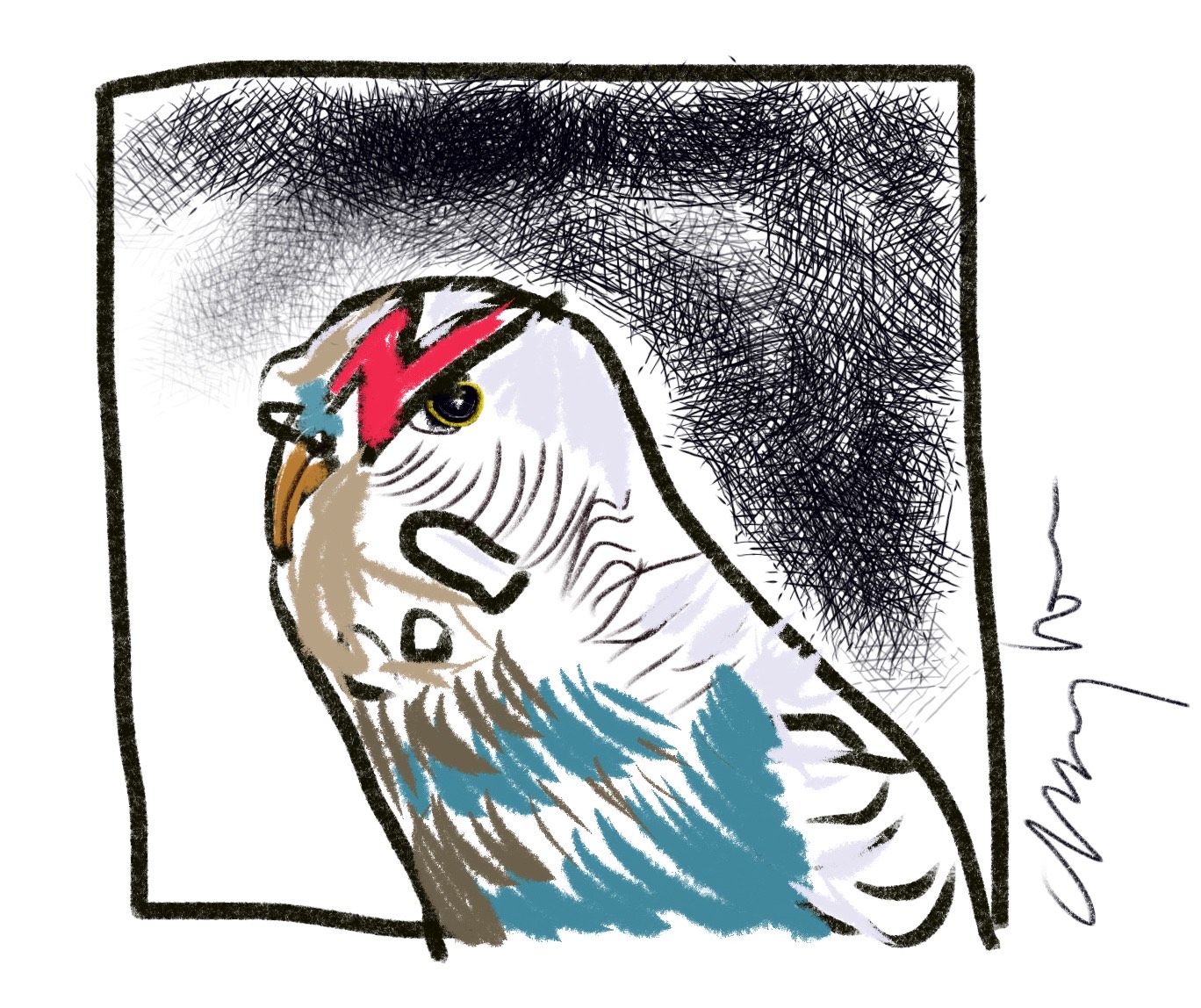
Next to the sofa is a large cage filled with tiny mirrors, dangling bells and a crazy looking budgie with a big red stripe running from its beak over the top of its head and down its back.
‘That’s Bowie,’ says June. ‘And he’s not a budgie he’s a parakeet. And he doesn’t talk.’
‘Do they normally?’
‘Quiet please,’ says Kuba.
Bowie assaults a mirror.

Behind Kuba on the wall are a selection of family photos in frames. Some are really old – the middle one around which all the others radiate is an ancient, black and white profile shot of a severe looking woman in a button-up crinoline dress. Kuba takes the cuff off June’s arm so it’s safe to ask her who the woman is.
‘That’s my great-great grandmother, Clothilde,’ she says. ‘She was French, you know.’
‘Was she?’
‘Yes, she was. Can you see a likeness?’
I look from one to the other.
‘I think I can,’ I say.
‘What is it?’
‘The nose.’
June laughs.
‘Le conk! I know! Shame, in’t it?’

*

‘Who is next patient?’ says Kuba as we head back to the car.
‘It’s a guy who needs the dressing on his arm changing. I think he fell over a couple of days ago, the ambulance came out, and they referred on to us. Once we’ve changed the bandage we can discharge to the district nurses. If he needs it.’
I glance at him and smile.
‘And then I can drop you home!’
‘Thank you very much.’
‘Got any plans for the rest of your day?’
‘I have to go to supermarket,’ he says. ‘Then some studying.’
‘What will you do when you finish your degree? Are you looking to specialise?’
‘Yes. I want to work in trauma,’ he says. ‘Something interesting.’

*

Half an hour later we’re standing outside the main door to a block of flats. A neighbourhood tabby cat comes trotting over when it sees us park; it sits next to me on the ground by the door whilst Kuba tries to figure out which keysafe belongs to our patient.
‘Hey mister!’ I say, bending down to fuss the cat between the ears. Normally a cat will pretty much levitate when you do that, but this cat means business. It stares at Kuba and narrows its eyes.
‘Which box is it?’ I say to the cat. ‘Which one’s Harold’s box?’
‘Is cat,’ says Kuba. ‘He cannot tell you.’ He sighs, and flips the cover off another box and starts pummelling the numbers.
‘Worth a try, though. Eh?’
I lean into the cat a bit more and whisper: Go on! Point! Which one’s Harold’s…?
Kuba flips the second to last box open and pulls out the key.
‘Got it!’ he says.
The moment he opens the door the cat rushes in, only pausing for a second to give us a particularly harsh look from the first landing, then turns and hurries on.
‘He will never get out,’ says Kuba. ‘That is end of cat.’
‘I dunno. I get the impression he pretty much owns the place,’ I say.
We go up the stairs, a great deal more heavily and slowly than the cat.

Turns out Harold’s door is on a chain.
‘Who is it?’ he says from inside.
‘It’s Jim, the nursing assistant from the hospital. We phoned earlier…’
There’s the sound of someone cursing, breathing hard. A woman’s voice, thin, worried. A creaking noise, presumably the walking frame – then after a while Harold appears, pressing his face to the gap like Jack Nicholson in The Shining.
‘What do you want?’ he says.
‘We’ve come to change the dressing on your arm, Harold. Do you remember?’
‘Can I see some identification?’
‘Of course!
I extend my badge on its sprung line and press it to the gap.
‘Hmm,’ he says. ‘Hah. And that’s supposed to be you, is it?’
‘Yep. I was younger then. Optimistic.’
‘Well…Alright then.’
He rattles back the chain, opens the door, and stands there holding onto it.
‘After you!’ I say. (If he falls I want to be able to catch him).
‘No. You go on,’ he says, waving me past. ‘Just go. Dorothy’s there.’
We let ourselves into the living room, where Dorothy is sitting in a high-backed chair, her legs barely touching the floor. She’s a broad, approximate figure, like someone made a sculpture by stuffing an old kimono with scatter cushions. The most extraordinary thing about her is her hair, which sticks straight up, like she fell into the chair down a chute three floors up.
‘Hello Dorothy!’ I say. ‘I’m Jim. This is Kuba. I’m a nursing assistant, Kuba is a nursing student. We’ve just popped in to take a look at Harold’s arm. Sorry to disturb you.’
She tuts, and fiddles with a handkerchief.
‘If you’re nurses,’ says Harold, wheezing into the room. ‘How come you haven’t got a box?’
‘I carry my dressings in a bag,’ I tell him. ‘I don’t like those boxes. They’re too cumbersome.’
‘Cumbersome?’ says Kuba.
‘Yeah. You know. Boxy.’
‘I don’t know about this…’ says Harold, frowning so hard his eyes disappear. ‘Who sent you?’
‘The paramedics who came when you hurt your arm. The day before yesterday. D’you remember? They wanted us to come in and check everything was alright, and then maybe get the District Nurses to see you in a couple of days.’
‘I don’t know,’ says Harold. ‘I think I’ll leave it, if it’s all the same to you.’
‘It’s your choice,’ I tell him. ‘But would you mind if I asked you a couple of questions about your arm before we go?’
‘What like? What questions?’ says Harold.
‘Is painful?’ says Kuba. ‘Is scratchy?’
‘What’d he say?’
‘Is your arm troubling you at all?’
‘No. Not a bit!’
‘Do you feel unwell?’
‘I feel fine, thank you.’
‘I can’t see any strikethrough on the dressing…’
‘Strikethrough?’
‘Sometimes the wound gets infected and a bit oozy. It starts to seep through the bandage. But that all looks pretty clean.’
‘I’ll wait for the District Nurses, if you don’t mind,’ he says.
‘Okay. That’s fine. I’ll make a note on your record. Sorry to have disturbed you.’
‘Right you are.’
I pick up all my bags again and we both leave.

Outside the main door again, Kuba sighs and looks around.
‘I was right about cat,’ he says. ‘Now. Please take me home.’

what happened to nobby

If the city is a cup, Mr Dexter lives on the rim. Not only that, you have to climb two flights of concrete steps to get to his front door. Even the flowers in the concrete flower bed strain upwards, as if everything round here has a compelling urge to be higher.

Mr Dexter told me on the phone I was to knock and let myself in. He’s sitting waiting for me in a pristine armchair, to the left of a room so clean it would take a team of CSI detectives to confirm anyone lived there at all.
‘Take a seat,’ says Mr Dexter. ‘Not that one. That one. Thank you.’

Unsurprisingly, like the plants, Mr Dexter is tall and drawn-out, like those stretchy toys you’d tug on the arms and legs and then toss on the window to stick and then slowly roll down.
‘So what happened, Mr Dexter? I know the basics – you got stuck in the bath, the ambulance came, you went to hospital for a while. But it’s good to hear it from you.’
‘Yes,’ he sniffs. ‘It’s true. I got stuck in the bath. It was all terribly embarrassing.’
‘Sounds awful. Do you have an emergency call button?’
‘No, but it’s on my list.’
‘So how did you manage to call for help?’
‘I didn’t. My cleaner found me.’
‘Goodness! How long had you been stuck there?’
‘A few hours. Six or so.’
‘And did they find out why you got stuck?’
‘No. They did all manner of tests. Nothing.’
‘Did you have problems before the bath incident?’
‘Nothing much. The usual wear and tear associated with extreme old age.’ He leans forward. ‘I’m old, in case you hadn’t noticed.’
‘I certainly didn’t think you were ninety-two.’
‘Well!’ he says, smiling, leaning back. ‘There’s my compliment for the day.’

*

I complete the assessment. All the usual checks are fine. I tell him the plan – that an Occupational Therapist will come round to assess the house for any pieces of equipment they think might help.
‘I don’t think the bath’s a good idea until you have a bath lift or something,’ I tell him. ‘Ultimately I think a wet-room shower set-up is the most practical, but it’s up to you.’
‘I couldn’t do without my morning soak,’ he says. ‘A wet room? Sounds barbaric – like something you’d have at the zoo.’
‘Baths are such a hassle though, aren’t they? I can’t remember the last time I had a bath – which sounds wrong now I say it. But you know what I mean.’
‘It’s good for the joints,’ he says, stretching his arms out like some great, gaunt, featherless condor demonstrating the principles of flight.
‘The Occupational Therapist shouldn’t come on Wednesday,’ he says, relaxing again.
‘Oh? Why? Have you got an outpatient appointment or something?’
‘No. That’s when my new car’s being delivered.’
‘Your new car?’
‘Yes. It’s one of those hybrid electric things. Save the Planet!’
He taps his nose and winks, like Save the Planet is code for something else, something less worthy.
I can’t believe he’s still driving, but I decide not to say anything. He’s so energised by the thought of the delivery, I can’t bring myself to ask whether it’s the best idea to be thinking of getting in a car when barely a week ago you couldn’t get out of the bath.

*

As I’m finishing off the paperwork we chat about other stuff. What he did in the past. He was an engineer, after a stint doing National Service.
‘I was in the RAF,’ he says. ‘I fared better than my friend Nobby, though. He went into the Navy. He told me about the time his ship was sent to witness one of the H bomb tests in the Pacific. They stood off about fifty miles or so, I think. Anyway, the Captain said All hands on deck! So up they went, and lined up on the port side. There’ll be a big flash! the Captain said. When it comes, just hold your hands up – like so!
Mr Dexter demonstrates, lacing his long fingers together and then holding them in front of his eyes palm inwards, like an extemporary mask. He holds them there whilst he says: ‘And Nobby told me, when the flash happened, it was so fierce, it lit up his hand like an Xray, and he could see all the bones there, clear as day.’
He holds his hands still a moment, imagining that, then slowly settles back into the armchair.
‘The bones of his hand! Well – you can guess what happened to Nobby.’

And I have to admit that – yes, sadly – I could.

the right one

Ray has the kind of face Disney would draw if he were animating an oak tree. A knotted, gnarly, weathered kind of face, smiling the width of his trunk, a songbird nesting in his hair.
‘Thanks for coming,’ says Ray, then turning stiffly on his roots, leads me into the sitting room.

And if Ray is a tree, Daisy is a deer – an ancient, other-worldly kind of deer, with sad pale eyes, uncertain footsteps and a wistful manner.

‘So!’ I say to her, dropping my bags and sitting at the other end of the sofa. ‘How are you feeling today, Daisy?’
She laughs – an unexpectedly girlish trill – as if I’ve asked the most ridiculous and scandalous thing possible.
‘How am I feeling? What a question! How do you think I’m feeling?’
‘Me? I don’t know. You look well, I have to say.’
‘Tell the gentleman about the fall, Daisy.’
‘The fall? Where?’
‘Not so much a fall as a slip out of bed. Onto your bum.’
Daisy looks at him blankly. But in the time it takes for her to turn and look at me, the moment has completely gone. She frowns a little, then fiddles with the cuff of her cardigan, muttering something I don’t quite catch.
‘You know about the dementia?’ says Ray, mouthing the words more than speaking them.
I nod.
‘Is it any worse?’
He shakes his head.
‘This was a little setback. I think we’re okay, though. Aren’t we Daisy? Eh? We’re okay?’
‘What are you talking about!’ she says, then turns to stare at me again.
‘Seventy-five years we’ve been married,’ says Ray. ‘Imagine that.’
‘Congratulations! That’s quite an achievement.’
‘That’s one word for it.’
‘How did you meet?’
Ray leans forwards in the armchair.
‘I was eighteen, just about to join the navy. There was a fair on the common, so I went there with my mate Harry to see what’s what. Daisy was there with her identical twin Maisy, so we hung out with them for a bit. Which one do you want? Harry said. I said does it matter? I can’t tell ‘em apart! So we took up with each other, and there you are. Harry got chucked after two days, and here I am, seventy-five years later, still wondering if I married the right one.’
‘How come she chucked Harry?’
‘He was too cocky. Me? I was just the right amount.’
He laughs and leans back in the chair. He has a twitch in his right eye, which he tries to ease by kneading it vigorously with a knuckle.
‘Nah!’ he says, dropping his hand after a while. ‘I definitely married the right one. Didn’t I Daisy? Eh? I say I married the right one!’
‘My husband should be back soon,’ she says, blanking him, folding her hands neatly in her lap. ‘Shall I fetch you some tea?’

Ollie’s Collie

When I walk into the front garden, a young collie rushes up from the back garden to the rusting, curlicue iron gate that pens it in, pushes its muzzle through the gaps, and barks crazily. I say hello, which only makes it worse, of course. It’s a funny-looking dog. The eyes are different colours – one brown, one blue – which, along with the patchwork black and white fur, mismatched paws, one ear up, one ear down, reminds me of an oil painting my auntie Ollie did of a collie dog, staring up from a hectic, pea-green background.
‘Whose dog is that?’ I said.
‘No-one’s,’ she said. ‘I did it off the calendar.’

All that remains of the keysafe at the front door is the base, though, and I realise that I’m expected to go to the side door, beyond the gate guarded by the mad dog. It gets so excited when it sees me coming back to the gate, it does an insane war dance on its back legs, spinning round on the spot, stopping itself by slamming its paws against the gate, then spinning round in the other direction. It looks pretty crazy, but I think what the hell, and reach in to flip the latch. The dog runs off into the garden, then sprints back with an empty plastic Coke bottle.
‘Thanks!’ I say.
It drops it at my feet. I toss it away into the garden again, then seize my chance to go through the kitchen door standing open on my right. ‘Hell-oooo…’

Maisie is lying on her bed in the gloom. There’s a substantial electric mobility scooter in the bedroom doorway – more like one of those big, sit-on mowers – with a seamy jacket slung over the seat and a basket filled with crap strapped to the bumper.
‘Over here,’ says Maisie.
The dog rushes in behind me and prostrates itself on the floor with the Coke bottle in its mouth, biting it with loud crackles.
‘Flash! Leave him alone!’ says Maisie. Flash drops the bottle and smile-pants up at me. I stroke Flash’s head, then straighten up, breathe in, and squeeze past the scooter into the bedroom.
‘The diet starts tomorrow,’ I say.

I’m guessing there’s been a partial deep clean at some point. There are lots of yellow bags zip-locked, piled up around the place. Maisie’s bed seems enormous, Maisie spread-eagled on it, like a depressed housewife cast adrift in a yellow ocean on a giant orange sponge.
‘’Scuse the mess,’ she says.

The phone rings. She grunts and rolls towards the side table. Before I have a chance to pass the phone to her, she knocks it off its base and the two things fall down the back of the bed. To be fair, it would be difficult NOT to knock anything off Maisie’s side table. It’s a cheap, warped affair, made worse by the fact it’s littered with stuff – bottles of spray, a glass of water, a mobile phone, an alarm clock. When I retrieve the phone and the base, hand Maisie the phone, and put the base back on the stand, I knock the alarm clock off. When I retrieve the alarm clock and set it down again, I knock the phone base back onto the floor.
‘Jesus Christ!’ I say.
‘Whoopsie!’ says Maisie. She holds the phone to her nose and prods the buttons myopically. ‘Dunno who that was,’ she says after a while. She hands me the phone. ‘Don’t drop it,’ she says.
I rearrange the side table as best I can, then start in on the examination.

*

Turns out, the phone call was from the pharmacist. She rings again and this time Maisie manages to answer it without anything else happening. There’s a long conversation, Maisie saying yes or no or yes or no or sometimes, all in a bored, non-committal way – then hands the phone to me.
‘She wants to talk to you,’ she says.
The pharmacist is someone I know well. She has the kind of incisive questioning that’s light and pleasant but still makes you sit up a little straighter.
‘Maisie says she hasn’t got her medication. It should be in a green bag somewhere. Could you check for me?’
I don’t have to check very hard; the bag is right there in front of me, beside the table. Not only that, the drug chart in the folder at the foot of the bed shows that the carers gave the morning dose as prescribed.
‘Good!’ says the pharmacist. ‘That’s a relief! Although why she told me she didn’t have it….is she confused this morning?’
‘No, she seems pretty orientated and okay. All her obs are fine…’
Flash has climbed on the bed by this point. He’s lying on his back with his legs in the air as Maisie tickles his tummy.
Who’s a silly boy? Who’s a silly boy?
Flash stares at me with his tongue hanging out, his mismatched eyes spinning with ecstasy.
‘No. She seems fine,’ I say.

*

The pharmacist has arranged to visit later to check up on things. I say goodbye to Maisie, and with the dog leaping around me like a species of giant flea, I see myself out, closing the gate as quietly as I can behind me.

I open my laptop and write my notes in the car. There are a few things to sort out, so I’m there fifteen minutes or so. I’m just about to finish up and move on when I hear a clatter from the gate. Maisie is coming out on the electric scooter, Flash trotting by her side. Maisie pauses at the front of the garden. She pulls out a packet of fags, nips one out with her lips, lights the fag with a flip of her Zippo, puts the packet back in her pocket, all in one smooth, practised motion. Then she sits there smoking a minute or two, looking right and left along the street, blowing smoke from her nose in a business-like way. Then she twists the key on the scooter again and heads right, at speed, to the park, I’d guess, with Flash high-stepping alongside her, trying to avoid the wheels. On the top of the basket, I can see an empty plastic Coke bottle rattling from side to side.

I wonder who put it there.

two wiggly chalk lines and a dot

Perched on the edge of her bed, her crochet cap looped over her ears, her smock rucked up, her square face a little wax-yellow in the light from the basement kitchen window, Wendy looks like a character in a painting by Brueghel, the village wise-woman, taking a breather half-way through making the latest batch of crab-apple gin.

‘I don’t drink the stuff,’ she says, wiping her hands down the front of her smock. ‘I just like giving it away as presents.’

She gestures to a row of elegant and antique bottles on a shelf behind her. ‘There’s more in the cellar,’ she says. ‘Have a look if you like.’

There’s nothing I’d like better. I could very happily spend the day exploring this extraordinary house, filled with Wendy’s charcoal sketches and stone sculptures and black and white photos and shelf upon shelf of tatty books – the beautiful strata of a long and colourful life lived in many parts of the world. I haven’t the time, though. Apart from checking Wendy over and making sure she’s okay, I’ve come to see what we can do to help. We’ve had a good long chat about the things she could do to improve things environmentally. I’ve offered to find help with some ‘rationalisation’ so we can accommodate the hospital bed she desperately needs. Nothing I’ve said impresses her over much, it has to be said, although she’s happy to think about it.

‘I like to be in the action,’ she says. ‘The kitchen is the heart of the house. I don’t want to lose that.’
‘You wouldn’t have to.’
‘Hmm,’ she says.

She shifts her position, and a batik-print cloth bag rattles out from a pocket onto the cot bed.
‘My bones,’ she says.
‘Your bones? What are you – a necromancer?’
She laughs. ‘My phones! My phones! Although – talking about divination – I did see things. In the past. Not so much these days, unfortunately.’
‘What kind of things?’
‘Oh – I knew they weren’t real. I didn’t let myself get frightened by them. And I certainly didn’t tell anyone else, or they’d have locked me up! My sister was the same. I think in retrospect it was a form of epilepsy. Only with us it was more hallucinations. When we were little we both got sent to a convent. Not that anyone had ever told us we were Catholic. What’s a Catholic? my sister said to me when we were lined up outside the classroom. I told her to watch out, keep her mouth shut and follow me. Anyway, there was this nun who took us for something or other. She’d slowly write a word on the blackboard, then underline it slowly with two wiggly lines, and finish off by screwing in the chalk to make a dot. And it was that particular sequence, you see, the two wiggly lines, the dot at the end, that would send us off. Animals would burst out of the blackboard. Foxes, eagles, herds of reindeer. We learned to control our surprise or we’d have been for it.’
‘Maybe they’d have thought you were visionaries. Is that what they call them?’
‘I think if you see the Virgin Mary you’re a visionary. Foxes and eagles they burn you at the stake. We didn’t tell anyone, needless to say.’
‘Do you still have visions?’
‘Sometimes. Odd times. The last one I was standing at the sink doing some washing up – which dates it! I haven’t done that in a while. Anyway, I was standing there with my hands in the sudsy water, and – maybe it was the pattern of light through the window, or something else, I don’t know – but suddenly I was standing on the edge of a vast, desert plain. And off in the distance I could see a dummy.’
‘A dummy?’
‘Like a tailor’s mannequin. You know? On a stand. And I moved closer, and I saw that the dummy was wearing a jacket – a nice, neat, green brocade affair, with pearl buttons down the front and at the cuff. A little closer and I could see some other details, a beetle brooch, a pair of calfskin gloves. And it was then I realised what I was looking at. It’s you, you dozy old cow! I said to myself. The vision vanished. I carried on washing up.’

white plastic flowers

There are three brightly-coloured, classic American cars parked nose-to-fin along the side of the road. It’s strange to see them in this thoroughly-suburban scene, like I’ve wandered into a perverse mash-up of LA Confidential and One Foot in the Grave. Frank’s bungalow is a little further up. It’s got a perfect square of grass out front, edged in pink cemetery chip, a white fountain in the centre with a cherub continuously urinating into a scallop shell. A little closer and you can see that everything is plastic, including the grass, which explains the sharpness of the lines and the colours, everything accentuated by the sky, low and grey, rumbling, threatening rain.

Frank answers the door, hunched over a zimmer frame, his dressing gown swinging open, his ascitic belly poking through.
‘Thanks for seeing me,’ he wheezes. ‘Come on in.’
The bungalow is meticulously clear. It’s a laminate floor and it squeaks a little as Frank wheels his zimmer frame along it. He leads me through to the conservatory out back, the most prominent feature being a small-scale but perfectly detailed drinks bar – a Thirties-themed affair, with optics against a checkerboard background of black and white glass tiles, shelves of fancy cocktail glasses, old cigarette trays, mats, ice buckets, the whole deal.

It’s a routine assessment. Frank only needs a little care support since coming back from hospital. Everything else, all the nursing and therapy needs, have already been taken care of. It doesn’t take long.

Whilst I’m finishing off the paperwork, writing out the folder notes, Frank readjusts his dressing gown and looks out into the garden. It’s a larger version of the one out front, although the lawn, the silver birch and the shrubs look real enough. He’s hung thick skeins of white plastic flowers everywhere, to give the scene a rich, Hawaiian look, I suppose. The sky is so dark with the coming rain, they stand out with a strange intensity.

‘Watch out! Here it comes!’ says Frank, as the rain suddenly clatters down on the conservatory roof. The noise is so loud, he even has to shout a little. ‘It’s like being on stage!’ he says. ‘The crowd goes wild…’ And he waves out at the garden, smiling, nodding his head right and left, graciously accepting the applause, as the white plastic flowers shiver in the rain.

operation broken wing

William shows me into a large, glossy, wooden-floored hallway. There’s a rack for shoes against the far window, covered with so many trainers and school shoes and slippers and fancy boots and things it looks more like someone backed a truck filled with odds and ends from a shoe store and had them tipped in one enormous heap onto the rack. Amongst all the shoes are micro-scooters, rugby balls, school bags, laundry bags, bags for life.
‘Sorry about the mess,’ says William.
I follow him through into the house. It’s a large, detached building where most of the ground floor has been knocked-through into one, vast living area. There’s a suggestion of corridors leading off into smaller, more private rooms, the bathroom and so on, but mostly it’s this wide, white space, a wall of glass at the far end past the kitchen area, skylights sunk deep in the ceiling here and there, and then enormous sofas and chairs dotted about the place. It’s a surprise to come into such an orderly area after the chaos of the hall, but maybe that’s the protocol in this house – you shrug off all your clutter there, like an airlock. This space is much more formal, like a departure lounge at an airport. But instead of a few people sitting on the sofas next to wheeled suitcases with the handles up, there’s just William’s mum, perched on the edge of an armchair, as upright and watchful as a buzzard in a raptor sanctuary.
‘Hello Mrs Claymore,’ I say, putting down my bags.
‘Hello,’ she says, turning her head to blink once at me, firmly. ‘And who do we have here?’
‘Mum’s staying with us whilst her arm gets better. Aren’t you mum?’
‘Yes,’ she says. ‘Apparently.’
‘And how is the arm today?’
She gives a tentative shrug, the broken right arm shifting uncomfortably in its collar and cuff.
‘Still broken,’ she says.
‘Much pain?’
‘Oh – not too bad. I’ve had worse.’
‘Really?’
‘Oh yes. Much worse. I’m ninety-six, you know.’
‘So the pain medication’s helping?’
‘It is and it isn’t,’ she says. ‘It makes one feel rather woozy. Do you know what I mean by woozy?’
‘I think so. A bit off centre.’
‘Yes. A bit doolally. And of course, it acts as a kind of brake on the whole bowel issue.’
‘That’s the codeine.’
‘So they say. But I’m eating well and all that jazz, so there we are.’
She looks around, a little forlornly, as if she’d much rather be hopping around in her own forest – and gives another, small shrug.
‘Everyone’s been marvelous,’ says William, sitting on the arm of one of the big sofas. ‘Haven’t they, Mum?’
‘What darling?’
‘I say everyone’s been marvelous.’
‘Yes. Absolutely. First class.’
She doesn’t sound all that convinced, though.

*

After I’ve performed the usual tests and asked about the practicalities of the thing, whether they need any extra equipment, how much physio we can offer and so on, I sit with the yellow folder on my knees, writing up the visit. William is attentive and polite. He’s done the right thing by taking his mother in and looking after her, but I can see it’s a strain. He’s perched on the arm of the sofa with his arms folded. Every so often he vigorously rubs his face, or pulls his phone out of his pocket and scans it for something – anything – that might demand his attention and give him leave to step out.
‘What did you do before you retired, Mrs Claymore?’ I ask her – as much to cover a sudden fall of silence as anything else.
‘The Foreign Office!’ she says.
‘Yes,’ says William. ‘She got up to a few things, didn’t you Mum?’
‘I did what?’
‘I say you had a few adventures.’
‘You could say that,’ she says.
‘Where did you serve?’ I ask her.
‘The Middle East, mostly. A stint in Hong Kong.’
‘Really? You know – my brother in law’s in Hong Kong.’
‘Is he?’ she says, blinking at me through a fog of codeine. ‘In what capacity?’
‘I couldn’t tell you,’ I say. ‘Something businessy. I must admit I don’t really understand it – what with the pandemic and China being a lot more heavy-handed. You’d think you’d do anything not to go back there. But of course – you know what our theory is, don’t you?’
‘What theory?’
‘We all think he’s a spy.’
‘Oh? And what makes you think that?’
‘One – he’s going back there in the first place. Two – he’s got more passports than Jason Bourne.’
‘Jason who?’
William leans in.
‘A character in a popular film franchise, Mum. About spies.’
‘Oh?’ she says. ‘Never heard of him.’
Then – gently cradling her broken arm and leaning a little towards me, she whispers: ‘S.O.E?’

please welcome on stage

Thomas is alert but strangely neutral, propped up on the ambulance trolley, his white hair wild on the pillow, his mouth slack. He’s put on so much weight it’s taken a team of four to wheel him off the ambulance, up the drive, through the portico and into the house. Jenny the OT and I have arrived just in time to help, although there’s not much for us to do other than carry in all the bags of personal possessions, drugs and so on. The patient transport crew are a loud and pleasant bunch, eyes smiling over their masks, plenty of to you / to me banter as they patslide Thomas into bed, make things good, get ready to go. One of them nods for me to follow her back out to the truck, though.

‘I don’t know what help you can give them,’ she says. ‘But I gotta tell ya – I’m worried about the daughter. She’s a donkey on the edge. See what you think. Personally – I don’t know – I wouldn’t put money on it.’

The story is that Thomas went into hospital after a fall, stayed a month, then got transferred to a nursing home for a few weeks’ rehabilitation. Meanwhile, the hospital OTs visited the house, put in a hospital bed, stand aid, commode and so on, and then referred him to us for more therapy and nursing support, along with bridging care until a full time agency can take over. All in all it’s about as much as anyone can do short of adoption, or residential care, of course. But we’ve been tasked to visit for the initial assessment, to see how it all looks, and if the plan is workable.

The house is like a spacious, somewhat incongruous pink Spanish villa, set back on a rise at the head of the close. Thomas’ hospital bed has been set up in the L of the vast, low-ceilinged living area, with bare stone walls, a heavily-timbered fireplace, brasses hanging here and there, a hunting horn, a few framed portraits. Even though it’s hot and bright outside, the late summer morning doesn’t penetrate overmuch; what light there is only makes it so far through the patio glass at the far end, lying like a glossy green sweat on the backs of the clubby sofas and chairs.

In fact, the scale of the place is a little overwhelming. It’s the details that make you dizzy. On the wall behind the head-end of Thomas’ bed is a giant oil-painting of a horse’s head; at the foot of the bed, on a granite pedestal, a fish tank filled with tiny silver fish.

Thomas’ daughter, Helen brings in a giant mug, filled almost to the brim with tea.
‘Don’t spill it!’ she says to him, putting it on the overbed table.
He glances down, shakily jerks his hands, the tea slops.
‘Look what you’re doing!’ she says.
I take the cup from him, move the table to one side, hand the cup back to Helen.
‘He really needs one of those spill-free mugs – you know – the ones with the spout.’
‘What – like kids use? For kids?’
I nod.
‘That’s it!’
‘Have you got any?’
‘We don’t carry them. But you can get them anywhere. The supermarket, pharmacy…’
‘A beaker for kids? You mean Tommy Tippee?’
‘A lot of people use them.’
She looks horrified, takes the tea back into the kitchen.

Whilst Jenny starts doing the paperwork and an audit of the equipment we’ll need to check, I run some basic obs. It’s immediately obvious things aren’t right.
‘I think this is looking like a failed discharge,’ I say, looping the steth back over my neck.

Alice and Frank, two of our most experienced carers, turn up for the lunchtime call. It’s good to see them – they’re so cheerful and grounded, it immediately makes any situation a hundred times better. Between us we set about sorting Thomas out, log-rolling him, tearing off his pads, cleaning him up, putting on fresh pads, changing the sheets, sitting him up again. Thomas coughs throughout. Frank raises his eyebrows at me.
‘Tested for Covid?’
‘A month ago.’
‘Oh-kay…’

Helen appears in the doorway. She stands watching us, her arms folded, staring at the pile of sheets on the floor.
‘What’s that?’ she says. ‘Why’s that there?’

Jenny goes over to her to explain the situation whilst we finish up.
‘They’ve just had to clean your dad up and make him comfortable. Have you got a washing machine?’
‘What do you mean? I’m not doing any washing.’
‘It’s not too bad, Helen. It just needs tossing in the machine with a tab of something.’
‘Well you can do that because I’m not. Isn’t that what you’re supposed to do?’
‘No, I’m afraid not. We’re effectively an emergency service. The carers will be coming in four times a day for bed washes, pad changes, and then simple meal prep and medication if that’s needed, too. But everything else – things like washing, cleaning, shopping – well, they’re all classed as domestic chores. You’ll need to find someone to cover that if you can’t.’
‘Well I’m certainly not doing it,’ she says. ‘Why should I? I’m not touching anything soiled.’
‘You can put gloves on.’
‘Gloves? Gloves? I’m not putting gloves on. Look – you do what you have to do, but I can’t … I just can’t… I’ll go and stay at a friend’s if that’s what you think’s going to happen.’
Jenny looks over to me.
‘It might all be a little academic…’ I say, feeling Thomas’ pulse again. He sits propped up on the pillows, the focus of everyone’s attention, his mouth bouncing up and down, mute as a ventriloquist’s dummy who still has a whole bunch of things to say – important things, mad things, funny things – but the hand some time ago let go of the lever, and left him on stage to carry the show alone.