
‘It’s a shame they’re selling this place off.’
‘They’ve been talking about it for years. I’ll believe it when I see it.’
‘No. It’s definitely going. It’s prime real estate, worth a fortune. They’d be crazy not to. Shame though. They could’ve built a whole new sort of hospital.’
‘Like what?’
‘I don’t know. Like a giant beehive, with nurses flying in and out, with jet-suits. Black and yellow stripes, going all over the city and seeing people in their homes, like they’re always on about. With little aluminium grabbers underneath…’
‘Like legs?’
‘….exactly. So if anyone needs to go in, you just scoop them up and fly straight back. Manual handling? Thing of the past.’
‘Yeah. I can totally see that. No traffic problems.’
‘Exactly.’
‘But in a way, that’s just a normal hospital. Only with bees.’
‘No it’s not.’
‘Think about it, yeah? What happens now? We treat people at home who can be treated at home, and we bring in those we can’t.’
‘Yeah, but I’m talking about a long time in the future. In the future there’ll be loads more things to keep people going.’
‘There’s already plenty of them.’
‘No, I know – but – in the future, medicine will be individually tailored to suit a person’s needs. Like organs. They’re already doing it. Pretty soon they’ll be growing spare organs.’
‘Where?’
‘I don’t know. In the lab. On a tree. So when your heart packs up, there you go, there’s another one for you.’
‘Nice.’
‘People won’t be as sick as they are now. And when you do go off, or fall under a truck or something, instead of getting taken to hospital in an ambulance, you’ll be slung under a giant bee.’
‘And A&E’ll be a big hole at the bottom of the hive, where they all go in.’
‘Maybe. It depends.’
‘On what?’
‘Structural questions.’
‘Cool.’
‘And instead of cubicles you’ll have cells, filled with patients instead of honey. And instead of nurses, you’ll have worker bees running about.’
‘I think that’s ants.’
‘I don’t mean real bees or ants. How would that help? I’m just using them as examples. From the natural world.’
‘Anyway. Yeah. Totally. I think you should definitely put it in an email to the Chief Exec. He’s always interested in new ideas.’
‘Yeah?’
‘Yeah. And copy me in.’
Uncategorized
POA
‘I’m Ellie, and this is my sister Jo. I live at the end of the road and I pop in now and again, which has been so, so handy. Jo moved to Edinburgh last year so it’s not been as easy for her. She only just flew in today, so she’s exhausted. You see – the thing is – we’ve all been taken by surprise by all this. Mum was doing pretty well up until the fall. I mean she was slow and everything. You had to watch her with those sticks. But she didn’t have carers, she went out shopping with the community transport, she cleaned for herself, she cooked her own meals, and I mean, okay, she was forgetful, but I’m the same, and I’m thirty years younger. I have to write things down. You heard about the fall, did you? It was pretty bad – well, it could’ve been worse, but bad all the same. She’d gone out in the yard to put the rubbish out when she caught her leg on the step, fell backwards and couldn’t get up. Of course, she wasn’t wearing her button. That was back inside, hanging on the kitchen trolley. So in the end it was three hours before there was anyone to help. She half froze to death. I’m pretty sure the button would’ve worked, even though she was outside. I think it would’ve been in range…’
‘Twenty feet,’ says Jo, folding her arms.
I take off my rucksack, as cautiously as a community health paratrooper shrugging off his parachute in a field. At least a field would be open. As it is, this hallway feels way too small for such an intense conversation.
I’m surprised they’re sisters. They don’t look much alike, or if they do, it’s with that light and dark, yin and yang, push-me-pull-you kind of synergy you sometimes get in families. Ellie does the talking; Jo does the listening. Maybe Jo’s just exhausted by the journey down today, but there’s something else, a watchfulness that feels more opportunistic, more controlled. As soon as I say that perhaps we should go through to the kitchen so I can meet their mother, Jo unfolds her arms.
‘We’ll be off then, Ell,’ she says. ‘Text me if you need anything.’
‘Okay. Will do.’
They kiss each other, cheek to cheek, as affectionately as two people flint-knapping.
As soon as the door’s shut, Ellie turns to me, widens her eyes, and jabs a middle finger in the air towards the space where Jo had been standing.
‘Honestly, she drives me absolutely nuts!,’ she says. ‘You wouldn’t believe how stressful it’s been the last couple of weeks. I’ve got a family of my own and a business to run. What’s she got? They’ve both just taken early retirement, so don’t ask me what they do all day. Well – actually I can tell you exactly what they do all day. Spinning classes down at the gym, planning their next holiday, and bossing me about on the phone: Have you done this? Have you done that? She’s so interfering. But it’s me that has to come running down the road every five minutes. I can’t believe it! She’s only been here an hour and she’s already buggering off. She doesn’t know the half of it. I’ve got a teenage girl going through exams and I know I haven’t been giving her enough attention. Somehow Jo ended up with power of attorney, and oh my God! Every last thing gets questioned! We had the bathroom converted into a wet room, because that made sense. Mum was struggling to get in and out of the bath, and there was more room to use her sticks and what have you. But it was a freakin’ nightmare getting Jo to agree. Well – I’m not sure it’ll add value to the house she said. Add value to the house? This is our mother we’re talking about! Who cares about adding value to the house, just so long as it makes her life easier. And anyway – a bungalow with a wet room? Hello! That’s called a selling point.’
She pushes her hair back and straightens her arms, like a Head Girl marshalling her cool.
‘En-ee-way,’ she says. ‘Sorry for the rant. You come in the door and you get landed with all that! I bet you’ve heard it all before a million times.’
‘A few. It’s always slightly different, though.’
She laughs. ‘Sorry! Come on! Mum’s in the kitchen having tea. Luckily she’s as deaf as a post.’
up the beanstalk
John is a big man.
A very big man.
In fact, John is so big, I could probably make a nest in the palm of his hand and sleep there quite comfortably. And if he sat up suddenly – which he’s unlikely to do, given his back pain – I’d have plenty of time to leap off into the pillows and make off with his goose.
I’m sure if he had a magic goose, he’d far rather it produced effective pain relief than golden eggs. As it is, he tells me the morphine patches, the various pills and the occasional massage really aren’t helping.
‘It’s absolute bloody agony,’ he says. ‘I’m a prisoner in my own home. My own body.’
‘At least you’ve got the commode here now, so it won’t be such a deal getting to the bathroom.’
‘Says you.’
We dragged the commode in yesterday – giant-sized, of course, spot-welded, more like a farmyard implement.
‘I can’t move him,’ says Audrey, his wife. ‘I mean – look at me!’
She holds out her arms, like the size-thing only just happened. She’s right, though. She’s even smaller than me. When they go shopping she probably rides in his hat.
‘How long have you been in bed now, John?’ I ask, flipping through the folder.
‘Three, maybe four days,’ he says. ‘And I tell you what, I’m heartily sick of it.’
‘I bet you are. Of course, the thing is – with back pain what they say these days is to keep mobile. Otherwise you seize up.’
‘Tell me about it,’ he booms.
He’s lying on his side, one colossal hand slapped to his forehead in an attitude of despair, the other draped over the edge of the mattress. The whole bed is dipping dangerously to the floor; you’d think getting out would just be a matter of rolling two degrees a little further to the right and then coming to rest on all fours. I imagine the whole neighbourhood shaking, people rushing to their doors.
‘The physio gave me some exercises to do in bed,’ he says. ‘Leg raises, bum clenches, I don’t know. I’m doing what I can.’
‘I’m sure you are, John. I just wish I had a magic wand…’
‘You mean you don’t? Audrey… show him the door.’
But Audrey’s gone back into the kitchen – whether to fetch his medication, a cup of tea or his singing harp, I’m not too sure.
evolution
‘You know why diplodocusus – diplodoci? – had such long necks?’
‘To see you coming?’
Maria’s husband Terry is at the foot of the bed, holding a water bottle with a fluffy dinosaur on the front. Behind him, Maria’s oxygen machine thrums and clicks.
‘No. Not to see me coming, Terry. I was reading about it in my magazine. They were specially adapted to save energy.’
‘What? Like a light bulb?’
‘No. So they could stand in one place and eat all the leaves from high up without having to move much.’
‘So they were basically lazy? Is that what you’re saying?’
‘Not lazy, Terry. Just perfectly adapted for their environment.’
‘I heard if they lifted their heads that high, they’d faint.’
‘Well that can’t be right.’
‘Why not?’
‘Because you wouldn’t have had any fossils if that had happened. You’d have had one diplodocus that fainted a lot, and that’d be it.’
Terry shrugs.
‘They could just have held their heads dead level. So they didn’t get dizzy.’
‘What’d be the point of that? Walking along with your head sticking out?’
‘Looking round corners?’
‘In case a Tyrannosaurus Rex was sneaking up?’
‘Maybe. Yeah.’
‘I don’t think Tyrannosaurus Rexes did much sneaking.’
‘How’d they get their food, then?’
‘They were hunters, Terry. They had big powerful legs. For running.’
‘Yeah – but then they had those funny little arms. You wouldn’t think they were good for much, would you?’
He holds the hot water bottle like a piece of meat he’s struggling to put in his mouth.
‘I don’t think they used a knife and fork, Terry.’
‘How did they manage, then?’
‘I think they put their face in their food and ripped it to pieces.’
‘Oh.’
She looks at me and shakes her head.
‘Do you want this hot water bottle or not?’ he says.
mrs weston
Mrs Weston gives the belt on her dressing-gown a hard tug and a double knot, like she’s about to abseil out of the window rather than sit on the sofa.
‘You should have seen this place,’ she says. ‘Like a murder scene. Blood everywhere, on the carpets, the sofa, a trail of it through to the kitchen. I was soaked through, of course. And there were all these bowls dotted about that the paramedics used to drop the tissues in – my best cooking bowls, I hasten to add. When Val my domestic came by the next day she almost fainted backwards out of the door. I told her I’d get the professionals in but she said no, she could handle it. And she did. Which is odd, when you think she never really dusts properly. She doesn’t move things, you see. She dusts around. Anyway, I’d been on the phone to my friend Janice for about an hour, and I’d just said goodbye and hung up when I felt this strange sensation – a loosening is the only way I can describe it – and then the blood started to run out of my nose, just as if someone had turned on a tap. When it wouldn’t stop I rang for an ambulance, who came round pretty quick. They weren’t at all thrown by my predicament, and I must say I was impressed by how thorough they were – even though I rather wish they’d found something else to put the tissues in. So – there we were – a paramedic hanging on to my nose and chatting about this and that, until after about half an hour the whole thing seemed to have stopped. My blood pressure and everything else was fine, so they tried to persuade me to stay at home. But you see, there were no guarantees the nose wouldn’t start up again, and I was scared when they left I’d be on my own. And I’d lost so much blood. The hospital’s on Black Watch or Black Alarm or something. You’ll be waiting hours. Well – they weren’t wrong. I was put on a chair in a waiting room and there I stopped. Six hours under the clock covered in blood without so much as a nod. Eventually this young woman came over, and she said did I have anyone with me. You never hear about these little acts of kindness, do you? I asked her if she could get me a cup of water, because I was so thirsty. She came back and said all the cups had run out, so she’d gone and bought me a bottle of water from a machine. I offered to pay her but she said no – it was her pleasure. Her pleasure! Honestly! I could have wept. She even helped me to the toilet. She was a true angel, despite the piercings. Anyway, after about eight hours I’d had enough. You see, the problem is, I’m part of that generation that accepts whatever happens to them. You wait your turn and you keep quiet. There’s an order to things. You respect those in authority. But even I could see it wasn’t working in my favour. I could see I was merging into the background. So when a doctor passed I reached out and I grabbed his trousers. And do you know, it worked! Because after he’d recovered from the shock of being assaulted by an old lady covered in blood – as soon as he heard how long I’d been sitting there and everything that had happened to me – he was appalled. He wheeled me straight in to a cubicle, and he even found me a lunch box, because I hadn’t had anything in so long. And when he heard the blood test still hadn’t been done – I’m on warfarin, you see – he ordered one of the staff to do it there and then. I asked him if he was going to put a camera up to have a look around, but he said no, that wouldn’t be necessary. Eventually a nurse came and told me a bed was available, and that was absolute heaven! I didn’t mind one bit that I was surrounded by demented patients, and the bed wasn’t what you might call comfortable. I was warm, I was lying down, and I had a button to press if the nose started up again. I managed to sleep for a couple of hours, and then in the morning they discharged me home. They’ve stopped my Warfarin and put me on something else. And there you are – it all seems to have settled down. Oh, for goodness sake! Over there, on the light switch! How Valerie missed that I’ll never know.’
a woman of substance
Nothing has changed in the few months since I was last here. Rene is still sleeping on her sofa, wearing as many clothes as she can, the whole ensemble bound together beneath a vast red towelling bath robe; there’s a commode to the right of her, a radio to the left; a pile of extra-large print Barbara Taylor Bradford romances on the floor, and a line of dusty faced dolls watching over the scene from their various shelves around the room. Even if Rene’s swollen legs would function sufficiently to allow her upstairs to the bathroom, she wouldn’t be able to lift them into the bath, and even if she could, there’d be no point, because the bath is filled with more junk than the sitting room.
‘How are you, Rene?’
‘I’m very well, thank you. Not bad. Now – don’t go moving anything or I won’t know where I am…’
She doesn’t allow for much in the way of help. Every so often she experiences another crisis, the GP refers to us, and we go through the same fruitless attempts to get her to accept equipment, physiotherapy, medical interventions – a tidy up, at the very least. I’m fit enough but even I have a job picking my way through to the kitchen to make a cup of instant chicken noodle soup.
‘Just put it down there,’ she says. ‘Lovely. I don’t suppose you can you find volume four of A Woman of Substance? I don’t know what I’d do if I couldn’t read.’
After I’ve completed the examination and made my notes, I ask if there’s anything else she needs.
‘No, thank you,’ she says. ‘So long as you’ve made sure all the doors are closed upstairs.’
‘Yep. All shut.’
‘Good,’ she says. ‘That’s it, then.’
I shake her hand.
‘Happy New Year, Rene.’
‘And a Happy New Year to you,’ she says. ‘Are you out celebrating tonight?’
‘Only at home. I’m working tomorrow.’
‘Shame,’ she says. ‘I’m having a party.’
‘Are you?’
‘Yes,’ she says, waving volume four in the air. ‘A party for one.’
easy call
We’re short on carers this morning, so I’ve been given a half dozen patients to see before my clinical calls. First on the list is Helen, an end of life case who has deteriorated markedly in the last twenty-four hours. The private agency the family uses has struggled to cope with the change, so I’m to double-up with their carer, assess the situation and come up with a plan.
Helen lives up in the suburban hills on the outskirts of town, where the original Thirties bungalows are gradually being replaced by expensively discrete designer houses. A chill mist lies across the valley below, isolating every sound so effectively I can hear the jangle of the man’s keys as he walks down the steps ahead of me to Helen’s front door. I guess he must be the carer I’ve come to liaise with, so I grab my bag, lock the car and follow him down.
‘Hello!’ I say, from the top of the steps. ‘I’m Jim, from the Rapid Response Team.’
‘Who?’ he says. ‘Well. I suppose you’d better go in.’
He opens the door and stands aside.
It’s obvious he’s not the carer. Something’s not right about this, but the momentum of my progress down the steep garden steps overrides the instinct to stop and find out more.
‘Thanks,’ I say, and go through.
I had been expecting a hospital bed in a front room; instead, there are a half a dozen people still in their hats and coats, sitting, standing, holding coffee cups, fiddling with phones. They all turn to look at me.
‘Hello,’ I say. ‘I’m Jim. From the hospital. Come to see Helen.’
An elderly man staggers over to stand in front of me.
‘She died,’ he says, frowning, with the crumpled, rather dazed look of someone saying something terrible out loud for the first time. ‘I’m afraid you’re too late.’
‘Oh. I’m so sorry.’
‘Easy call,’ says someone.
‘I’ll let the hospital know,’ I say, and then adding, rather hopelessly, ‘I’m sorry for your loss.’
No-one says anything as I turn to go.
The man who showed me in is still standing by the front door. As I pass he says: ‘I suppose I could’ve told you that before you went in.’
‘It’s okay.’
Just before I step outside, someone calls to me from back inside the house. I wait as the elderly man from the front room walks towards me, painfully favouring his left hip, working his way along by using the walls, the book case, the stair rail. When he’s close enough he pauses to catch his breath, then holds out his hand. I shake it.
‘Thank you so much for coming,’ he says, ‘I really do appreciate it,’ and then drapes his left hand over his right, for emphasis, support, or both, it’s hard to tell.
alf’s view
Alf has a great view of the sea from his armchair – and me, soaked and shivering on the front step, frantically trying to persuade him to come to the door. I’ve held up my ID badge, shouted and smiled and tapped my watch. I’ve even performed a mime to illustrate the word: phlebotomy (which in retrospect could be taken as IV drug user, but whatever). Despite everything, though, the best I get is a tetchy shake of the remote control, as if I’m just another damned thing on the TV he’d like to end now.
I simply can’t hang around a moment longer. I couldn’t be more exposed if I was standing on the sacrificial altar at the top of an Aztec temple in a typhoon.
I hurry back down the steps to the car, throw my bag inside, and then myself.
‘Try again later,’ says Michaela. ‘I think his daughter must be out.’
*
At least the rain’s stopped.
I’m back on Alf’s front step, waving at him through the window. He holds my gaze whilst patting the sides of the chair for the remote. But suddenly there’s a movement in the hallway, and his daughter Cynthia comes to the door.
‘Good job you weren’t here earlier,’ she says. ‘The weather was dreadful.’
Alf calls out ‘Who’s there?’
‘Someone from the hospital,’ she says over her shoulder, then looks at me and smiles, as lightly as anyone could who hadn’t slept in days.
‘He won’t like this,’ she says, and leads me through.
She’s right, of course. Alf submits to the observations and the blood test with the wariness of a bad-tempered old donkey. It’s hard to understand why he’s so crotchety. His room is about the nicest I’ve seen: warm, well decorated, a good bed, books, pictures, a fine view. Cynthia and her husband to look after him, and so on.
‘Dad hasn’t moved from the chair in two days now.’
‘Why’s that, then, Alf? Do you have any pain anywhere? Do you get dizzy? Sick?’
Nothing like that, he says.
‘So how do you manage with the toilet?’
‘He wears a pad. You know – like a nappy.’
‘Do you have carers?’
‘Your office sent some people – didn’t they, Dad? – but I’m afraid he just turned them away.’
Alf folds his arms.
‘So I have to do it,’ says Cynthia, finding that smile again.
‘How on earth do you manage?’
‘It’s difficult,’ she says.
‘Well hopefully the bloods will show if there’s a problem anywhere – an infection or something – something that might explain why your mobility has gone a little south lately.’
‘I’m not going to hospital,’ says Alf.
‘Let’s hope it won’t come to that. But if there is something wrong that can’t be dealt with at home, hospital might be the best option.’
‘I’m not going.’
‘Why not?’
‘People die in hospital.’
‘Yep. Well, that’s true. But then – people die at home, too.’
I study him to see if the significance of that hits home, but he’s as resolute and unyielding as before.
‘One step at a time, though,’ I say, brightening.
He stares out of the window again.
I pack my things away.
‘Nice to meet you, Alf.’
I hold out my hand but he doesn’t acknowledge me.
Cynthia shows me to the door.
‘We haven’t had a wink of sleep in months,’ she says. ‘He calls out through the night, but it’s not like he’s in pain or there’s anything particularly wrong. You wouldn’t think it to look at him now because he puts on this act. He says what he thinks you want to hear. We’ve had the doctors out any number of times but they can’t find anything wrong. We were offered respite but he turned that down, just like the carers. My husband’s due to go in for an operation next month and then it’ll just be me. I don’t know what to do. Something’s got to give and I’m scared it’s going to be me. Dad’s lived with us ten years, and it’s been fine, but the last couple of months… It’s been absolute hell.’
I try to be reassuring. We’ll see what the bloods show, if there’s anything acute going on. But I tell her I’ll speak to our social worker, and the mental health nurse, too. It’s complicated. There’s a capacity issue. It’s Alf’s registered address. I imagine Cynthia and her husband moving out, Alf raging at them through the window – but of course, I don’t tell her that.
‘One step at a time,’ I say, shaking her hand.
Out on the front step again and the sky is vast and clear and blue, the silvered arc of the horizon completely opened up. It’s like standing at the top of the world. I re-shoulder my bag and take a deep breath, then turn to wave at Alf through the window. He doesn’t respond. I can feel his eyes on me all the way back down to the car.
horses in the fog
Agnes has being doing well up till now, considering her age. Thoroughly independent – bloody-minded, according to Stella, her great-granddaughter, who lets me in and shows me through to the bedroom.
‘My husband was a Jim,’ says Agnes, smiling sadly, reaching out to me.
‘It’s a sign! says Stella.
‘You’ve brought the cold in with you.’
‘I know. It’s pretty foggy out there.’
‘I can’t see a blessed thing out of the window. It’s like someone’s made off with the world whilst I was asleep.’
‘A real peasouper.’
She watches as I put my bag down and take my coat off.
‘You know, I couldn’t help thinking what we used to do with the horses when they were like this,’ she says.
‘Horses?’
‘Agnes and Jim had a veterinary practice,’ says Stella, sitting down on the other side of the bed and stroking her hand. ‘Didn’t you, nana?’
‘We did. Oh yes, we did. And I was just trying to remember what used to happen in similar circumstances.’
‘I can tell you exactly what used to happen, nana. You took good care of them in the stable, and you had them back out, running round the field in no time.’
‘Ah!’ says Agnes. ‘Yes.’
There’s a delay getting the equipment we need to the house; for now, Agnes is so frail it’s easy enough to slide her up the bed using the bottom sheet. Once she’s comfortable, I take the blood sample I’ve been sent round to collect.
‘Have you had much time off?’ she asks.
‘It’s been all right, thanks, Agnes. It’s worked out pretty well.’
‘We were always so busy over Christmas. But that was our life, you see, and we loved every minute of it.’
‘There! All done. You’re a model patient,’ I tell her, taping a square of gauze to the crook of her arm.
‘Am I?’ she says, gently touching the dressing with the tips of the fingers of her left hand. ‘Well – I should hope so, too.’
*
Back outside the freezing fog has lifted a little, and the low sun on the frosting gives everything a sharp, delicate quality, from the sagging strands on the cobweb strung from the porch light, to the last, dark apple at the top of that tree.
I get back into the car. I’ve only been gone half an hour and it’s already cold, so I turn the engine over to warm it up. After I’ve written out the blood form and the labels on the bottles and stashed everything neatly away, I take out my diary, note down the finishing time, and set off.
There’s a large field to the left of the road. I can make out two horses high up on the slope of it. They hardly look real, standing absolutely still, silhouetted against the irradiated glow of the fog. It would make a great photo, I think – but there’s nowhere safe to pull over and take a picture, even if I had the time. So I turn the heating up instead, and carry on to the hospital.
the long way down
Nora is asleep, lying on her side in bed, her legs crooked up, one hand to her cheek, the duvet gathered snug to her chin. She hardly looks real, more like an elderly doll, her silver hair stranding over her face, her features slack and doughy and scoured with lines, eyes scrunched shut.
‘Someone to see you, mum,’ says Helen, leaning over her. ‘Someone from the hospital.’
She opens her eyes and looks at me. I wave and smile. She stares for a few seconds, then closes her eyes and goes back to sleep.
Helen sighs and straightens up again. Helen is the one who should be in bed. She looks exhausted, hollowed out with stress, her hair standing out like frayed rope.
‘They’ve set the hospital bed up in the front room downstairs,’ she says. ‘D’you think you could help me get her on the commode? And then maybe we could get her dressed and take her down on the chair lift?’
‘Okay. I need to do some obs first, just to see how she is. And then we’ll have a look.’
After I’ve woken Nora up and made her comfortable, I work through the exam as gently as I can. All the readings are borderline – nothing radically out, but still, the overall picture suggestive of an underlying problem. I take some blood to screen for the usual things, then help her sit up.
‘Just a minute!’ says Helen, anxiously searching under the bed for something whilst I support Nora.
‘Here!’ she says, fitting two ancient green slippers on her feet. ‘She’s got a phobia about floors.’
I look at Nora to see her reaction, but she sits on the edge of the bed as passively as before. Once the shoes are on we set about transferring her to the commode – a hazardous operation, as Nora barely takes her own weight at all, leaning back against our arms, anxiously paddling her feet.
‘I’m not sure taking her down on that stair-lift is going to work,’ I tell her, once Nora is safely on the commode.
‘But the bed’s downstairs,’ says Helen. ‘What else are we going to do?’
‘We can ask patient transport to come and carry her down.’
‘What in?’
‘They have special chairs.’
She gnaws her lip, looking at me with the expression of someone who disagrees but doesn’t feel able to voice it.
‘Oh,’ she says. ‘And they’ll do that, will they?’
‘Absolutely. It might take a few hours, and it might not even be today – depends how busy they are.’
‘I’ve managed it on my own before.’
‘I’m surprised. The thing is, you’ve really got to take care of your back. And it’s not all that safe for Nora, either.’
‘She’s not always like this. She gets better through the day.’
‘Even so. You said yourself her mobility has got worse lately.’
‘A lot worse.’
‘So.’
‘And you’ll sort it out, will you?’
‘Yep. Let’s get your mum back to bed, then I’ll give them a call.’
It’s as fraught as it was getting her onto the commode. She grabs and paddles and leans back, and it’s all I can do to stop us all from being rolled left and right in a heap on the bed.
‘There!’ I say, finally managing to position her on her side. Nora immediately resumes her original position, one hand to her cheek, legs drawn up, duvet snuggled close.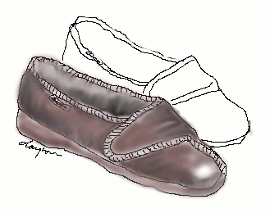
‘I don’t know about the ambulance, says Helen, arching her back and pushing her fists into the small of it. ‘That wasn’t too bad. I reckon we could do it. Couldn’t we, mum? Hey? We could do it.’
But like a doll that closes its eyes as soon as it’s horizontal, Nora is already asleep.
 jim clayton