

John’s stroke has left him with a profound left-sided weakness. That, along with increasing heart failure means that the little mobility he used to have has all but gone. For now and the foreseeable future, he’ll need to be cared for in situ. He’s already on a hospital bed, but his deteriorating condition means he needs to go onto a dynamic mattress to cope with the increased risk of pressure damage. To do that we’ll need to slide him back over onto the old bed that – fortunately – hasn’t been dismantled yet. He’s a large patient, so three of us have been assigned to do the work: me, Margot and Sonya. The delivery driver has rung to say he’ll be there within the hour, so we all meet up outside John’s house to get him over in readiness.
John’s wife Ann lets us in.
‘It’s been absolutely crazy today!’ she says. ‘Non-stop. You don’t mind if I carry on writing out my Christmas cards, do you? I’m so behind with everything…’
She goes off into the kitchen.
John is as cheerful as ever, nodding and smiling and raising his good hand in an affable, vaguely regal kind of way. We involve him as much as we can, checking he’s okay, asking him questions, cracking jokes and so on, but the logistical demands of the move – the limited space, the strategic repositioning of furniture, the climbing on and off the old bed, the best way to use the pat slide and glide sheets – well, it’s easy to forget we’re moving an actual person and not just another piece of furniture. John is stoical about the whole thing, though, surrendering himself to the indignities of the whole thing with good grace.
Once he’s across and comfortable, we take off the redundant mattress and make space for the delivery of the new one.
The delivery driver arrives. A tall, red-faced man, his prominent eyes seem more to do with the stress of the job than anything else. He’s immediately cross no-one told him he’d be expected to take away the redundant mattress.
‘Typical!’ he says. ‘I’m in the little van. Never mind. I’ll see if I can squeeze it in.’
I struggle to imagine a guy of his size in a little van. And with an old mattress stuffed in there, too, his eyes must surely be in danger of popping out completely. But so long as he’s happy to give it a go, I don’t feel inspired to come up with anything else.
We help him set things up. He unwraps the pump and hooks it over the end of the bed, then brings in the new mattress, unzipping it from its enormous holdall and rolling it out on the frame.
‘I expect you’re busy,’ I say, plugging in the pump.
‘Always,’ he says, miserably. ‘Christmas is the worst.’
‘Why’s that, then?’
‘The hospitals want ‘em all out, don’t they? They just want to clear the books.’
He crouches down, straps the mattress into place with a series of aggressive tugs, jiggles it all to make sure, then straightens up again.
‘Right – it’ll take about twenty minutes to inflate. Okay?’
Then tucking the old mattress under his arm, he crashes out through the hall.
Ann appears in his wake.
‘My goodness! Who was that?’ she says. ‘Santa Claus?’
‘No,’ says Sonya, snapping on some fresh gloves. ‘His little helper.’
‘Not so little,’ says Ann.
‘But very helpful.’
‘That’s the main thing.’
‘Ready to move over onto the new mattress, John?’
He smiles lopsidedly, makes an encouraging sound or two, then tentatively raises his hand.
‘I’ll just be in the kitchen,’ says Ann. And leaves us to it.
No-one could argue with the logic. Something had to change.
Even though I’d been working in the Rapid Response team for a year and a half, I still struggled to understand what all the other teams and departments did. What should have been a comprehensive meshing together of services to act as a safety net for community patients sometimes felt like a haphazard net to snag the unwary. Even simple things were difficult, like finding out what number to call, and who to ask for if you made it through the bewildering menu choices. Phone calls, faxes, emails, scrawled messages in the day book – often it felt like finding your way through a blizzard of referrals and re-referrals, passing colleagues in the deluge, everyone with their eyes down, groping for spare capacity, balancing the budgets, moving things along.
The latest idea was to merge a few sections into one large department with one single point of access, one number that would connect you to a dedicated triage team who would then farm out the work according to need. It needed doing. There were already far too many overlaps and duplications; the bulging yellow folders in the patients’ homes were a testament to that. The other hope was that it would encourage mutuality, a sharing of the workload. Once the new team was established, if one section was struggling to cope, the other could more easily step in to help, and vice versa. That was the theory at least, and it balanced out nicely on paper. And when the change came – slowly, heralded by a growing number of meetings, emails with Powerpoint attachments, flowcharts, timetables, managerial edicts flashing and thundering way-off in the managerial highlands – no-one could say it was a bad idea. And then suddenly, after months of talk, we were one team.
Early days, of course, but so far the only noticeable differences has been a busier office. We had always been busy, of course, but now it is more like a loud telesales centre or mainline ticket office, with a constant buzz of people coming and going with folders and pieces of paper, crossing each others’ paths, flying around at full stretch, queues at the copier, hot-desking, not-desking, while the shelves in the kitchen fridge groan under seventeen independently labelled cartons of milk, and a Tupperware of blackening noodles.
As far as work-sharing goes, I’ve had a few extra patients here and there, but nothing too out of the ordinary. Today is different, though. Today is the first time I’ve been abstracted from the rota completely, and sent across town to work at a bedded rehab unit.
‘You’ll just be helping out with obs and bloods and whatever else,’ said Jenny, one of the clinical leads. ‘I’ve told them to expect you.’
At least I know where it is. I’ve visited Bevan House in the past, when I worked as an EMT in the ambulance service. A brisk, self-contained place, tucked away on a tributary arm of a Brutalist housing estate on the edge of town, Bevan House is a busy unit of some twenty beds, four beds per section, each section divided by colour-coded walls and flowery canvas pictures back-lit on the walls. Patients are transferred here from the main hospital to prepare them with physiotherapy and so on prior to their release back into the wild. It’s underfunded, of course, another pinch-point in the whole discharge process, but there’s not much to be gained by thinking about that too much. Whilst Austerity beats on with its relentless mantra of More for Less, there’s no time or room down in the galley to do anything other than row.
It’s still early. The automatic door hasn’t been switched on yet, but I can see a woman behind the desk in reception, hanging her coat up. I knock on the door and wave. She hesitates a moment, then presses a button and lets me in.
‘Morning!’ I say, striding forwards with my rucksack on my shoulder. ‘I’m Jim, from the Rapid Response Team. They’ve sent me over to help out.’
‘Oh?’ she says, her eyes drifting down to look at my badge. ‘I’d better get Bee.’
She hurries out from behind the desk and disappears down a corridor.
It’s utterly quiet.
A ginger cat is staring at me from under the branches of the lobby Christmas tree.
‘Hello there!’ I say, crouching down, making kissy-kissy noises and holding out my hand. The cat thinks about it for a second or two, then sprints away in the same direction as the Receptionist. I watch as it skitters in a panic across the laminate flooring and skates round the corner.
It’s like he’s gone to fetch help, because almost immediately the Receptionist appears again, this time with a nurse.
‘Hello! I’m Jim, from the Rapid Response team,’ I say, straightening up.
Bee shakes my hand.
‘Who sent you?’
‘Jenny. She said you might need some help.’
‘Well we always need help’, she says, but from her expression I can tell that Jenny hasn’t phoned ahead.
‘Come into my office and I’ll tell you how it all works,’ she says.
I pick up my bag to follow.
‘I’ve met the cat already,’ I tell her.
‘Brandy? He’s not our cat.’
‘Oh.’
Bee is a small, pinched woman, compacted by experience. Even her name is clipped to save time.
I follow her into her office, a closet-sized space with just enough room for two chairs, a desk, computer and shelf upon shelf of files.
‘Here’s the list,’ she says, sweeping a space clear on the desk and laying out a piece of paper. ‘It’s very simple. I’ll mark the ones you can visit today. These are on the ground floor, these are upstairs. You’ll need the blue folder for each patient. You’ll either find them in the kitchen or common room on each floor, or failing that, on the trolley in the office. Or on reception. Give me a ring if you have any trouble. Here’s my number…’
She explains about the blue folder, and what to write in the notes.
‘Good luck. It’s all pretty straightforward,’ she says. ‘There are plenty of people about to ask if you get in a jam.’
*
A change of routine is certainly energising. Even though I’m doing much the same as I do out in the community, here in Bevan House everything is brand new – the protocols, the people. I have to explain who I am and what I’ve come to do half a dozen times. It gets so slick even I don’t believe it. Added to my unease is a feeling that however neutral I try to be I might inadvertently be stepping on someone’s toes. The whole thing has that First Day level of stress, and I’m glad to find when I check my watch that’s almost lunch.
My final patient of the morning is an elderly man called Jack. I knock on his door, and when he calls hello? I go in.
I shake his hand.
‘We’ve met before,’ I tell him.
‘Have we?’ he says. Then ‘Yes! I think we have!’
I remember him lying on a single bed in a box room, a dressing on his leg, a row of perfectly constructed Airfix planes on a shelf above his head.
‘How are you, Jack?’ I say to him.
‘Shoot me now,’ he says, turning to lie fully on his back, so he can get a good look. ‘Anyway, what are you doing over here? Changed jobs?’
‘I’m just helping out. They were a bit short-handed.’
‘Well they are busy,’ he says. ‘But I shouldn’t moan. They’ve been absolutely wonderful.’
It’s good to see a familiar face. We chat about things whilst I run the obs and write the notes. He tells me how long he’s been in Bevan House, and when he hopes to get home.
‘If I make it,’ he says with a sniff. ‘You never know, d’you?’
‘Didn’t you have a load of Airfix planes?’ I ask him. ‘And you were a mechanic in the RAF or something?’
‘That’s right!’ he says. ‘I was. Oh – them model planes, they was just a bit of a laugh. They kept me out of mischief. It’s silly really, but whilst I was putting them together, they helped me remember what the real things were like.’ He thinks about it a moment, then smiles. ‘Bigger, for the most part,’ he says.
I finish the exam, shoulder my bag and shake his hand again.
‘Good to see you, Jack. Hope you feel better soon.’
‘Have bag will travel,’ he says, nodding at the rucksack.
‘Yep. That’s me. The Dick Whittington of the health service. All I need is a cat.’
‘I think there’s one downstairs.’
‘I know. He scarpered as soon as he saw me.’
‘He’ll be back,’ says Jack, relaxing back into the pillow and pulling the duvet snug about his neck. ‘He knows a good number when he sees it.’
I trip the alarm as soon as I open the door. The call box on the table just inside beeps and squawks, and then a voice booms out:
Hello? Mrs Castle? Is everything all right?
– Yes. Hello. Sorry. It’s Jim, from the Rapid Response Team. I’ve come to see Mrs Castle for a health review.
Oh. Hello, Jim. That’s fine, then. Is everything okay there this morning?
(I can see Mrs Castle, lying facing me on the bed, hugging a pillow. She’s smiling dreamily, raising her head from the pillow, ready to get up)
– I’ve only just got here, but she seems okay.
Great. I’ll close the call then. Have a good morning.
– You, too. Bye.
The box beeps and whines again for a second, and then the red light goes out.
I shut the door behind me and go further in.
‘Hello! Good morning, Mrs Castle! I’m Jim, from the Rapid Response Team at the hospital. I’ve come to see how you are today.’
She sits up and puts the pillow aside.
‘What’s the weather like?’ she says.
‘A bit misty and murky,’ I tell her. ‘At least it’s not cold, though.’
‘No.’
‘Shall I make you a cup of tea?’
‘That’d be nice.’
‘Sugar?’
‘Half a spoon.’
‘Won’t be a mo.’
I go through to the lounge, put my bag down and then on into the kitchenette to make some tea. There are laminated signs stuck to various doors and objects. Don’t put anything under here on the grill; The carers are doing your meals on the microwave (turned off at the plug with a note over that, too); Don’t go outside on the patio doors.
Whilst the kettle’s boiling I go back into the bedroom to help Mrs Castle into her dressing gown. She holds both my hands as we walk together into the lounge, where I settle her into her favourite chair.
‘What’s the weather like?’ she says.
‘Not so nice today. A bit dreary. Not like yesterday, with all that sunshine. Maybe it’ll perk up later, though.’
‘Let’s hope so,’ she says.
‘I’ll get you that tea.’
‘Tea? Oh you are good. Half a sugar.’
‘Right.’
Once she’s settled with her tea I start getting ready for the examination, setting out all the forms I’ll need, writing her name and date of birth on the top, the time of the visit and so on.
‘Where were you born?’ she says.
‘London.’
‘Whereabouts?’
‘Pimlico. Just off the Vauxhall Bridge road.’
‘Really?’
‘What about you?’
‘Camberwell,’ she says.
‘I’ve only been there once,’ I tell her. ‘I can’t remember much about it. Seemed like a nice place, though.’
‘It was a nice place’
‘Did you work there?’
‘I was a machinist.’
‘Making what?’
She laughs.
‘Now you’re asking!’ She takes a sip of tea. When she puts the cup back on the saucer she says: ‘What’s the weather like?’
‘I’ll show you – look.’
I draw back the curtains. The earlier, heavier fog has lifted into something thinner and more vaporous. I watch the commuter traffic nudging in one unbroken line along the coast road, from the gently irradiated banks of cloud to the east, to the darker outlines of the city to the west.
‘A duvet day, if ever there was one,’ I say, going back to my chair.
‘Oh dear!’ says Mrs Castle, taking another sip of tea.
‘Shall I get the examination over with? It’ll only take five minutes. And then I can make you a nice big bowl of porridge.’
‘Right you are.’
‘Great!’
I take her pulse, SATS reading, count her resps.
‘What’s the weather like?’ she says.
‘Not too bad. I’ve seen worse.’
‘Where were you born?’
‘London. Pimlico. Behind the Tate.’
‘Were you? I was born in Camberwell.’
I suddenly remember that one of the guys I used to play softball with lived in Camberwell. He bought a tiny flat in the basement of an old fever hospital there. It used to be the mortuary, he told me, running his hand appreciatively along the curved walls.
‘Nice place, Camberwell,’ I tell her. ‘I like London. It’s just so expensive these days. My eldest sister’s still there, though. In Ladbroke Grove. You know. To the West.’
I put the blood pressure cuff round her arm.
‘What’s the weather like?’ she says.
‘Not great,’ I tell her. ‘Still making up its mind.’
‘Is it? Well I wish it’d hurry up!’ she says.
‘Your blood pressure’s fine,’ I say, taking off the cuff and rolling it up. ‘You’re fitter than I am.’
‘You look all right to me,’ she says.
‘Thanks!’
‘You’re welcome.’
‘I’ll see to that porridge.’
There are sachets of instant porridge in a cupboard marked Let the carers do this for you. There’ll be here soon. It’s quite fiddly, tearing off the top of the sachet, emptying the oats into a bowl, filling the sachet to the dotted line with milk and then pouring it into the bowl without spilling it everywhere. When it’s finished the two minutes, I have to add more milk to thin it out, stirring carefully because the bowl is actually just a little too shallow. Once it’s just right, I take it through and set it up at the table, putting out a clean spoon, and a square of kitchen roll folded into a triangle.
‘There you go!’ I say. ‘Breakfast is served. I can make you some toast as well if you like.’
I help her out of the chair and over to the table.
‘Lovely!’ she says.
I sit opposite, writing out my notes as she eats.
After a couple of mouthfuls she gently rests the spoon on the edge of the bowl, places her hands in her lap, and sits back in the chair.
‘All right?’ I say. ‘Not too hot?’
‘Just right!’ she says.
‘You’re welcome, Goldilocks!’
She smiles at me, the light in her eyes as delicate and evanescent as the mist passing by the window. Then she gives herself a little shake, and picks up the spoon again.
‘What’s the weather like?’ she says.
What with the thick fog and the hectic, five o’clock traffic, if I didn’t already know where The Hermitage was – in the centre of a village on the outskirts of town – I wouldn’t have the faintest hope of getting there. As it is, once I’ve made it to the village and negotiated the one-way system to a reasonable walking distance from the place, it takes a heroic and faintly suicidal effort to park, holding up the traffic with my warning lights, doing everything but smearing butter on the bonnet and boot to fit the car into this last, tiny space. It’s all pretty stressful. But when I struggle out of the car with my bags, I find that just opposite, on the village green beside the pond, there’s a floodlit war memorial, and the effect in all the fog is so eerie – a ghostly cross hovering on a bank of luminous orange mist – I’m immediately soothed.
The Hermitage is a lovely place, summer or winter, an old nunnery or something, converted a few years back into a dozen self-contained flatlets. At the heart of it all is an oak-panelled dining room with an enormous, tiled fireplace, hunting trophies and old paintings, and a sequence of elegant patio windows overlooking the garden. Running the place, along with the cook and the gardener, the teams of carers coming in and out, the cleaner, and the old guy staggering around with a battered bag of tools, is Shirley, the Hermitage manager. Shirley’s nominally on site during office hours only, but it always seems to be Shirley who comes to the door whenever you ring, bustling along the corridor, attentive as a gigantic species of mole, packet of tissues in one pocket, torch in the other, radio wobbling precariously on her hip.
‘I’ve come to see Mrs Wakelin, to do her blood pressure and whatnot. Take some blood.’
‘Good luck with that!’ says Shirley, throwing the door wide. ‘Come on in. I’ll show you there.’
I follow her down the corridor. The walls are so smooth, the ceiling so rounded and low, it’s easy to imagine Shirley has fashioned them herself with all her comings and goings.
After a bewildering number of turns and double-tucks, until I’m certain we’ll simply find ourselves back out in the lobby again, she stops outside a door and straightening her uniform, gives a couple of short knocks.
‘Mrs Wakelin?’ she sings. ‘Only me. You have a visitor.’ And then leaning in, she presses her ear to the door. After a moment, even though I don’t hear anything, she straightens up again, turns the handle and pushes open the door.
‘Buzz if you need me,’ she says, standing aside to let me through. And then with one last smile, so super-friendly it fills her face completely and forces her eyes shut, she backs away, and leaves me to it.
Although it’s apparent that extreme old age and years of breathing problems have had a cruelly withering effect, still it’s also clear from the portrait of the young woman on the wall behind her that Mrs Wakelin has always been on the aquiline side of thin.
‘And what do you want?’ she says, turning to look at me with one smoothly direct movement of her head, and one, slow blink.
I introduce myself, and show her my ID.
‘Who sent you?’ she says.
‘Your GP. I think because of your recent hospital admission she’d like us to see you over the next few days. To make sure you’re recovering well and don’t – you know – slide back.’
‘Slide back? What on earth do you mean, slide back?’
‘Get any worse.’
‘No,’ she says. ‘Quite. So what will this involve? You haven’t told me exactly what it is it you intend to do.’
I tell her about the basic obs, the blood pressure and temperature and heart rate. The blood test.’
‘And what if I decide I don’t wish to donate any blood?’
‘You don’t have to, Mrs Wakelin. But it’s the best way of seeing that we’re keeping on top of the infection, checking your kidneys are working properly and so on.’
‘Hmm,’ she says. ‘Well if the doctor says it’s got to be done, I suppose it’s jolly well got to be done.’
‘Great.’
I chat to her whilst I set out my things and get ready.
‘It’s quite a journey out here,’ I tell her. ‘Especially in all this fog.’
‘Nonsense!’ she says. ‘When we lived in Africa we’d drive four hundred miles for a picnic.’
‘She’s just in the bathroom but she’ll be out in a minute. Please – take a seat.’
Gillian shows me through to the living room, then goes to check up on her sister.
The living room is a warm, well-appointed place, the entire length of one wall given over to books of every kind; on the wall opposite, a decadently carved, antique rococo mirror. A lemon tree is growing in a large, ceramic pot in the bay window, thriving in the lush afternoon sunshine, its foliage partially obscuring a crouching statue. At first I think it’s a reclaimed gargoyle, but the clothing of the creature is odd, too modern – something like a bell hop, with a pill-box hat and braided jacket. And then I realise what it is: a flying monkey from The Wizard of Oz.
‘She’s just coming,’ says Gillian, suddenly appearing in the doorway. ‘You know the story, I suppose?’
‘I think so. Discharged from hospital yesterday, another fall this morning, struggling a little…’
‘I meant about the drinking.’
‘There was some mention of that.’
‘Maxine has an alcohol problem. Has done for a while. I think because she was in hospital overnight without access to any, she simply had to have something as soon as I picked her up.’
‘How much, roughly?’
‘Most of the bottle.’
‘Wine or spirits?’
‘Vodka. The detox programme is supposed to start in a day or two. But she can’t just stop, you see. She gets these terrible shakes and hallucinations.’
‘It must be hard.’
‘It’s been devastating. Completely devastating. She certainly can’t teach anymore.’
‘What did she teach?’
‘Religious education.’
The door opens and Maxine comes through.
‘Sorry about that!’ she says, rubbing her hands. She looks dreadful: a middle-aged woman preternaturally aged, stooped and sallow, with a haunted, hunted look. She takes up a seat at the far end of the sofa, and takes a sip from the Evian bottle Gillian hands her.
‘I was just telling Jim about the drinking,’ says Gillian.
‘Oh?’ says Maxine. She smiles, then raises the bottle . ‘Don’t worry,’ she says, screwing on the cap. ‘It’s water.’
Sandra has an appointment at the dentist later that day.
‘My plate came out in the salad,’ she says, holding out her arm, bunching up the sleeve.
‘You wouldn’t think salad would do it.’
‘Yeah, but the rolls were stale. Anyway, it’s all very annoying. I hate going to the dentist.’
‘Me too. It’s a throwback to when I was a kid. I think they were all a bit drill-happy in the seventies. They used to pull you in for a filling if they heard you whistle in the street.’
‘And that mask! In my head it’s like this disgusting rubber shell coming down from the sky and covering my face.’
‘At least they’re better now. It’s a lot less painful than it used to be.’
She nods, and watches me draw her blood.
‘It’s a shame you’ve got to go all that way,’ I tell her. ‘But then – you couldn’t really have a travelling dentist, could you? A covered wagon rolling down the street. I read somewhere they used to have fairground dentists who conned people into thinking they’d cured their toothache by pulling out a worm.’
‘Really?’
‘I think so.’
‘Well I wouldn’t like that.’
I put a square of gauze on the puncture site, release the tourniquet, withdraw the needle.
‘All done!’ I tell her, dropping it in the yellow sharps box. ‘Just keep your finger on there a minute.’
‘Bloody dentists,’ she says.
‘Have you got anyone to go with you?’
‘Nope. Jean’ll go most places, but not the dentist. She came with me on the London Eye the other week.’
‘Oh? How was that?’
‘It was okay. For a while. I mean – I’m terrified of heights, but it was all so slow and easy, it didn’t really feel like anything. And the view was pretty spectacular. But then Jean taps me on the shoulder and she says Sandra! Look down there! Look how high up we are! And as soon as I did I completely froze, and spent the rest of the trip clinging on to the rail with my eyes shut. When we made it back down again they had to prise me off with a broom handle.’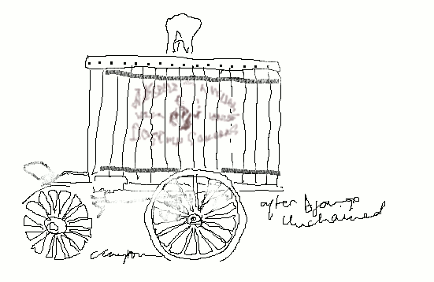
‘So – how did you come to fall?’
‘I was going in to mindfulness class when I tripped on the step.’
Myrna is an engaging patient. Seventy-three going on seventeen, hair silvery blue and woven in plaits; tie-dye dress, yellow and black stockings, moccasins. Above her, hanging from the paper moon lampshade, a dream-catcher.
A large, tortoisehell-and-white cat struts in through the living room door into the middle of the carpet, its tail straight up, just the very tip of it flexing languorously left and right and left again.
‘Pippin!’ says Myrna, holding out her hands. ‘Where’ve you been, you naughty boy?’
Pippin wanders towards me for a closer inspection, cautiously sniffing the hem of my trousers.
‘Extraordinary!’ says Myrna, clasping her hands together. ‘He’s never done that before.’
‘We’ve got a cat,’ I say.
‘I don’t know,’ says Myrna. ‘I don’t know. He’s a rescue. He’s had bad experiences. There’s something else…’
Now that Pippin has our full attention he decides to put on a display. He walks round and round on the carpet between us, eventually collapsing to one side. Then he arches his back and stretches his legs, almost doubling in size. After holding that position for a moment or two, his ears go back, his eyes darken, and he suddenly starts clawing the carpet, hauling himself in a mad circle, which ends up with one back leg in the air and his nose stuffed under his tail to give himself a clean.
‘We’re making such progress!’ says Myrna.
Around her on the sofa are piles of red wool and a stack of knitted red squares. Myrna reaches over and picks one up.
‘Cat jackets,’ she says, giving it a gentle shake. ‘You know – jackets, for cats. When the weather’s bad.’
‘They’re lovely.’
‘I donate them to an animal welfare shop. I used to work there, but the stories upset me too much and I had to come away. I like to doing what I can, though.’
She holds the half-finished jacket up.
‘I might trim it with a little fur, to make it more Christmassy. Mind you, I don’t really celebrate Christmas. When you think of all those turkeys and what they do to them. It just makes you… it makes you…’
She looks tearful. But then Pippin jumps up beside her.
‘Pippin!’ she says, putting her knitting down again and leaning forwards so they can rub heads. ‘What a truly magical little cat you are!’
There’s an ancient, framed tapestry above the fireplace: white camellias in bloom. I’m sure Mae’s grandmother was a babe in arms when the last thread was tied and the tapestry hung on display; now, Mae is ninety-three, bowed with scoliosis, and the camellias have faded almost to nothing behind the glass.
Beneath the tapestry are two black and white photographs: Mae as a young woman – three-quarter profile, looking stage left with a Margaret Lockwood wistfulness; and opposite, a young airman, leaning in, laughing, a pipe in his hand.
‘Mae used to be an actress,’ says Leonora, the carer.
‘Wow!’
Mae grunts.
‘What was your favourite role?’ I ask her, bunching up her dressing gown to make room for the blood pressure cuff.
‘I was glad when anything came my way,’ she says. ‘Look – are you sure this is absolutely necessary?’
‘I won’t do it if you really don’t want me to, Mae, but the doctor said to keep an eye on you. Especially after all these falls you’ve been having.’
‘Oh, very well…’
The Velcro of the cuff gets snagged on the fluff of her dressing gown, which doesn’t improve her mood.
‘So you were an actress? How wonderful!’ I say, pressing on. ‘What did you prefer? Tragedy? Comedy? Musicals?’
‘It’s all the same.’
‘I suppose so.’
‘Do you?’
‘Well I don’t really know.’
‘Don’t you? Hmm.’
Her observations are quite good, considering her age and health. There are several trip hazards in the flat, but Mae doesn’t want any alterations that might make it safer for her to get about. When she’s eventually persuaded to try a zimmer frame, she ignores my instructions on how to use it, swinging it about instead, wilfully demonstrating how it will get caught in various cables and table legs, insisting on carrying-on with her old kitchen trolley. (As soon as Leonora saw the frame in the hallway she told me there was no way on earth Mae would use it. She raises her eyebrows when I look at her, but doesn’t say anything.)
I help Mae back into her chair and start writing out my notes.
Leonora goes into the kitchen to get started on lunch.
‘Were you born here?’ I ask Mae.
‘No.’
‘London? Further north?’
‘Moscow.’
‘Moscow? How come?’
‘My father was in the diplomatic service.’
‘How interesting!’
She shakes her head, and starts fussing with the sleeves of her dressing gown.
‘And how old were you when you came back to England?’
‘I was three years old.’
‘I’d love to go to Russia,’ I tell her, leaning forwards on the folder a moment. ‘It’s such an interesting place.’
‘It isn’t!’ she says. ‘It’s monstrous! I’d never go back.’
I want to ask her more about it. She surely can’t have any direct memories of Russia if she was just three when they left; her reaction must be more to do with something that happened to the family. Given her age, I wouldn’t mind betting it was the Revolution. But now Leonora is coming into the lounge with Mae’s lunch, and there isn’t time to ask anything else.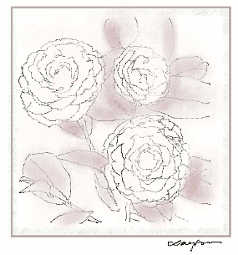
‘I’ll be off then,’ I say, closing the folder and gathering my stuff together.
Mae is already tearing in to a quiche.
‘It’s been lovely to meet you, Mae.’
She dismisses me with a wave of her fork. A glob of quiche flies off and lands on the carpet.
Leonora goes to fetch some kitchen towel.
I thank her for her help, and see myself out.
I knock first, then let myself in to Olive’s flat using the key from the key safe. She’s in the galley kitchen off to the left, her slippered feet just visible below the edge of the cupboard she’s rummaging through. I know from her notes that she’s deaf and suffers from dementia, and I’m worried that my sudden appearance when she closes the cupboard door will give her such a jump-scare she’ll have a heart attack. But there’s no easy way of making my presence known. As gently but as clearly as I can I call through to her. She closes the cupboard and stands there, sniffing the air rather than seeing me directly.
‘Make us some toast,’ she says.
‘Of course. Shall I help you back to your seat first?’
‘And some tea,’ she says, reaching for my hands. ‘Two sweeteners.’
Her mobility is terrible, and her chest sounds as rough as a tractor left in a barn for years and then dragged out and cranked.
On the way through to the living room, she seems to come alive, though, squeezing my hands, shuffling her slippers and singing Dah dee dee daaah! But then the coughing overtakes her again and she has to stop.
It takes an age to get her safely back to her armchair. When eventually she’s settled and I’ve figured out how to turn the TV on, I go back into the kitchen to make breakfast. It’s a dismal scene. Sometime around nineteen fifty these kitchen units probably featured in a glossy spread; now, the only colour is a yellowing patina of sticky ghastliness on every surface,. The fridge is so filthy it would make more sense to cast it in concrete for a thousand years rather than open it and look for butter. But at least the toaster works. Whilst I wait for it to pop up, I notice a small, black and white photo propped up against an ancient biscuit tin. It’s Olive, sometime in the late thirties, I would guess, tightly buttoned in a WRAF uniform, her eyebrows plucked and pencilled, her lipstick just-so, her hair expertly gathered in a bunch.
I make her some jam toast, a cup of tea in a delicately patterned but horribly stained china cup, and carry it all through.
‘Lovely!’ she says, tucking in.
It doesn’t take much of an examination to discover that Olive is very unwell. The chest infection she’s had for a few weeks hasn’t responded to the antibiotics, and it looks like she’s sliding into sepsis. I try to explain to her that she needs to go to hospital, but between the deafness and the dementia there’s little hope of making her understand. She finishes breakfast and immediately falls asleep. I phone for an ambulance. The call taker tells me there are long delays, but says a crew will be with us as soon as they can. Meanwhile, I find a carrier bag and gather her medications ready to go, along with any notes the crew might need. Once that’s done, I phone Olive’s daughter to let her know what’s happening. She sounds as decrepit as Olive – which is probably the case. Olive is ninety-eight; her daughter must be in her seventies. She says she’ll rendezvous with the ambulance at the hospital, seeing as it’s that side of town.
With everything done that needs to be done, I settle down to wait.
Olive doesn’t so much wake up as slowly unfold. She raises her chin, puts her hands right and left on the armrests of the chair, and gradually opens her eyes.
‘Five years he’s been gone,’ she says, mournfully carrying on a conversation I wasn’t part of. ‘But I haven’t been with nobody else. We were married seventy years. He was a lovely man. I can’t believe he was took like that. I don’t believe in God no more. Not if he goes and does things like that.’
‘It must have been hard for you.’
She doesn’t seem to hear me, exactly, but orientates herself in my direction like a sea anemone sensing a change in the murky waters around her. She mumbles a few words.
‘What’s that, Olive?’
She waggles a hand in the air, like she wants me to come closer.
I go over and lean in.
‘What did you say, Olive…?’
Suddenly she reaches up with both hands, grabs me by the shoulders, tugs me towards her and kisses me on the cheek.
‘Hey!’
She laughs as I straighten, so wickedly the whole of her face seems to collapse in on itself. But then she coughs, and feels the pain of it deep in the right side of her chest.
‘Ooh – rub my back a little, rub my back,’ she says, leaning forwards. I wonder if it’s another trick, but I do it anyway. ‘Is that better?’
But she doesn’t answer.
She’s already asleep.
 jim clayton