dog’s trust

Harry’s daughter Rachel opens the door with her father’s Yorkshire terrier Sammy tucked under her arm.
‘Are you all right with dogs?’ she says, Sammy squirming so violently she’s forced to set him down.
‘Absolutely!’
It’s immaterial whether I am or I’m not. Sammy has already launched himself nose-first into my trousers, huffing and sneezing. He’s so emphatic about the whole thing I wouldn’t be surprised if he threw me against the wall and started patting me down.
‘Have you got a dog?’ says Rachel.
‘Not on me.’
‘What sort of dog?’
‘A lurcher.’
‘Lovely!’ she says. ‘Come in!’
Sammy trots shotgun down the hallway as Rachel shows me into the living room and quietly shuts the door.
‘I need to let you know the situation,’ she says. ‘Have a seat.’
I put my bags down, take off my coat, and by the time I’ve turned round to sit down on the sofa. Sammy’s already there, bolt upright, watching me closely. Rachel settles down in an armchair to tell me about her father.
‘He’s terrified of hospitals. Well – doctors, nurses, anyone clinical, actually. When he got stuck in the bath the other day he absolutely would not let us call the paramedics. We had a hell of a job to get him out. Luckily the gas man came to read the meter and we roped him in. It was like one of those Carry On movies. Carry On Being a Stubborn Old Bastard.’
‘So when was the last time Harry was seen by a doctor?’
‘This morning.’
‘Oh! Okay. That’s good, then.’
‘Hmm. It was all a bit of a deal. He wouldn’t let him do anything. Certainly wouldn’t let him look at his leg, which is the main issue. I know the doctor wanted him admitted there and then, but he got so upset the doctor had to go. We’re all so worried about him. He won’t agree to anything. None of us live local. We just can’t cope.’
‘Why’s he so scared of hospitals?’
‘He had a bad experience. He had this infection in his leg and the doctor was late picking it up. Not this doctor. Another one. From that surgery that closed. By the time he went in it was gangrenous and he lost a few toes. Ever since then he’s not wanted anything to do with anyone.’
‘Do you think he’s got an infection now?’
‘I’m sure of it. I just don’t know if he’ll let you in the bedroom, let alone lift the covers.’
‘I can have a go. The doctor’s asked me to come and take some urgent bloods.’
‘Good luck with that. But hey – I’ll go on up and smooth the way, and see if he’ll agree to see you.’
‘Thanks.’
‘Wait here a minute.’
She goes upstairs, leaving the sitting room door open. Meanwhile, Sammy adjusts his position on the sofa next to me, squaring up a little, pre-empting any move on my part to reach out for my bag or do anything suspicious.
I can hear Rachel talking to her dad.
There’s a nice man from the hospital come to take some blood, pops.
– I don’t want to see him.
He’s got a dog. A lurcher.
– A lurcher?
Yeah.
– I didn’t hear Sammy barking.
No! So that’s a good, isn’t it? Shall I bring him up?
– All right. But I’m not going to hospital.
Sammy flicks a look over his shoulder as Rachel comes back into the room, then continues to scrutinise my intentions.
‘He’ll see you now,’ she says.
‘Great.’
Sammy leaps off the sofa as I stand up, then spins round and round on the rug.
‘This way!’ says Rachel.
Sammy bounds on ahead of us.

*

By the time I make it up into the little attic room, Sammy’s already up on the bed, his paws spread, his shoulders set, just the other side of the Harry-shaped lump in the duvet.
The room is insulated by shelf upon shelf of books, except for a space on the wall above the bed for an oil painting of a sailing ship battling through heavy seas. The light from the window opposite, set at an angle, illuminates both the bed and the painting so softly and so directly it’s like I’m walking into a painting myself: The sick man and his dog.
‘Hello Harry,’ I say, quietly setting my bag down. ‘How are you feeling today?’
‘How am I feeling? Not good.’
‘Sorry to hear that.’
‘Jim’s come to take some blood,’ says Rachel, taking hold of the rails at the foot of the bed. ‘And maybe take a look at your leg.’
‘No thank you,’ says Harry, pulling the duvet over his head.
Sammy stares at me to see what I’ll do next.
‘Well. You don’t have to do anything you don’t want to,’  I say. ‘It’s always good to hold onto that, even when you’ve got people like me marching in and out with official looking folders and stuff. But at the same time I think it’s really important you understand what it is you’re refusing to do – you know, what the consequences might be. Rachel told me about your bad experience at the hospital a few years back, and I’m sorry to hear about that. That’s why I think it’s even more important we make sure nothing like that happens again, and you get the treatment you need nice and quickly. Because of course, if you do have an infection, the sooner you act the better it’ll be. You know what Rachel wants you to do. And Sammy.’
Harry groans, but pulls the duvet away from his face a little and peeks out. He doesn’t look well, a sallow puffiness to his face, chapped and peeling lips, and when he puts an arm outside the covers, I can see a generalised, pruritic rash.
‘How about I do something easy first, like your temperature?’ I say, slowly unzipping my bag.
Sammy straightens.
Rachel holds onto the rails even tighter.
‘Oh for God’s sake, go on, then,’ says Harry, and closes his eyes.
the thirty-niners

There’s an ambulance parked outside Mr Fenway’s house and I can’t help thinking it’s for him. I’m just taking my stuff out of the car when one of the paramedics comes out to put the ramp down and fetch a carry chair. It’s Stan, an old colleague of mine I haven’t seen in a while.
‘I thought you might’ve been called to Mr Fenway,’ I tell him, pumping his hand and slapping his shoulder. ‘It’s really nice to see you!’
‘Nah. You’re all right there, Jim,’ he says. ‘How’re you keeping, mate?’
It’s great to catch up, swapping gossip in that intense way you do when you see someone after a long gap and immediately want to know everything.
‘’Course, I’m retiring at the end of the month,’ he says, folding his arms and rocking back on his heels.
‘No!’
‘Waaalll – the job’s changed, Jim,’ he says, sliding into that doom-laden, front-line voice I know so well. It’s surprising what you miss.
‘It’s not what it was. You see – the problem is – what happens is – you get a management team come in with a certain point of view, and of course, it stands to reason! It’s only human nature! They’re only going to hire people who support that point of view. So nothing gets challenged, mistakes get made, and everything tips along very nicely thank you, until something happens and they all get cleared out. And then the next lot comes in – slightly different point of view, slightly different set of slides on the old laptop – and the whole thing starts again.’ He shakes his head at the madness of it all. ‘The only reason I stuck it as long as I did was the patients, Jim. You know where you are with the patients. They make the job. You just have to keep your head down the rest of the time and not draw attention to yourself.’
‘How long have you been in the ambulance, Stan?’
‘Thirty-nine years,’ he says. ‘I would’ve seen forty, but another year would’ve killed me.’
‘It’s great to see you again. And if I don’t see you before – happy retirement!’
I shake his hand and ask him to send my love to Jane, the paramedic he’s working with today.
‘See you around,’ I say, as he heads back into the house with a carry chair and a rolled blanket.
‘Righto!’ he says, raising his free hand and bowing his head, like he’s making a pledge.
I go next door to see to my patient.

Mr Fenway is sitting in an armchair by the front window, his long, thin legs stretched out in front of him, his arms on the arm rests, his pale skin almost translucent in the warm afternoon sunshine. Mrs Fenway watches him from the opposite chair, as rapt as a disciple witnessing The Transfiguration.
Mr Fenway finished his treatment for cancer some months ago, but he suffered a bad fall recently, and the trauma of it all has set him back. We chat about different things as I tap around for a serviceable vein – how they met, where they lived, what they did.
‘This is a lovely spot,’ I tell them.
‘What – the vein?’
‘No – although this’ll do fine, I think. No – I mean the house. How long have you lived here?’
‘How long is it, June?’ he says, turning his head slowly to the side.
‘Ooh – I should think about thirty-nine years,’ she says.
‘Thirty-nine? That’s funny! I just met an old ambulance colleague of mine outside. He says he’s retiring after thirty-nine years!’
‘Can’t he see forty?’
‘He says that last year would finish him off.’
‘I don’t doubt it,’ says Mr Fenway, slowly bringing across a finger to press on the square of gauze I’ve put in the crook of his arm. ‘I don’t doubt it for a minute.’

kindle pitch

Mr Francombe’s hair is sticking up so outrageously it’s like he’s spent the night hanging from a rail.
‘It often goes like that,’ he says, licking his palm and attempting to paw it back into place. ‘That’s what happens when you get old, you see. Your hair takes over. Amongst other things.’
No-one could say that Mr Francombe hasn’t embraced technology. Apart from his TV and radio, he has a laptop on his over-chair table, a mobile phone, and a Kindle, in a smart, red fabric case with elastic strap.
‘What are you reading on the Kindle at the moment?’
‘Oh, nothing much,’ he says, giving it a shake. ‘We-ell, I downloaded a couple of things the other day. There’s this one about a guy who runs a small island, like one of them criminal masterminds, you know? And this family’s sent there to basically kill him and everything, but then they’re captured, and they have to try and escape. And then there’s this other one about this guy that’s had this implant in his brain, so he becomes like a plaything in a rich man’s game, hunted all over the island, like – you know? – like an animal or something? And he has to figure out what he’s going to do, and how he’s going to escape.’
‘Same island?’
‘Different island. And then there’s this other one, a bit more life-like, where this young kid from Carlisle has to move south to look for work, and then this terrible thing happens. Which is why I thought I’d download it. ‘Cos that’s where I’m from. Carlisle.’
I want to ask him about the terrible thing, but instead, to make conversation, whilst I’m packing my stuff away, something else occurs to me to say instead.
‘Imagine how freaky it’d be if you downloaded a book on Kindle,’ I tell him,’…completely at random, because you liked the cover or there was just something about it. And then you found out it was exactly your life, the things you said, the clothes you wore, everything. Where you lived, the whole bit. You’d be scared to carry on reading it, because you’d worry what it might tell you about the future.’
He studies me quietly a moment.
‘Nah!’ he says. ‘I don’t think I’d download that one.’

brains

Malcolm has Alzheimer’s. To add to his problems, he suffered a bout of gastro-enteritis last week, had a fall, fractured a rib, and is laid-up on the sofa. Still, his wife Carol is taking good care of him. She’s helped him dress this morning – check shirt buttoned at the cuff, cable knit jumper, combed white hair – and he lies on the sofa, dozing, hugging himself like a child caught in a dream.
A tall, generously proportioned woman in her seventies, the seams of Carol’s coral-pink sweater strain to keep her in. She was about to vacuum the apartment when I arrived. She stands there with it resting against her side – an intimidating machine, straight out of the 80s, as big as a floor sander, with a headlight on the foot for running down the dirt.
‘I won’t start just yet,’ she says, dragging it over to set against the wall. ‘It’s a bit noisy.’
She comes to sit down in an armchair opposite Malcolm whilst I carry out my examination. She still has the plug in her hand, though. She turns it round and round, unconsciously exploring the prongs, the edges, the plug-ness of it.
‘He used to be so mobile a couple of weeks back,’ she says. ‘We’d go for a walk round the park every day, trips to the cafe.’
After a while she says:
‘Carol ordered the bed sides, but they still haven’t come.’
‘Sorry – who ordered the bed sides?’
‘I did.’
You did?’
‘Me? Yes.’
‘And you’re Carol?’
‘Yes. I’m Carol.’
‘Sorry. I’m terrible with names.’
But I’m confused. Was she referring to herself in the third person? Did she mean to say someone else but used her own name instead? Are there two Carols? I’m on the verge of asking, but duck out as I can’t think of a tactful way to do it. She saves my confusion with another question.
‘Can Alzheimer’s progress that rapidly?’ she says.
‘I don’t know. I thought Alzheimer’s was pretty gradual. It’s probably a good sign Malcolm was out and about walking just the other week. I think the tummy bug and the fall have set him back, but that’s just a guess. His obs are good, though. I’ll take some blood, see what they show, and then liaise with the GP.’
Taking blood from Malcolm is about as easy as it could possibly be. I roll up his sleeve, his veins are defined, and when I introduce the needle he’s as indifferent as if I’d punctured one of the cushions instead. I draw off a couple of tubes, and tape a square of gauze to the wound.
‘Look!’ says Carol, suddenly waving at the patio window behind me. ‘There’s Brains!’
I turn round. Through the patio window behind me, slightly off to the left, is a tall wooden bird table with a little house on top, elaborately covered with chicken wire. On the roof of the house is a squirrel, standing on his haunches, looking around, his tail twitching.
‘He’s so clever. That’s why we call him Brains. He knows Mrs Flaxman’s away today, otherwise she’d be out there with her broom. It doesn’t matter what she does to protect her nuts, he always manages to find a way in. You watch!’
Sure enough, after a second or two, Brains begins running around the wired house, stopping every now and again to probe for weakness. At one point he’s underneath the table, reaching up through a gap – and then just as suddenly he’s back on top of the house, on his haunches, a peanut in his paws, munching it furiously.
‘He wouldn’t have done so well in our last house,’ says Carol. ‘We downsized, you see. It was all getting too much. Back then we had dogs. The last one was a border terrier, Teefa. That’s him, there…’
She gestures with the plug to a painting above the fireplace. And then I notice for the first time all the border terrier-related stuff around the place, ceramics, photos – even the fob of the keys on the table between us.
‘Oh he was smart, was Teefa! Such a wise old expression. You always had the feeling he could’ve talked if he’d felt the need. He’d just stare at you, like this…’
She leans forward with her head on one side and her eyes wide.
‘…you know – using the power of his mind. He was such a character.’
‘He sounds cute. Teefa. What’s that – German?’
Teefa?
‘Yeah. What is that? Where does that come from?’
Carol stares at me in much the same way that she had a moment before, her eyes wide again, her head on one side.
‘Teefa,’ she says. ‘T for Terrier.’

wrong arnold

A tough round of calls, tight but do-able.
As always when the schedule’s busy like this, I’ve annotated the list in my diary, marking the addresses with circles or shaded circles, triangles or squares, or shaded squares with arrows, to group them according to proximity and time of day (a system that makes sense to me but would take Bletchley Park a month to crack). The last call is a simple one: drop off two tall, narrow wheeled zimmer-frames (code-name: TNWZFx2) to a John Canning at number fifteen, Arnold Avenue.
I’ve been to Arnold Avenue any number of times. I figure that a drop there will leave me well-positioned for the run back to hospital, given the flow of traffic, so I leave John and his TNWZFx2 till last.
Everything goes smoothly to plan. I’ve assessed patients, taken bloods, delivered equipment, made referrals – reaching a pitch of efficiency that’s a terrifying hybrid of expediency and hysteria. Last call –  the shaded square with the arrow: fifteen Arnold Avenue.
I pull up outside, take the frames, go to the front door. A handwritten sign taped to the knocker: Please come round the back. Through a rusted, filigree iron gate so narrow and overgrown it’s a job to fit through with the frames. Eventually I’m in the back garden. I can see John in the kitchen, just about to take his kitchen trolley through to the gloomy interior. I rap on the window. He struggles to turn round, bobbing his head in an effort to see who it is. I hold up one of the frames and point to it. He paddles the air with his hand miming Come in! Come in! I go round to the kitchen door and step inside, struggling to find space and getting horribly tangled up.
‘Hello, John!’ I say, when I’ve sorted myself out and put my diary on the draining board to shake his hand. ‘I’m Jim, from the hospital community team, come to deliver your frames.’
‘I don’t need any frames. I’ve got this.’
He gives his kitchen trolley a little shake.
I push my hair back and put my hands on my hips.
‘Yes. Well. They’re great, of course. But the thing with those trolleys is they haven’t got any brakes and they tend to run away with you. A zimmer frame is a little more steady.’
He doesn’t look convinced.
‘Who sent you?’ he says.
‘I’m guessing you must have had a visit from an occupational therapist recently?’
‘Ye-es.’
‘So they must’ve ordered these for you because they think you needed them. One for downstairs, one for up.’
‘But I’m happy with this.’ He gives the kitchen trolley another little shake. ‘It’s nice of you to come, but I really don’t want anything else. You can’t carry anything on those frames, can you? You need both hands. The trolley’s got a shelf for all my bits and pieces.’
He edges the trolley forward so I can see: tissues, newspaper, empty cup, teeth.
‘You are John Canning,’ I say, flipping open the diary.
‘Ye-es.’
‘Well. I mean – you don’t have to take them if you don’t think they’ll be useful.’
He repositions his glasses.
‘One for downstairs and one for upstairs, did you say?’
‘Yes. I think that’s the idea.’
‘But this is a bungalow.’
‘Is it?’
He straightens.
‘I think you want Arnold Avenue,’ he says.
‘I do! Why – what’s this, then?’
‘Arnold Way.’
‘Oh. I thought you said you were John Canning?’
‘Yes. Tom Kenney, ye-es.’
I stand there helplessly for a moment. Arnold Avenue. I can see it on the map as clearly as if a ghostly A to Z had appeared in front of me open at page twenty-nine: a cheeky little stub of road three miles further west.
‘Don’t worry,’ he says, reaching out and patting me on the shoulder. ‘Lots of people have made that mistake. You wouldn’t believe all the things I’ve had coming through my gate over the years.’
He holds out his hand for me to shake again. ‘But never mind. Thanks for dropping by. Always nice to see a new face.’

working from the life

There’s a pause between Helena hearing the question and answering, as if she’s processing the request in a mechanical way, like one of those seaside fortune tellers, a mannequin in a glass booth whose jaw works up and down for a moment before the eyes illuminate and a printed card gets dispensed.
I’m fine, really. There’s nothing the matter. A little bored, perhaps.
She’s as comfortable as you could expect, for someone of such advanced age. The care home is small and personable; her room has windows on two sides, overlooking the garden; she has everything to hand, her fortifying drinks, her remote control, her copy of The Radio Times, a book or two, and around her armchair on the wall, a selection of watercolour sketches she’s painted over the years. The sketches are beautifully observed. A busy French marketplace. A dilapidated barn with overgrown machinery. A fallen tree.
I ask her if she still paints.
I sketch a little she says. Every once in a while they hold an art class downstairs. I didn’t much like it. They’re just copying, really. I need to get out on my own. I need to be there, working from the life, and that’s a little difficult these days, as you can see.
She tells me a little about her life. How she worked as a code-breaker during the war. How she tried to earn a living as an artist but was forced to work in the Civil Service to supplement her income. And when after many happy years together her husband died, she had to move because the house was too big and she felt lonely.
My niece found this place for me she says. It’s perfectly nice. It’s just I feel rather tired and at the end of everything.
I finish the examination, take blood as requested, write out the ticket.
‘I can imagine you as a code-breaker,’ I tell her, packing away. ‘I mean – looking at your paintings. You’ve obviously got such a strong feeling for pattern and design. That marketplace. I mean – everything just hangs together so beautifully. I bet you’re good at crosswords, too.’
Yes she says, after a long pause. The easy ones.

the chandelier

Maud puts her cinnamon porridge aside.
‘That’s enough of that,’ she says. ‘Now then. Where’s my tea?’
There’s only one photo on the mantelpiece. Her brother, Clive, dead these fifty years, in a bow tie and tux, his hair shining, his moustache a dashing pencil line, leaning back in an ecstasy of expression, a violin tucked under his chin.
‘He could’ve played in an orchestra if he’d had the training. Self-taught, you see. Wonderfully musical. Just a little distracted, d’you know? Oh, he played in jazz trios, dance bands, that sort of thing. He did well enough. I made him a violin once. He said it sounded all right. Now look. I can barely hold a spoon.’
Despite her advanced age and extreme decrepitude, you can still see the woman Maud once was. There’s something very pleasing about the shape of her face, the play of light about her eyes.
‘What did you do for a living, before you retired?’
‘I never retired!’ she says, putting the tea back down. ‘But there was the war to begin with, of course. I went to Cardiff of all places, to teach infants in a little school there. I must have been about twenty or so. Poor Cardiff. It was bombed pretty comprehensively. They had the docks, you see? The town hall came through without a scratch, but the docks and the industrial areas took a pounding. The school I worked in was almost completely destroyed after one raid. The smell of pump water on burnt wood… there’s something particularly dreadful about that. You can smell it for days afterwards. It settles into everything. Still – even though most of the school was destroyed, the annexe was still serviceable so we used that. The next day there was a rumour that the King and Queen were coming to visit the docks. To rally the troops and that kind of thing. I wasn’t convinced, but the children persuaded me to go outside and ask a constable who was on duty in the street. Yes, he said, although I don’t know how you heard about that, he said. It’s supposed to be top secret. Anyhow, he said, yes it was true, the King and Queen are coming down to see the docks and the hospital, and he was there because when they were finished they’d be driving out on this road to the station. Well of course as soon as the children heard that they wanted to come out and wave to them on the pavement. They didn’t have flags, but they had their little white handkerchiefs, and they practised waving those. I thought it looked a little like surrendering, but there you are, I kept quiet about that. It was remarkable, though, how optimistic they were, after everything we’d been through. So eventually the constable said he’d rap on the window when the King and Queen were approaching. And sure enough, the signal duly came, like a pigeon, rap-rap-rapping on the glass. So the children all rushed out with their handkerchiefs and stood on the pavement, waving them like mad, and all these cars and motorcycles came round the corner, and then came to a stop, and then the next thing we knew, the King and Queen were getting out to have a chat with us all, which was absolutely marvellous. It made the papers the next day. The King made a point of saying that after all the suffering and destruction he’d seen that morning, it lifted his spirits to see all these smiling children.
‘It’s odd, what stays with you. I remember one particular bombing raid. It was the middle of the night, and the Germans dropped flares to light up the city. They must have been attached to balloons or something, because they drifted down so slowly, in circles, lighting everything up with such a fierce white light it was like daytime. It was so beautiful, but at the same time, so unpleasant, if you see what I mean? To be laid bare like that, with all those the bombers droning towards you in the distance. I’ll never forget those lights. They reminded me of a chandelier in a dance hall Clive played in once. Bigger, of course. Monstrous! And slowly turning as they drifted down. And there wasn’t a damned thing anyone could do about it.’

land of the giants

‘I don’t like needles.’
‘It’s understandable.’
‘Do you see it a lot, then?’
‘A fair bit. What happens when you see a needle?’
‘I don’t know. I just come over all – anxious.
‘I’m sorry to hear that. I’ll be as gentle as I can.’
‘They normally struggle, you see?’
‘Do they? Oh dear!’
‘They struggle like anything. There was one nurse, she kept jabbing me and jabbing me. Rooting around she was, waggling it around, like she was trying to hook a duck at the fair. This other nurse had to pull her off.’
‘Well I won’t do that. If I can’t get it first go, I won’t keep on. I’ll call in the specialists.’
‘They said you were a specialist.’
‘Did they?’
‘Yes.’
‘Oh. Well – I’m not bad. I don’t do it all day every day, like the phlebs. But I have a go.’
‘That doesn’t fill me with confidence.’
‘No?’
‘No. I don’t want you having a go. I want you not to hurt me.’
‘I’ll do my best. Let’s just roll your sleeve up and see what we’ve got.’

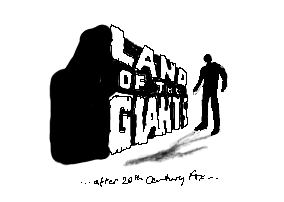
Reluctantly he unbuttons his cuff and rolls his shirt sleeve up, keeping his eyes on me. Playing on the little portable TV opposite is a re-run of a seventies show, Land of the Giants. Some astronauts have crash-landed on a planet identical to earth, except everything’s much bigger. It’s hard to resist watching some of the show whilst I lay out my kit. Two giant scientists have one of the astronauts sellotaped to their work bench. They prod her with the end of a pencil, making her scream, whilst two of her colleagues hide behind a lunch box, wondering what to do.

‘At least it’s not as bad as it used to be.’
‘What isn’t?’
‘Needles. They used to have these gigantic bloody things. It’d take two of them just to carry it in the room.’
‘A bit like the show.’
‘What show?’
‘Land of the Giants. Anyway – I think you’re right. I think things have improved.’
‘What d’you reckon, then? Will you get any?’
‘I think so. There’s a nice one, look. And there. Maybe last time when they tried you were dehydrated or something.’
‘Hmm.’
‘But don’t worry. I only need to get enough for these two little tubes.’
‘There was this one girl, though. Used to work out of the surgery. She understood me. She’d come round, give me a nice big smile, and before I knew it she was packing up to go. And I’d say to her, I’d say – don’t you want any blood today, then? And she’d say to me I’ve already got it!
‘Wow. Shame she wasn’t available today.’
‘I’ve already got it! I didn’t even know she’d started!’
‘She sounds amazing.’
‘She was an absolute dream.’
‘I’d like to meet her.’
‘When the surgery rang and said they were sending a specialist round I thought that’s who they meant.’
‘Oh.’
‘And then you walk in.’
‘Okay. Here we go, then…’
Christ…

Behind me in the Land of the Giants, the two astronauts have snuck out onto the workbench whilst the giant scientists have turned their backs. They cut through the tape and set their colleague free. But – the whole thing was a trap! Lights are flashing, klaxons sounding, giants running around.

‘All done.’
‘Really?’
‘Yep. It wasn’t too bad in the end. Put your finger here. I’ll give you a plaster in a minute.’

He keeps his finger on the piece of gauze in the crook of his elbow whilst I write out the form. Land of the Giants has taken a break, just as the giant scientists are about to drop a cage on the astronauts; for now, though, it’s an advert for stair lifts.

‘Right! I’ll run these samples down the path lab and your GP can check the results online in a few hours. And that’s it! I’ll just put a little plaster on there for you.’
‘Thank you.’
‘You’re welcome. I’ll see myself out.’

In the lobby, quite unexpectedly, I find that I have to fight a giant spider with one of thegiant lancets in my pocket. It’s touch and go, especially as I trip over and fall flat on my back. Just as the spider veers over me waggling its legs, ready to chaw down, somehow, with my last remaining strength, I manage to hold up the lancet. It lodges in the spider’s abdomen. Spider goo covers me from head to foot – but it’s okay. I’ve got some cleansing wipes in the boot of my car. Only – how the hell am I going to reach them?
showering ted

Ted is ninety-five, entirely independent, coping well. Unfortunately for Ted, a bout of high blood pressure, dizziness and intermittent weakness has made life more difficult for him recently. He hasn’t changed his clothes or had a shower in a good many weeks. The doctor has referred him to us for equipment and clinical observations, but so far, despite encouragement, Ted has refused any help with personal care. Today I find out it’s because he’s embarrassed. Most of the carers are female. He’s uncomfortable with that.
‘Come on, Ted. Why don’t I help you with a shower this morning?’
I lay out a change of clothes, and then he takes my arm as we walk along the hallway to the bathroom.
The walls are lined with photographs of family groups, from starch-collared, stiff-backed Edwardians to sprawling, gap-toothed Seventies kids, but generally the apartment feels cowed, cobwebby and quiet, with Ted, like some grumpy, nonagenarian badger, shuffling down his ancient burrow in the half-light.

It turns out, helping Ted take a shower is no easy thing.

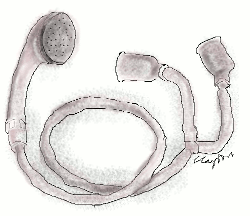
At least there’s plenty of room. It’s an old apartment, and the bathroom is positively cavernous, the ceiling so high up no doubt the spiders in the corners have little family portraits of their own amongst the webbing. The bath itself is a grand, claw-footed affair. It would have been impressive fifty years ago; now, two encrusted drip-stains mark the tap end, the enamel is as pock-marked and pitted as an old saucepan, and the grouting is no more than a series of sprouting black lines between the tiles. At some point, Ted has rigged up a wooden frame around the bath, something like a four-poster bed, except the poles are only a quarter inch thick, and they wobble alarmingly when Ted grabs hold of them. We’ve provided a bath board already – a slatted plastic seat that fits across the bath, so he can sit on it when he showers and not get stuck. What complicates things is that the shower is actually a rubber hose with a sprinkler at one end and two rubber cups for each tap at the other. It’s almost impossible to set the temperature, which runs hot or cold suddenly and without any warning, despite elaborate attempts to get it right. Ted insists on using the shower head himself (He’s very clear about that. He only wants me there to help him in and out, to soap his back, and to hold the shower head whilst he takes care of his ‘bits and pieces’). The problem is, every time the water changes temperature, he yelps and holds the sprinkler away from himself, spraying water everywhere. Despite my plastic apron, I’m immediately soaked through, and the floor is flooded.
‘You could really, really do with a proper walk-in shower,’ I tell him, after the water’s finally – mercifully – shut off, and I’ve helped him swing his legs back out of the bath, and he’s sitting side-saddle, towelling himself dry.
‘They would never agree to that,’ he says. ‘I’m only a tenant. They’ll wait till I’ve popped off and then sell up. It’d be a waste, otherwise.’
‘Seems a shame.’
‘Maybe so. But there you are. Can’t be helped. Can you fetch me over that tin?’
There’s an old biscuit tin on a rotten little stand by the sink. I pass it over. He puts it carefully beside him on the corner of the bath and prises off the lid. The tin is showerfilled with talcum powder, and a fluffy white powder puff. He paddles the powder puff in the talc, and begins energetically dabbing it all over himself, under his arms, his neck, over his chest, in his groin, down his legs…. In a matter of seconds he has completely disappeared in a chokingly sweet cloud of powder.
‘There!’ he says, as the talcum blizzard settles and I stop coughing. ‘I feel like a new man.’

le petit cirque

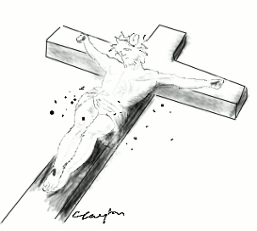
The circus is due to start at four, and here we were, at ten to, standing at the foot of a roadside Jesus with bees flying out of his loins.
‘It’s a miracle.’
‘It looks like they’ve made a nest.’
‘Is that what they do, make nests? I thought they made honey.’
‘Yeah but first they swarm, and then they build a hive, and then they make honey.’
‘They’re going to struggle up there.’
She’s right. Jesus’ back is arched and his legs crooked-up, but still there’s not a lot of room between him and the column. We stand there looking up at the roadside shrine, the bees zipping in and out.
‘I think they’ll wait till they’ve got enough – you know – personnel, and then move on.’
The bees make Jesus’ suffering seem even worse, but if he feels it, he doesn’t let on, looking out across the golden French countryside with the same, mournful expression.
‘I think it’s up here,’ says Simon, tapping the map.
‘It says the conservatoire. Does that lead to the conservatoire? ‘
‘I think it leads to the cemetery.’
‘You wouldn’t have a circus in a cemetery. Would you?’
‘Depends on the circus.’
He folds the map and we head up the steep road anyway, the houses on either side shuttered up, no-one about.
‘Maybe that’s where they’ve gone. To the circus.’
‘If they are, it’s a long way off.’
It’s true. You’d think a circus would make a lot of noise. As it is, there’s an unbroken silence all around.
When we reach the crest of the road it divides into two, smaller tracks. One leads down to a little walled cemetery that overlooks the valley on that side; the other bends sharply right and round, into a hedged field that must belong to the school across the way. It’s only when we take this track that we start to hear something – a muffled PA, a dog barking, a small generator.
‘Up here!’
Snatches of red and yellow through the hedge, cars parked up on the verge, and as the track takes us further round, a stand of circus vans and trucks, each with the same peeling decal on the side: Le Petit Cirque, and busting through the lettering, a smiling clown. The tent is just exactly the kind you would come up with if someone asked you to sketch one: round at the sides, pointed at the top, with red and yellow stripes and guy ropes radiating from the centre. I guess it can only hold about thirty people, max, not allowing for the performers. The plastic of it looks worn and battered, like it’s travelled a great distance, all weathers.
‘Here we are! Come on!’ says Simon, striding ahead.
There are two performers standing outside the tent waiting to go on, a young woman in black spandex , and a short but muscular guy in an open necked shirt and flared trousers. Both of them are wearing make-up so thick it looks as if they applied it to each other with their eyes closed, for a bet. Simon goes straight up to them, and for a second I have a horror that we’ll end up going on with them and having to improvise a show. But I can relax: Simon gets all six of us in for a handful of euros; the tent flap opens and we duck inside.
It’s surprisingly humid, despite the coolness of the weather. There’s a rich smell of trampled grass, audience, animal, the sweetly spotted haze of unpacked canvas. A tiny, D-shaped arena picked out with red sleepers, with a stepped-auditorium of plain boards on three sides. There are four or five families waiting for the show. As soon as we’ve taken our seats,  a middle-aged woman steps out onto the stage holding a microphone. She immediately launches into her introduction, whipping the tail of the mic behind her, distributing her professional, four o’clock enthusiasm about the place. I don’t speak French, so I try to follow what she’s saying through body language and inflection. It’s difficult, though, and I’m pretty lost. She seems tired to me. After a scattering of fantastiques and incroyables and Le celebre jongleur mondialement – Daa-viid! I fully expect her to unplug the mic and go back behind the screen for a lie-down.
Daa-viid! turns out to be the guy in the open-necked shirt who sold us the tickets and let us in. It’s immediately apparent he has lost all the fingers on his right hand, and I can’t help wondering if that was from juggling knives. He’s good though – amazing, actually, considering how difficult it must be to catch things when you’ve pretty much only a palm on one hand. He moves efficiently from balls to clubs to rings, whilst the sound system blasts out The Windmills of your mind on a loop. We applaud loudly to make up for the lack of numbers. He bows deeply, gives a little skip, and then runs out back through the flap the woman holds open.
She gives aother speech, exactly the same as the opener, except this one mentions hula hoops. The young woman who’d been standing outside the tent with David comes on, with about fifteen hoops on either shoulder. Over the next ten minutes she spins the hoops on her hips, arms, legs, finishing with all the hoops at once, gyrating dangerously like a great, clacking, whirlwind of plastic. She lets the hoops fall to the ground, steps out of them, takes the applause and the hoops and jogs back through the flap – then almost immediately comes out again with an elderly man dressed in white shirt and corduroy trousers. Together they assemble a little platform in the middle of the ring, and stack a half dozen chairs to the side. Whilst they’re doing this, the woman – who I’m guessing is the old man’s daughter and the hula-hoop girl’s mum – gives us another monologue about something world-beating, world-class, giving the mic lead a flip every now and again, to re-energise her smile and move things along. When finally the stage is set she throws her right arm out to the side, shouts Daaa-viiid!, takes a step back, and David runs in again, dressed this time in a lycra one-piece made up to look like a suit. His demeanour is changed, too. He’s more urbane, the kind of insouciant smile and knowing wink that seems to promise that yes, he’s about to do something amazing and no, we shouldn’t try this at home. He puts one of the chairs on the platform, puts his damaged hand on the back of it, his good hand on the seat, and flips himself up into a handstand, holding it there for the applause. Once he’s back down, he puts another chair on top of the first, and repeats the trick. And so it goes on, the stack of chairs growing in height, the arrangement increasingly precarious, the woman – who I’m guessing is his wife – coming on half-way through to help him get on and off. Daaa-viiid! she cries at the end. We clap. The old man comes on to help pack away. Another announcement, and then the old guy comes on with a goat.

I feel sorry for all of them, but especially the goat.

It’s a cute, pygmy variety, black and white, with fierce silver eyes and neat horns that curve left and right. It’s on a lead. The old guy is shouting stuff out, flicking a whip, making the goat climb up on a star-patterned platform, kneeling, or rising up on its back legs. We all clap, but I feel uncomfortable. It’s one thing, struggling to make a living as a jongleur, a hula-hoopeur – but at least they have a choice. The only way I can find any comfort is to think that the goat – and then the llama, and birds, and even performing cats that make their way onto the little D-shaped stage for our entertainment – is that at least they have a better quality of life than many of the animals we farm for food back in the UK.
But I’m relieved when the animals are done and we’re back to the woman and her announcement – the
world-famous clown, apparently – Daaa-viiid!
He waddles on dressed in an orange and red check suit, a red nose screwed into the middle of his face, some dabs of white and black on his face. There’s some schtick between him and the woman, which I can’t begin to understand, until Simon leans in and says that ‘there’s been a clown strike / he’s refusing to go on.’ In his place he gets three children out of the audience, but that’s as far as the strike routine goes. He makes some balloon glasses for one kid, a balloon crown for another, and a balloon giraffe for the kid that cries and runs back to into the auditorium.
The woman then has a turn at performing. She gives a short magic show, at one point parading an empty cylinder round the stage, presenting it for our inspection with a worryingly intense smile, like she’s fully prepared to hit us with it if we reach out to look more closely. She pulls flowers and flags out of the cylinder, and then turns to the bird in the cage her daughter has just brought on. After some finger-to-mouth expressions of wonder and alarm, she suddenly claps the cage flat, opens it again, and drags out a rabbit – an extraordinary animal, its fur so clumped-up at first I think it’s just a hat.
Applause, retreat.
David makes one final appearance, to do some balancing on variations of plank and cylinder.
The children buy pennants the hula-hoop girl brings out. Then the show is over and we all file outside, saying thank you to David, his wife, daughter and father, lined up to wish us bon voyage. After watching the animals grazing in the field outside, we head back down the lane,  towards home.

I don’t know what’s more depressing – thinking about the goat, dropping down to its knees at the flick of the old man’s whip, or the family striking the tent each evening, packing it all away, counting up the few euros they made that day, wondering how much longer they can go on.jesus

When we reach the statue of Jesus at the crossroads, I notice that the bees have all gone. Jesus’ head seems a little lower than I remembered. Maybe he’s relieved the bees have found somewhere else, although it might just be an optical illusion, the effect of the sun, much further down now, almost completely obscured by the hills on the far side of the valley.