molly

 ‘Did you see that programme about the woman who rescues baby elephants? It’s such a shame what’s happening to them. I think the parent elephants are getting killed by the poachers for their tusks, and the babies are left to fend for themselves. There’s still quite a demand for the ivory, of course, and all those ridiculous herbal medicines, and what have you. And I don’t think it helps that when the elephants go from one place to another they always go straight, like they’ve always done, never mind there’s a village in the way. It’s not their fault. An elephant’s a big old item, though. It’ll do a lot of damage.

‘You see, mankind’s in conflict with the animal kingdom. We won’t have these lovely animals for much longer. We’re using them all up. It’s the same with the monkeys, the orang-utans. We’re cutting down all their forests and they haven’t got nowhere to go. We need to start doing something about it, though, or  what’ll the planet be like in future?  They’ve named this age after us, the Anthropocene – and I tell you what, that’s hard to say without your teeth in – because you see we’re a thing now, the human race, like asteroids, or the ice age. We’re killing things off on a huge scale. It was the same with the whales and the Victorians. When you think of those magnificent animals, cut to pieces, and for what? A bit of oil for your lamp? A few corsets? I don’t know if you remember, but we used to have anti-macassars on the backs of chairs, because all the men had this oil on their hair and it stained the fabric. And when you think of them poor old whales…

‘But it’s hard to tell younger countries not to go the way we did, with the industry and the pollution and what have you. It’s like saying: we’ve enjoyed all this progress, we’ve made a stack load of money, but sorry, mate – you can’t do the same because it’s not good for the planet. How do you justify that? You’ve got to make it worth their while, or you’re on a hiding to nothing.

‘I never had an education. I went to the local school and then I worked in a bank. I had this aunt with a bit of clout. She saw something in me and got me an interview. They sent me up to London, to Lombard Street, the heart of the city, to sit this test. It was a huge thing for me then. There I was, a tiny little mouse from the country, getting off the train with my little packed lunch, stepping off into another world! A skyscraper world! They sat us in the biggest, most grandest hall you could imagine. I was so nervous I could hardly write. But I worked my way through it. There was this woman walking round looking over our shoulders, and she came over to me and she said “I’d have another look at question five, if I were you”, so I did, and I passed with flying colours! That was nice of her, weren’t it? So the next thing I knew I found myself working in a bank. Not on the desk, mind. They didn’t let women out front on the desk in those days. I was in the back, working the machine that processed all the cheques. That’s where I met my husband. And when we got married we bought a little sweet shop.

‘You should’ve seen it. Lovely teak counter, rows of jars behind me up on the wall. It was quite a knack,  climbing that ladder to fetch a jar without breaking me neck. They were heavy items, you see. But we used to sell all kinds of things. Necessaries, you know. Bread and milk. Newspapers. I used to be up at half past five in all my make-up, marking out the papers for delivery. I wish I’d took a photograph. It’s all gone now, of course.

‘We had this rocking chair just beside the counter. People used to come in, take a seat, light a cigarette (you could in those days), and just chat. Oh – I got to know everybody. All their problems. I loved it. I didn’t want to retire, but I suppose everyone’s time runs out sometime. So here I am, chatting to you, trying not to fall out of bed. Who’d have thought?

‘But that’s enough about me. Tell me about you. Do you have a family?…’
doctor’s orders

I knew it would be difficult to find. The Beeches, Crossways. The very minimum of information (demonstrating the upper class theorem which states that the amount of words in any particular address is inversely proportional to the amount of money it takes to acquire it). I’m surprised there’s not a family crest on the fax. There’s a postcode, though – a sop to modernity – and my satnav has certainly done its best, but still I need help with the last little stretch, because the flag’s in the middle of an expensive nowhere, and I’m worried that a guy like me in a car like this driving slowly from grand stone gatehouse to grand stone gatehouse will inspire an armed response.

The voice when it answers is as brisk as a knighthood.
Yes? Hello?
‘Oh, hello! My name’s Jim. I’m with the Rapid Response Service. I’ve been asked to visit Mr Bletchley and I was wondering where you were.’
I’m sorry – who did you say you were?
‘Jim. From the Rapid Response. You know. The hospital.’
Who sent you?
‘I think it was Mr Bletchley’s GP.’
I can assure you it wasn’t. I’m a GP.
‘You’re the GP?’
No. I’m A GP. My husband’s GP is Dr Smith. Shouldn’t you know that? And I can assure you I’ll be talking to Dr Smith as a matter of urgency, because this is simply unacceptable. What did you think you were coming here to do?
‘Anyone who gets referred to us has an assessment by two people – a clinician to do the blood pressure and so on, and then a physio or OT to assess mobility issues, the social side of things…’
And you’re a clinician are you?
‘I’m what they call an Assistant Practitioner.’
And what is that? A nurse?
‘No – more like a nursing assistant.’
What nonsense! My husband’s vital signs have been taken already today. Someone called Bartlett.
‘Bartlett?’
Yes. Bartlett. He said he was from the Rapid service people or whoever you are. Now look. This is ridiculous…
‘I don’t know anyone called Bartlett.’
I can’t help that. What I can help is my husband being bothered by an endless stream of people traipsing through the house on some fool’s errand. This is absolutely not what I intended. I asked the care agency to refer my husband to an occupational therapist because he’s been struggling with his mobility. And now all of a sudden I have nursing assistants dropping in willy nilly at all times of the day and night to absolutely no purpose.
‘Would it be better if we had this conversation face to face, rather me sitting by the side of the road on the phone?’
Yes. I think it probably would. Just park in the street and I’ll let you in.
‘Could you tell me where you are then?’
What do you mean? Just do what you did before.
‘But I haven’t been before. That’s why I called. To find out where the house is.’
This is absurd. I shall be talking to Dr Smith, you know.

She gives me directions to The Beeches – strict instructions to park out on the road, as ‘the gardeners are in with all their vans and things and there won’t be room’. She’s right about that . A team of gardeners in neon orange safety gear and hard white hats are standing around having coffee, screened from the house by a stand of rhododendron, a giant orange chipper nearby. They nod good morning to me; one of them, the tallest and toughest, tosses the dregs of his coffee off to the side, in a grimly knowing kind of way, like he fully expects to be feeding me head first through the chipper in a couple of minutes.
I walk on up the gravelled drive, rap the lion’s head knocker on the iron-banded door, and step back.
After a long, corridor’s march, Mrs Bletchley appears, an elderly but vividly animated woman, ruthlessly dressed like some kind of debutante samurai, in slacks, polo neck, pearls and earrings, with a phone pressed to her ear.
No. I don’t know who it is. Another Bartlett she snaps into the phone, and after running me through with her eyes, nods for me to go through to the lounge, where Florence, the live-in carer is wringing her hands and waiting.
Luckily for me, Florence is the perfect antidote to her employer, a natural correction, in the same way you often find dock leaves growing next to stinging nettles.
‘Have a seat’ she says, kindly indicating an impressively plump sofa with the flat of a perfectly manicured hand. A great, limestone fireplace dominates the room, a discretely-lit oil painting above it – dawn on a Scottish loch – and then on a low display case to the side, a collection of ceramic bulldogs.
‘Can I get you a tea or anything?’
‘No. It’s okay, thanks.’
She fetches me the folder, tells me everything I need to know. I can see immediately there’s been a duplication. Ricky, one of the other assistant practitioners, has already been in that morning for the clinical assessment. His surname’s Partetto, and I have to admit, when he says it quickly, in his Italian accent, through that trendily thick beard, it’s quite conceivable you might hear it as Bartlett. All that Mr Bletchley needs now is the OT assessment, which should be anytime soon. I tell Florence what’s happened; she smiles with great warmth and understanding.
‘That clears that up!’ she says, and then glances towards the door. ‘Mrs Bletchley will be pleased.’

historical drama

Denis takes a while to get to the door. It’s a long way from the bedroom, he’s exhausted, his legs are shot.
‘They took all the veins out for the bypass,’ he says, turning round painfully.
‘I don’t know they’d take all of them.’
‘A lot, anyway,’ he says. ‘It’s a big operation. The biggest.’
I follow him back through the flat, everything cream and white, a designer’s rule between each chrome fitting, glass table and black leather chair, framed pictures of nothing in particular, cracked willow with fairy lights in a floor-standing, rough stone vase – all the warmth and amiability of a show home.
Denis makes it back to the bedroom and climbs into bed.
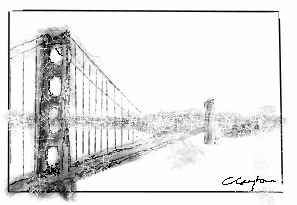
Above it, a sepia print of the Golden Gate bridge.
‘I’ve put a chair out,’ he says, gathering the quilt around him.
His yellow folder is on the seat. It’s stuffed full of everything from final demands to hospital discharge summaries; I have a job to keep it all together on my lap.
‘No-one wants to know,’ he says, watching me from the bed. ‘I’ve got heart problems, back problems, they bodged my knee and lied about it. I’ve got all this going on and I’ve paid in all my life and I don’t get any of the attention I deserve.’
And then he turns his head to the side and cries – or, at least, gives a strange, dry-eyed approximation, like he’s been hiding one of those tragedy masks amongst the folds of the quilt, held it up to his face, and then just as suddenly dropped it down again.
‘I’m sorry you’re feeling so low,’ I say. ‘Have you spoken to your doctor?’
He straightens up and looks at me with his normal face.
‘They just fob me off with more pills. They don’t care.’
‘What about talking therapies? You know – counselling and the rest. Would that help, d’you think?’
‘Talk about what? How my life’s fucked up? How I’ve been dicked around and hung out to dry? How’s talking going to help anyone?’
‘I don’t know. I think it’s good to get these things out in the open sometimes. Otherwise they just grow out of proportion and take over.’
He turns to the side again, another brief display of the mask.
‘I’m sorry,’ I tell him, putting the folder on the carpet, and getting out my obs kit. ‘I can see you’ve got a lot on your plate.’
He straightens again.
‘My daughter won’t talk to me,’ he says, pulling a tissue from the box by his side and dabbing his nose.
‘Why? What happened?’
‘Laura, the granddaughter, she was due to get married, and of course it causes all kinds of ructions, ‘cos no-one likes the guy. I mean I didn’t like him either, but – what do I know? Anyway, my daughter was putting her under a lot of pressure, so Laura comes to me and asks me to get involved. Which I try to do as nice as I can – but then it all blows up and I get the blame and now nobody’s talking to me. Me! So sick they had to open my chest and stuff a load of leg veins in there to keep it all working. The most dangerous operation you can have. But they don’t want to know. They don’t ring, they don’t write. I asked the doctor to call my daughter and tell her how sick I am, but the doctor says it’s something I’ve gotta sort out for myself. Me! In my condition!’
‘It’s difficult. But I’d be tempted to take a deep breath and make the call. I bet she cares more than you think. Someone has to make the first move.’
‘Nah, fuck it,’ he says, tossing the tissue in the bin. ‘It’s not gonna be me.’

After I’ve finished the assessment and written up the notes, he seems to brighten up a little.
‘Pass me that iPad, could you?’ he says. ‘D’you know much about these things?’
‘A little,’ I tell him. ‘Shame my daughters aren’t here. They’re pretty good with this stuff.’
I wonder if it was tactless to have mentioned daughters, but he’s too engrossed with the iPad to notice.
‘What’s the problem? Email?’
‘What? No – the iPlayer’s stopped working. What d’you think it is?’
He hands me the tablet.
‘It looks like it needs an update.’
‘Can you do it?’
‘I’ll have a go.’
I click around. Luckily, it seems to work.
‘There!’ I tell him, handing it back. ‘Ready to go.’
‘Great,’ he says. ‘I can watch the last episode of Poldark.’

goldengate

how long the bee

There are a dozen, rough concrete steps dropping precipitously from road level to Jack and Janice’s front door. The patio at the bottom there is so sheltered –  the cottage behind, the terraces of the garden in front – that all the containers and hanging baskets there are still going strong despite the lateness of the season.  Great, fleshy ropes of tradescantia hang in tangles overhead, ornamental roses line the wall beneath the window, lavenders and daisies ranged in a variety of pots along the path, and to my right, a tall fuchsia, its delicate lanterns vividly pink and red in the grey morning light. There’s a solitary honey bee moving between the flowers. I watch it whilst I wait for someone to come to the door. I bet it can hardly believe its luck. Such riches, so late on. But how much longer can the flowers last? And how long the bee?
Jack opens the door.
‘Yes?’
I start to tell him who I am, but he’s so deaf I have to start again with my mouth up to his ear.
‘I suppose you’d better come in,’ he says. ‘There’s someone else here already. I don’t know if you know ‘em.’
The hallway’s so narrow, and Jack’s so frail, we have to improvise a slow tango for me to come in sufficiently for Jack to close the door.
‘You don’t see anyone for months on end and suddenly it never stops,’ he says.
‘Feast or famine,’ I tell him.
‘Sorry?’
Feast or famine.
‘I’ve had some toast,’ he says. ‘But never you mind about me. She’s upstairs in bed, if you’re interested.’
‘Shall I go up and say hello?’
‘Eh?’
I point.
He nods.
‘I try to encourage her but it don’t do no good,’ he says, then ‘Oh! Right! I was s’posed to be making tea!’ Then he turns painfully and struggles off into the kitchen, wobbling from side to side like a bear with sore paws, swiping the radio as he passes, which comes on at such volume I can hear it clearly all the way up the stairs.

Ellen, a nurse from another team, is in with Janice. Sometimes these overlaps between services are frustrating – it’s a muddle, things get missed – but today it’s a straight-up piece of luck. Ellen’s so experienced, and so warm, it lifts and illuminates the whole assessment.
‘I just love that bathroom,’ she says, dropping the dirty flannels into the basin of water and handing it to me. Janice smiles vacantly from her freshly-plumped pillows.
Ellen’s right. There’s a cute roll-top bath, with an equally ancient pedestal sink next to it, chrome and glass shelving, a brass shaving mirror, a porcelain soap dish shaped like a fish, and on a ladder of rails, a stack of brightly coloured, neatly folded towels.
‘He runs a pretty nice place,’ I say, coming back into the bedroom and peeling off my gloves.
‘Ye-es’ says Ellen, flicking through the folder. I know what’s she’s thinking. Even though Jack’s still managing to keep things together, Janice is deteriorating quickly. It’s going to be difficult to cope in such a tiny cottage.
‘Here we are!’ says Jack. Somehow he’s managed to struggle up the stairs with a tray of tea. Two china cups for me and Ellen, a beaker for Janice.
‘Don’t she look a picture! Eh?’ he says, holding on to the handle of the door whilst he gets his breath.
And anyone would have to agree. She does, she really does.

the three

‘Three in one day!’
‘Wow!’
‘Yeah. I think the Grim Reaper must’ve swapped his scythe for a strimmer…’

It’s certainly unusual. We’ve had several End of Life patients on the books for some time now, picking up the slack from the regular palliative agencies struggling to cope after years of cuts and under-funding. These End of Life patients are invariably double-ups – needing at least two people to deal with the complex manual handling issues relating to bed care. It’s a significant strain on the service, leaving us with little capacity for anything else. Of course, we’re all shocked to hear about the deaths; we’ve built up close relationships with the patients and their families over the weeks. But aside from the emotional impact of the loss, three patients in one day? Well, at the risk of sounding callous, it’s a dizzying release of manpower.

The carers sit round the big table at the beginning of the shift, going over the details as they write down their patients for the day.
‘So which three was it, then?’
‘Well first off was Old Mr Denton.’
‘Oh no! Lovely DD.’
‘Yeah. It’s a shame. They were just setting up the driver when he went.’
‘Still. I think most of the family made it over. He’d have been happy with that. Who else?’
‘Jenny C.’
‘That’s a shock.’
‘Tell me about it. I was there yesterday and she was showing me pictures of the new baby.’
‘That’s terrible. Poor Jenny. I hope it was quick. Who else?’
‘Errol.’
‘Oh my God! Finally!’
‘Yep. It was incredible how he hung on.’
‘I didn’t think he’d survive the pad change last night he was so bad. But he’s a fighter, I’ll give him that.’
‘Here – chuck us that eraser.’
‘Who found him?’
‘Darryl did. He was there with Jane and he said as soon as he walked in the room he knew. They checked him over, then went in to tell Jeanette.’
‘How did she take it?’
‘Pretty well. She said “Oh yes. I kind of knew he’d gone when I took his tea in and he didn’t make his usual comment.”
‘She’s a funny one. But I think it’s going to hit her hard, when all the dust’s settled.’
‘Whose biscuits are these?’
‘Have one. They’ve been kicking around for ages.’
‘You’re not selling them to me.’
‘I think Sandra found them down the back of the fridge.’
‘Three in one day!’
‘I know! That’s knocked some gaps in the rota.’
‘Won’t last.’
‘No. You’re right.’ Dunks one of the biscuits in her tea and finishes it in one swallow. ‘Never does.’

on edge

I’m met at the door by a young guy with a buttoned-down manner and a way of speaking that’s low and whispered and slightly off to the side.
‘There’s someone here from the hospital come to see you,’ he says, over his shoulder to the locked door behind him. ‘Shall I take him down to the living room?’
Yes. I’ll be out in a minute.
He smiles at me (if he bowed I wouldn’t be surprised), beckons me in, then closes the door behind me with one hand on the latch and one flat on the panel to stifle the click.
‘This way.’
A long, narrow corridor, bare walls, widely spaced down-lighters, every door closed, until he stops in front of one, opens it, and stands aside to let me through.
‘Shan’t keep you,’ he says, and with a deferential scrape, leaves me alone.
The living room is well-named; there’s scarcely room to do anything else. A cluttered, boxy affair, it’s completely dominated by a waxy white leather sofa and a glass table covered with lifestyle, physical culture and health magazines. The sofa is enormous, like a gigantically plump mushroom grown fat on the dark shag-pile carpet, and silence.
I hold on to my bag, sit down and wait.
After a few minutes another, older man appears at the doorway. He’s wearing stripy pyjama bottoms, with a Scottie-dog patterned bathrobe draped over his shoulders, the only way he can wear it with the sling he has on his left arm. I stand up and introduce myself. He holds out his left hand; I reach across to squeeze it.
‘Nice to meet you.’
‘Do sit down.’
He waits for me to resume my place, then carefully guarding his injured arm, takes a seat next to me. He’s an extraordinary figure, with greasy golden hair that runs down from a prominent forehead to curl inwards at the jaw line – a formal crop that with his beaky nose, lidless eyes and haughty blue expression makes him look like he’s just stepped down to earth from a twelfth century stained glass window. He gives his head a shake, as if he’s clearing a little mental space to deal with whatever comes next, then slowly turns his eyes on me and smiles.
‘I expect you know the story,’ he says.
‘I didn’t get all of it.’
‘Well let me fill you in, then. You see, I’m very good, and I go to the gym quite regularly. I wouldn’t describe myself as a body-builder, quite, but I do have an interest in physical culture and so on. Unfortunately my usual trainer was delayed, and inadvisably, I attempted some bench presses without him there to spot for me. Awful, stupid, idiotic.’ He gives his head another little shake. ‘It could have been fatal, for goodness sake! Anyway, the first set was absolutely fine, the second was a little more of a strain. And Mike still hadn’t arrived. But you see one of my things is cussedness. I’m quite cussed. The more difficult something is, the more tempted I am to just go at it. So I put on some more weights and started the third set. Well of course it all went disastrously wrong and I suffered a collapse. Luckily I managed to direct the bar off to the side, but it wrenched my shoulder and tore up the superior and inferior glenohumeral ligaments. As I’m sure you know. Hence the sling.’
‘Ouch.’
‘Ouch indeed.’
He smiles at me again.
‘I must say, you’re a little more relaxed than your colleague.’
‘Jane? I’m surprised to hear you say that. But then – I suppose you have to realise – a single woman, coming into a flat with two men. When it’s dark outside. I think if I was her I’d be a little on edge.’
‘Oh please!’ he says. ‘On edge! Look at her. She should be so lucky.’
He adjusts the hem of his bathrobe, then very casually lifts his chin and says: ‘I wouldn’t give her to my son.’

thumped

I can’t ignore the foot.

I’ve blundered into this situation like the most naïve of fools – Hello sky! Hello trees! Hello sheltered accommodation warden! – and now here I am, mesmerised by that foot, struggling to think how to make things better, how to get away in one piece.
‘None of you care what happens to my mother. You just want her off your hands as quickly as possible.’
Thump, thump, thump goes the foot.
It’s like Thumper from Bambi. If Thumper had grown two metres, aged forty years, put on a cable-knit sweater, hadn’t shaved for a week.
‘I’m putting in a formal complaint. I’m making this a safeguarding issue. I think it’s an absolute disgrace. A family friend is a nurse and she agrees with me. This should never have happened.’
Thump, thump, thump.

I do what I always do in these situations, which is to adopt a more aerodynamic profile. I make sure I’m sitting in an attentive but neutral position (but not too obviously); I maintain eye contact (but not too much);  I listen to his concerns and then repeat them back to him in a way that shows I’ve listened and understood what he’s said (but not too glibly). I’m amazed he doesn’t laugh out loud, it’s all so obvious, a TedTalk on Dealing with Difficult Customers. But it seems to work. The foot taps a little less aggressively, and settles into a vestigial twitch.

This unexpectedly hostile reception isn’t my only difficulty. There’s also a strange disparity between the son’s anger and his mother’s situation. If you had told me to study the son’s fury in close-up and then guess the scene that inspired it, I would have said that his mother must have been fly-tipped by the side of the road at midnight. But here she is, sitting very comfortably, thank you, on a sofa with everything to hand, in a beautifully warm and well-kempt flat, carers arranged for the morning, food in the fridge, a personal alarm, and family that lives locally. And whilst it’s true she suffers from dementia, it hasn’t progressed to a disabling loss of cognitive function, more of a mild, essentially benign dissociation with the present.

Careful not to apportion blame or make promises I can’t keep, I tell him I’ll look into the circumstances of the discharge, and in the meantime, offer some things that we as a service can do to help right now. He breathes heavily through his nose as I lay out my wares: a toilet aid, a perching stool, a walking stick.
Thump goes the foot.
A review of the longer-term issues of care support.
Thump.
‘Why wasn’t this all taken care of before my mother was discharged? She struggled to get out of bed this morning and wet herself.’
‘I’m sorry to hear that.’
I’m also tempted to ask why he wasn’t able to be at home with his mum when she came home, to make sure everything was okay in the short term. I don’t, of course. Rule number whatever: don’t get drawn into an argument. And anyway, it’s essentially a monologue with some gaps for comment, certainly not a conversation. The practicalities are almost secondary. For now – and for whatever reason – he simply needs to vent his frustration, and if I can’t for the moment see what’s really behind it all, at least I can acknowledge it, however uncomfortable it makes me feel.
‘Okay. Well. Actually – the reason I’ve been sent round today is to do a simple medical screen,’ I tell them, slowly drawing out my folder of paperwork.
Thump.
‘I need the loo,’ says his mother.
‘Okay. That’s handy! Because one of the things I need is a sample of urine!’
His mother stands up. I offer my arm. She threads her hand through the crook of it and we walk slowly out of the room together, bluebirds twittering and singing in a circle over our heads, all the woodland creatures, the owl, the family of field mice, the deer and the baby horse, all lining up to smile and nod as we process – all except Thumper, the old crosspatch, who folds his arms and scowls at us from the other side of the room.

on the needle

One of the other nurses hadn’t been able to take Mary’s blood that morning so I’ve been assigned to try again this afternoon.
The day is high and blue, the kind of easy, late October day that makes you forget you’re standing on the edge of winter, with the clocks back, the nights shuffling up, and a prospect of colder days to come.
Mary answers the door in a red silk wrap patterned with Chinese dragons and lilies. She’s frail and watchful behind a pair of heavy black-framed spectacles.
‘Come in out of the cold,’ she says, standing aside. ‘Lord – what would my son say if he knew I was answering the door like this.’
She shuts the door, and then takes a seat at the little table in the window.
‘I suppose you’ve come to have a shot, too,’ she says, laying her right arm amongst the papers and letters and unopened catalogues, bunching her sleeve up. ‘I don’t think there’s much there, but be my guest.’
I set out my kit and then inspect her arm, tapping up the likely candidates.
‘Here!’ she says, ‘you’re not supposed to just waltz in and beat me up!’
‘No. It doesn’t look good, does it?’
I put the tourniquet round her upper arm and prepare to go for a vein.
‘So what did you do before you retired?’ I ask, as much to distract her attention as anything else.
‘I was a nurse,’ she says. ‘Well, come on – you did ask.’
‘Uh-oh! A nurse? Now I’m for it.’
‘Don’t be daft. It was a long time ago and I’ve forgotten more than I knew.’ But she leans in as I insert the needle.
‘Anything?’ she says.
‘Not a thing.’
‘I suppose you’ll just have to keep going until you strike oil,’ she says, relaxing back again. ‘Don’t mind me.’
We chat about her symptoms whilst I look for a different site.
‘I was in Marks and Spencer’s,’ she says. ‘Don’t laugh. And I was standing with the assistant, looking over all the bags, and I was thinking how they didn’t have much – certainly nothing I’d want to carry out in public – and then suddenly I couldn’t get my thoughts in order.’
‘You were confused?’
‘I was muddled! More than that – I just didn’t know what I was doing there or what I was supposed to say.’
‘I’m like that, in Marks and Spencer’s.’
‘But I couldn’t understand what any of it meant, Jim. And my heart was going a mile a minute. And the assistant was looking at me like I was some kind of alien or something. And I just had to get out.’
‘So you went outside?’
‘I did. I left the store. And I stood outside, in the fresh air. And everyone was walking past me, all busy with their own lives, all going somewhere, and I just had to sit down and let it wash over me.’
‘Did you feel short of breath? Sick, dizzy?’
‘No. Nothing like that. I just kind of felt not myself if you understand me. You hear people say it a lot, don’t you? I’m not feeling myself today. Well that’s exactly what it was. I felt like someone else, in my own body.
She pushes her specs back up her nose and stares at me.
‘I expect you think I’m ready for the fella with the big white butterfly net.’
‘No. I mean – it might be an anxiety thing. But it could be something else.’
‘Like what? My heart, d’you suppose?’
I shrug.
‘You’re on quite a few meds. Some of them have changed recently. It might be some kind of interaction. I don’t know enough about it.’
‘Me neither,’ she says, sadly. ‘There! That’s flowing now! Thank Christ for that.’
I manage to fill the two phials I need. She presses the square of gauze to the crook of her elbow as I loosen the tourniquet and withdraw the needle.
‘There! All done! It’ll be interesting to see the results.’
‘Interesting’s not the word.’
Mary’s quiet as I pack my things away. Eventually she says: ‘My daughter-in-law’s on the case, you know – phoning up the doctor to find out what’s going on. Marlee’s a holy terror, bless her. She won’t let them get away with anything.’
‘Quite right. But don’t give her my number, whatever you do.’
‘Ah – you’re all right. I’ll put in a word.’
I write out the blood form.
‘So where did you do your training?’ I ask her. ‘Down here or over the water?’
‘London,’ she says. ‘I loved it, y’know? It was fantastic. Me and the girls, we used to go dancing in the Tottenham Court Road. And – you’ll laugh – but we used to give out these silly fake names on the door: Clare Voiyant. Sonya Bike. Theresa Green. They must’ve known, but they just used to shake their heads and wave us through. We had a grand ol’ time of it.’
‘I bet you did.’
‘I’d go back there in a snap.’
I remove the gauze square, inspect the wound, put a plaster on it. Mary watches.
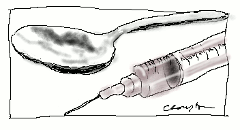
‘Y’know, I used to work in the community,’ she says, pulling her sleeve back down. ‘I remember, one of my patients, he was this beautiful musician – such a beautiful man. He’d make you gasp just to look at him he was so beautiful. And he used to take heroin. I’d go round to see him, and he’d be there, warming the spoon over the candle. And he was so careful to get every last drop … it was terrible to see. I asked him once. I said to him – why do you put that shit in your veins, pardon my French. And he looked at me, with his beautiful blue eyes. And he said, They’re all doing it, Mary. All the musicians. They’re all on the needle.
needleandspoon

geoffrey (1a)

‘I just wish I didn’t feel so damn swimey all the time.’
I’ve not heard that description for dizziness before – although swimey sounds about right. A portmanteau word, two meanings packed into one, maybe light-headed and swimmy.
‘I came over all swimey and fell down in the street,’ he says, walking ahead of me down the long hallway, veering from wall to wall like a bad seaman on a rough crossing. ‘That’s when they called the ambulance, you see. Everyone was very kind and all that. I didn’t want to go to hospital so they brought me home.’
Geoffrey eases himself into his favourite armchair and immediately rolls up his sleeve.
‘Come on then,’ he says. ‘But I warn you now – it’ll be high.’
For someone of ninety-two, Geoffrey is doing pretty well. He lives on his own, quite independently, in the basement flat he moved in to when he was thirty. The flat must once have been the servants quarters to the rest of the building, an imposing Georgian town house in an immaculate square in the centre of town. I’m not sure how Geoffrey manages the steep concrete steps down to the basement, particularly with his wheeled trolley, but apparently that’s what he does, off to the shops most mornings, to his clubs, and his grand-niece or something, who lives nearby and helps out now and again. The steps are so worn and precipitous I have to concentrate when I come down; for a ninety-two year old suffering from swiminess – well, it’s a vision of terror.
‘Oh I manage all right,’ he says. ‘I’m used to it.’

I’ve been sent by the GP to run an ECG. We chat whilst I stick the dots on and make everything ready.
‘I was in the RAF,’ he says. ‘I didn’t fly the planes. I was a driver, mostly. Ambulances, fuel trucks, recovery vehicles, motorcycles. There wasn’t anything I couldn’t drive. That’s something I miss, you know. Driving.’
‘Do you ever go out with your grand-niece?’
‘Yes. She’s very good. She takes me places. And I go with the old whatsisname – the community bus. But it’s not like having a wheel in your hands. It’s not the same thing.’
‘We’re so lucky, not having to face a war,’ I say, plugging him in to the machine. ‘I can’t imagine what that must have been like.’
‘It was hard,’ he says. ‘But you just got on with it.’
‘What did you think of it all?’
‘What did I think of what?’
‘You know – the war and everything. What it was all about.’
‘You didn’t think anything about it. You didn’t have a choice. It was just there. It happened, you got your papers, that’s it. Off you went. There weren’t none of us liked it. But we was only young when it started and we didn’t know much else. Probably just as well…’
‘Hold still for a second, Geoffrey.’
The trace on the screen settles down. I print off a strip.
‘Okay. You can relax now.’
‘So what does that tell you?’ he says, leaning forwards. ‘Still alive, am I?’
‘Yep. You’re pretty good. Look – you jog along nicely and then every now and again you have these little extra beats thrown in that don’t do anything, but they make the pulse feel a little bit irregular. Other than that – fine.’
‘Oh,’ he says. ‘Good. So what’s causing all this damned swimeyness then?’
‘I don’t know, Geoffrey. We’ll have to look into it some more.’
I unstick the dots and pack the machine away.
When I’ve finished with the rest of the examination, I write up the notes and then say goodbye.
‘Don’t get up,’ I say, shaking his hand.
‘Thanks for coming,’ he says.
‘Pleasure. And we’ll send an OT round tomorrow to see what equipment you could use around the place to make your life a little easier. Especially with all this swimeyness.’
‘Well that would be good,’ he says.

When I step outside I notice a handwritten sign thumb-tacked to the door beneath the concrete stairs, (probably the door to an alcove where the bins are kept). The sign is written in shaky block capitals:
PLEASE KEEP THIS DOR SHUT. YESTERDY WHEN I OPENED IT A FOX JUMPED OUT. THANK YOU. GEOFFREY (1A)

things you can see

Eileen opens the door.
‘He’s upstairs,’ she says, towelling her hands dry as she speaks. ‘I’m just finishing the washing up. You go on ahead.’
Then she turns and hauls herself back along the narrow hallway, vigorously swinging her body left and right to cheat enough play in her hips. It’s like watching a great ape learning to walk; I half expect her to wave the tea towel over her head and jump up on the counter.

Malcolm has gone to bed. Bruised and shaken after his fall a few days ago, his confidence has taken a knock and he doesn’t know what to do with himself.
‘Everyone’s been so kind,’ he says. ‘The doctor, now you people. Really, I couldn’t fault it.’
When I pull back the duvet to have a look at his injuries, I’m surprised to see that he’s fully and nicely dressed in a check shirt, knitted green waistcoat and corduroy trousers. He’s wearing something round his neck on a piece of string – not an alert button, but a smart phone in a black leather wallet.
‘It’s good!’ he says, tapping it gently. ‘I’m still getting the hang of it, though. I mean, the other day, when I rang the surgery, this blasted voice was giving me all these options – press one for this, two for the other – but there was nothing on the screen! I couldn’t get any further with it! I felt like a prize idiot! But my granddaughter showed me what to do. Easy when you know how.’

Eileen sashays in.
‘Still alive, is he?’ she says, considerably out of puff from the climb.
‘Not bad, considering.’
‘I’ve known this woman sixty years,’ says Malcolm. ‘She used to cut my wife’s hair. We all lived in the same street. I ran the garage at the end, Eileen had a little place just round the corner.’
‘Is it sixty years?’ says Eileen. ‘I’m not that old, am I?’
‘Sixty years,’ says Malcolm. ‘Then my wife died, and then Eileen’s husband died…’
‘When you put it like that it sounds a bit off,’ she says, wiping her hands on the tea towel like she’s just come from the scene of a crime.
‘Well – you know how it is,’ says Malcolm. ‘Things change, whether you like it or not.’
‘I’ll just be downstairs if you need anything,’ says Eileen.

*

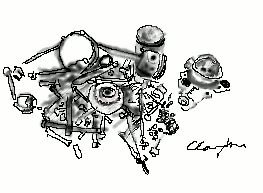
‘You wouldn’t think to look at me now, but I used to be quite a handy fellow,’ says Malcolm. ‘I had an interest, you see? Cars. Motorcycles. Anything with an engine. I just loved getting my hands dirty, getting right in there, in the oil and …and the grease. Because you used to get dirty in those days. Not like now. It’s all computers now. I wouldn’t know where to start. Plug it in somewhere, I expect. Then what? No idea. Back then, you see, it was much more straightforward. You just had to see how it all meshed together, how it moved. All the timings and what have you. I loved all that. Tappets! Jets! Things you could put your hands on! Things you could see!’

*

It looks from the examination that Malcolm might have a UTI.
‘Maybe that’s why you fell in the first place,’ I tell him, writing out the specimen docket.
‘I’ve had them before,’ he says. ‘They made my head go all funny.’
‘Hopefully we’ve caught it sooner this time. Anyway, I’ll let the GP know what’s going on.’

*

Eileen shows me to the door.
‘Is he going to be all right?’ she says.engine
‘I think so. He’s doing really well.’
‘Good,’ she says, opening the door. ‘’cos I don’t know what I’d do without him.’