slow & steady

Community care is struggling, a hundred factors  winding into each other like weeds in an overgrown garden.

Where do you start?

No-one would argue against the need for rationalisation. There’s a great deal of overlap between departments, which is a waste of resource and confusing as hell. A single point of contact for community referrals is a good idea. The work can be sensibly triaged, assigned, case-managed. So long as there’s adequate administrative support, and enough clinical staff in the field, it can only be an improvement. But at the moment the whole thing is shaking out more like a managerial putsch disguised as an initiative. Staff are leaving in distressing numbers; nurses and carers and managers with years of experience and local knowledge. The garden needs attention, sure; lately it feels as if the gardener is so fixated on The Plan everything’s getting ripped up and thrown on the bonfire.

Out in the community, though, the air’s a lot clearer. Metaphorically, at least.

There’s a mouldy loaf on Rosa’s kitchen table, subsiding organically into the general muddle of biscuit wrappers, unopened letters, wildly scribbled notes, remote controls, random junk; the table a model for the rest of the house, of course. We’re picking our way through it all to see if Rosa’s actually there. We hardly need to. It’s odd how a house so filled with junk can feel so empty. Despite all the cuddly toys in yellowing cellophane, bookcases and shelving cluttered up with years of bric-a-brac, little walkways through all the junk in each room like rabbit runs in a field of grass, there’s a distinct feeling of absence.
‘Maybe she’s in the garden?’
‘I don’t think so. The door’s bolted from the inside.’
‘Let’s check anyway, in case she went round the back.’
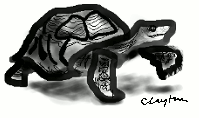
She’s not there either. Instead there’s a large tortoise, walking in that awkward, drag-stepping way they have, like the whole shell thing was maybe not such a great idea after all. But it’s making progress, from its little lean-to under the lilac tree to the dense vegetation on the other side.
The neighbour comes out and talks to us over the fence. Apparently Rosa went in to hospital by ambulance sometime this morning. A good thing too, he says. We’ve been trying for years to get her some help but she just keeps turning it down.
‘Are you okay to look after the tortoise?’
‘Hank? Sure! Hank’s no bother.’
We all watch him. And whether it’s because he senses the attention, or whether it’s because he’s realised he’s left his wallet back in the hut, he stops, cranes his head round, and stares. It seems to last a long time, but eventually, with an odd, gacky little snap of his beak, he looks forward again, and after gathering himself, sets off on his long, slow progress across the garden.tortoise

oh mother dear

Marla is standing supporting herself against the wall, her arms straight out in front of her, the fingers of each hand spread like claws. All she’s wearing is a small white vest and a pair of scrappy pink knickers, bunched up at the groin like a Band-Aid round the apex of a wishbone.
‘Are you all right, Marla?’
I put my bag down and go straight over.
‘What? Yes, yes. Perfectly fine. Why wouldn’t I be?’
‘I don’t know. You look a little stuck.’
‘I’m not stuck. I’m feeding les petits cochons d’inde.’
For the first time I notice a plate of chopped carrot and lettuce in a Tupperware box on the floor just under the table. She must have been en-route to the guinea pigs in the sitting room when she felt herself going and had to grab on to the wall.
‘Do you speak French?’ she says.
‘Schoolboy,’ I say. ‘Un peu, malheuresement.’
‘Ah – the English! Absolutely appalling at languages.’
‘Let me get a chair for you,’ I say, picking one up, bringing it over and setting it ready behind her. ‘Une chaise. Just in case.’
She tuts, but her legs are about to give way and she collapses into it.
‘That’s better!’ she says. ‘Now then. What do you want?’
‘I’m Jim, from the Rapid Response Team at the hospital.’
‘Ah! Lucky Jim! How I envy him…’
‘I’ve just come round to see how you are, to make sure you’re okay. How are you feeling? Any pain?’
Take my hand, oh mother dear, in truth I feel a little queer… or something like that. Do you like the Victorians? We added queer of course. Although it didn’t mean what it does today.’
‘Shall I feed the guinea pigs for you?’
‘That would be marvellous, thank you. Would you mind giving Rupert a little extra? He’s bigger and does more.’
After I’ve emptied the box I come back into the kitchen to make Marla some black tea and to check her blood pressure. It’s been low all week – probably due to low weight than any infection.
‘Do you know my favourite quote from Shakespeare?’ she says, taking a tiny sip of tea and then composing herself again. ‘Aroint thee witch the rump-fed runyon cries!’
‘I love that play. It has such great language. And it’s short.’
‘Terribly unlucky to quote from it, of course,’ she says, tapping the SATS probe on her finger. ‘Is this doing anything?’ she says. ‘Still alive, am I?’
‘Pretty good. Everything’s fine apart from your blood pressure.’
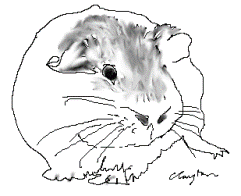
‘Ah, well, you see. My father was ninety-three when he died. I take after him. Cursed with longevity. Not like my mother. She had terrible health problems, poor woman. Arthritis and so on. Stuck in bed for the last few years. I was working in a West end show at that time, in the chorus, and I really had no time to look after her. So I hired Mrs Tubbs to pop in now and again. An old family friend. Although my mother couldn’t stand her. One day I was tucking mummy in and she said to me Could you be a sweetie and bring me up that little black handled knife from the kitchen? And I said Well whatever for? And she said I’m going to stick it in Mrs Tubbs’ back. Maybe THAT will stop her coming round all the time. I said Don’t you think that would make rather a mess? And d’you know what she said? Don’t be silly, darling, I’ll give her a handkerchief…guineapig

choco horror

SCENE: The early morning scrimmage at the big desk, taking down care calls, re-ordering caseloads, planning routes.

‘She said I had a nice personality. She said I was refreshing.’
‘Like a hygienic wipe’
Personality, Tom. Would you like me to spell it for you?’
‘I don’t know, Tara. Did you bring your crayons? I know what a personality is, thank you very much. Just because I don’t choose to wave it around willy nilly.’
‘I’ll leave the willy waving to you.’
‘Okay then. How many thank you’s have you had this year?’
‘I’ve had my share.’
‘How many? Go on.’
‘It’s not always about a card or a box of chocolates, Tom. Sometimes it’s just a smile or a kind word.’
‘So that’s none, then.’
‘Why? How many have you had?’
‘Two.’
Two?
‘This year.’
‘Who from? Your mum?’
‘No. Mrs Camden…’
‘Well that’s not saying much. How did she address it? Dear Prime Minister…
‘…and Stuart Groves.’
‘Come on! You’re having a laugh!’
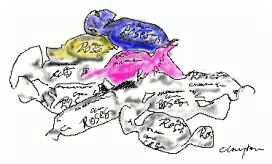
‘No. And chocolates. Which, by the way, I hardly had any of. I put them on the desk, handed my patients over to Michaela, and when I turned back there was just a pile of wrappers.’
‘You’re not serious.’
‘I’m perfectly serious. Nothing left but the strawberry dreams.’
‘Stuart Groves?’
‘He liked me, Tara. What can I say?’
‘The Stuart Groves who put that horrible complaint in against Alisha? The Stuart Groves with the creepy shrine to Daniel O’Donnell?’
‘His musical tastes have no bearing on the issue.’
‘What did you do? Sing Danny Boy?’
‘No. I was the consummate professional.’
‘Competent would be a start. But seriously, though. How did you screw a thank you card and chocolates from Stuart Groves? That’s like getting a bunch of flowers and a sloppy kiss from Mussolini.’
‘I think that’s a bit extreme, don’t you?’
‘He’s a douche bag.’
‘Oh dear. What happened to Miss Refreshing Personality 2016? Didn’t last long, did it?’
‘Well. I mean. Poor Alisha.’
‘She can look after herself.’
‘I wouldn’t have had any of those chocolates. I can just imagine him sitting there with a needle…’
‘You’ve got a surprisingly warped imagination, Tara. Anyway, if you were going to inject chocolates, you’d have to do it to one of the creams. A toffee wouldn’t take it. Your truffle might, but you’d really have to go for a strawberry dream or a coffee creme. So I’d have been all right, ‘cos I hate them. I only ever go for the toffee finger.’
‘So I’ve heard.’
‘Cheeky. Look – I can’t sit around wasting my life with you losers. I’m going out to do some good in the world and I bid you all a fond farewell.’
‘See you later, Tommy.’
‘Bye-ee.’
(after he’s gone)
‘He didn’t really get two cards, did he?’
‘I think so. Yep.’
‘Where are they? I want to check the handwriting…’
chocs

the domino effect

Even if I was sitting the other side of the office – and not just the other side of the desk – I could tell it was a difficult call.

It isn’t anything to do with Michaela’s body language. She often sits like that, a little hunched over, focusing on the task at hand until it’s done, then switching fully to the next. And it certainly isn’t how loudly or quickly she’s speaking, because generally with Michaela, the more pressurised she is on the phone, or anywhere else, the quieter and more precisely she speaks. It ‘s more to do with the fact that she’s repeating the same thing over and over again.
I can’t hear what the caller is saying, of course, but from Michaela’s insistent ‘Yes, I understand doctor, but I’m sorry to say we have no capacity’ it’s a fair guess it’s something like: ‘My patient is struggling and needs some care.’

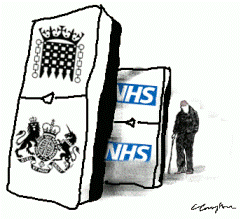
It’s a conversation we seem to be having more often. And if the glib answer would be to point out the current state of the NHS and ‘the domino effect’ of public spending cuts, I suppose the one reassuring aspect would be that at least it isn’t a particularly long line of dominos. Four at best, with one really big, Treasury-patterned domino at the beginning.

In some respects, our service is a victim of its own success. Or at least, the clarity of our mission statement. The Rapid Response Team was set up as a three-day service to provide the clinical support, care and equipment someone might need to stay at home and avoid hospital admission. Our referrals come from four main places: the ambulance service, A&E, GP surgeries and the District Nurse clusters, with some additional patients from other community healthcare agencies. In the context of this bewildering mesh of services, the simplicity of our aim makes us a clear target. As things have got tighter we’re increasingly seen as the fixers, a kind of NHS marine corps, the thin red line between The Service and The Courts.

Which brings me back to the doctor on the phone, and the dominos.

When Michaela says we have no capacity, what she means is that our carers are working at full stretch, with lots of patients still on the books after a month, many of them complex palliative cases that require double-up carers three or four times a day. And the reason for that is that there aren’t enough carers in the community to refer on to. And the reason for that is that councils across the country are buckling under the strain of maintaining adult social care services in the face of continuing budgetary cuts. And the reason for that is, well, the government.

‘Yes, I’m sorry doctor. But I’m sorry to say we just don’t have the capacity.’

And even though Michaela says goodbye very politely, and puts the phone down with admirable restraint, maybe it’ll be enough to add a little something to all the other shock waves currently playing out across the system, to join together into one big wave, that might finally start pushing the dominos back the other way, and setting things right again.domino

the doll’s house

Eric died today.
Although it was expected, it came quickly. End stage COPD complicated by serious infection. Fortunately the palliative team had been able to get in a hospital bed, anticipatory drugs and arrange for an emergency package of care. The room he died in was tiny – little more than a box room, barely enough space for a carer either side to roll him gently for cleaning and pressure sore treatment.
I was there just yesterday. The family had been gathering in the front room downstairs, drawn from miles around the last couple of days, now patiently waiting for the end, finger-walking through magazines and phones, taking it in turns to make tea, talking about supermarkets and football and the M25 and struggling to make sense of any of it.

‘How’s he doing, poor sod?’ said his brother. ‘Still away with the fairies, I ‘spect?’
Well…you know. He’s struggling, but I don’t think he’s in pain.
‘Would you like some tea?’
That’s kind, thanks, but I’d better not.
‘What about a biscuit? We’ve got biscuits coming out of our ears.’
‘John!’
‘What?’
‘He said he didn’t want anything.’
‘He didn’t say anything about biscuits.’
‘He’s just being polite.’
I don’t normally say no, but I’ve just had lunch.
‘It’s your funeral.’
‘John!’
‘What?’
I’ll just finish writing in the notes and then I’ll leave you in peace.
‘Don’t do that. I snore something rotten.’

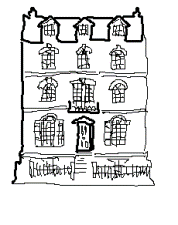
One of the reasons the box-room was so cramped was the presence of a large doll’s house. If Eric had made it, he was quite a craftsman. It was an immaculate, three storey Georgian affair, every detail painted just so, railings along the front, slate steps to the front door, a gable roof, curtains in the glazed windows. It looked as if the front of the house was hinged. Whether it was because the weather was close and scratchy, or the weight of expectation downstairs, or a combination of the two,  it’s hard to say, but I had the queasy feeling that if I’d flipped open the house (if there had been the space to do it), I’d have seen a miniature replication of the scene I was in.dollshouse
A dying man in his bed, me and the other carer by his side, and downstairs in the living room, half a dozen relatives, each holding a cup of tea and looking up.

thoroughly organised

‘With a surname like mine, I couldn’t very well not be a banker,’ says Samuel Ransom, leaning sideways to see that I get the joke and almost pitching sideways out of the bed in the process. I help him straighten up and re-arrange his inflatable leg supports.
‘This is a damned wretched business,’ he says, surveying the scene. ‘Six weeks I’ve been laid up like this. Six weeks!’
There’s a squeaking and a trundling from the hallway, the door nudges wider, and Sally, his wife, comes in on a seated rolator, punting herself backwards with her legs.
‘Don’t fret, darling,’ she says, manoeuvring herself so she can see him, ‘Now look. I’ve called the bed people and they say they’ll have someone round to have a look.’ She puts the phone back on the base unit, and smiles at me – quite a feat, given the amount of lipstick she’s wearing. ‘The moving mattress thingy,’ she says. ‘It’s stopped making that rustling noise. Is it broken, d’you think?’
I give it a quick look. There’s no error message on the console at the foot of the bed, and the mattress seems nicely inflated. But she’s right, these dynamic mattresses are designed to cycle through alternative pressure distributions, and it does sound suspiciously fixed.
‘Best leave it to the experts,’ I say.
‘Fair enough.’
She pushes herself backwards across the room, over to a pile of clothes draped on a chair.
‘How’s the old duffer looking?’ she says, shaking out a pair of pyjama bottoms. ‘Time for a new model?’
‘You wouldn’t think I was such a sportsman to look at me now,’ says Samuel. ‘Football. Golf. Swimming. You name it. I broke my finger pretty badly playing football. I was a goalkeeper, you see. I dived to save a ball, and got a boot in the hand for my trouble. Knocked six bells out of this finger and – see? – it’s never gone back.’
He holds up his left hand. Whilst it’s true the ring finger is twisted at an unnatural angle, the effect is a little diluted by the general state of his arthritic hands.
‘I struggle to hold a beaker these days, let alone a golf club,’ he says, relaxing back on the pillows. ‘But you should have seen me then! I couldn’t sit still for five minutes.’
‘Or stop talking,’ says Sally, punting backwards to the phone again, and taking it out onto the landing to make another call.
I finish the examination.
‘Not too bad,’ I say, looping the stethoscope round my neck. ‘Better than yesterday. I think what you really need is a course of physiotherapy, to get you moving again.’
‘Great!’ he says. ‘Thank you.’
He watches me write out the ticket for a while, then says: ‘It’s a new kind of problem, isn’t it?’
‘How d’you mean?’
‘All these old folk, hanging around, kept going with drugs and so on. How are we to afford it?’
‘I don’t think you’re hanging around. I like having you here.’
‘That’s kind. But look…’ he says, touching me on the hand and lowering his voice. ‘I can see it coming. There’ll be a knock on the door. They’re here! says Sally, because an appointment will have been made well in advance. It’ll all be above board, properly regulated and so on. Thoroughly organised. And she’ll open the door, and it’ll be a smartly dressed man, in a pin-stripe suit – and a woman, too, no doubt – and they’ll be very polite and so on, and show their credentials. And they’ll follow Sally upstairs to see me. She’ll travel up on the stair lift, of course, and no doubt they’ll make a note of that. Then they’ll come into the room, much like you did. And they’ll ask to see my documents, my passport and so on. That’s fine they’ll say. That’s all in order. Then they’ll unpack their case and …’
He raises his hand in the air and gives it a little shake, a motion that has to pass for a click of his fingers.manwomanclipboard
‘Yes,’ he says, relaxing back into the pillows. ‘I can see it
coming. Because really, you know, this can’t go on. This can’t go on at all.’

jinxed

The signs were clear from the start.

The house of the first patient turned out to be a hostel for independent living, divided into flats. I tried number one, no answer. Then two, three, four…. no-one, and no on-site staff. I rang the patient’s mobile – out of commission. I rang Claire in admin back on base – permanently engaged, except for a couple of times when I was put through and then immediately cut off. I rang the source of the referral, a street-sleepers facility, who gave me five alternative mobile phone numbers. I tried them all. None of them worked. I phoned Claire again (and got through, incredibly).
‘I give up. I’ve tried everything but a Ouija board to get in touch with this guy. We’re going to need some better information.’
‘I’m not surprised,’ says Claire, sounding exhausted. I can picture her, the phone cradled to her ear, whilst people come and go through the cubicle, all of them stressed and wanting something, whilst she writes out a memo and reads an email at the same time. ‘Last time he was on the books I think we caught up with him once.’

So I’m looking forward to the next patient. It’s been given to me on the fly. Would you mind swinging by to see Rachel, an eighty-four year old female with a query UTI? If you could do a quick set of obs and a urine dip, that’d be great.
It’s a smart block of flats I’ve been to before. Easy parking under a shady tree, so the car won’t be quite such a sweat box when I come back. It all looks good. The stress of the morning already feels easier.

I go to the main door. There are a dozen key safes clinging to the wall in a group like mussels on a rock at low tide. I have the code for one of them. Sometimes these things are marked with a dab of nail varnish or a piece of coloured tape to help you go straight to it, but I don’t mind. I start at the top and work my way down.
None of them open.
I put my bag and book down and try again. Same result. I try buzzing the flat directly. Sometimes there’s a relative on scene, sometimes the patient can actually get to the door.
After a while, Rachel answers.
Yes?
‘Hello. My name’s Jim. I’m from the Rapid Response Team at the hospital. I’ve come to see Rachel McGoogan.’
Well I’m Rachel McGoogan! What is it that you want?
‘I’ve come to do your blood pressure and so on. To see how you are.’
To see how I am?
‘Yes.’
Who did you say sent you?
‘The doctor.’
What doctor?
(I suddenly realise I don’t have that information, so I try to wing it).
Your doctor.’
And who is that?
‘I’m sorry but I don’t know.’
Are you sure you have the right place?
‘Yes. Absolutely.’
I’m not sure you do.
‘Yes. Absolutely. Rachel McGoogan. Beech Apartments. Flat Seventeen.’
Well that’s me!
‘Yes.’
And what did you say you’ve come for?
‘To see how you are.’
I’m fine thank you. Good day.
She clicks off.
It suddenly occurs to me it might still be early enough to use the tradesman’s button. I press it. The door opens. I grab my bag and go up.

I knock on her flat door and ring the bell. There’s no reply. I peer through the letterbox. It’s all quiet.
‘Rachel? Hello-oo. It’s Jim, from the Rapid Response Team. Is it all right if you came to the door for a chat?’
No response.
I check my book and find her telephone number. The phone rings – at immense volume – just the other side of the door. When eventually she picks it up, I can hear her voice more clearly through the door than through my phone.
Rachel McGoogan.
‘Hello, Rachel. It’s Jim, from downstairs.’
Downstairs? What do you mean, downstairs?
‘The front door. From the Rapid Response Team.’
What do you want?
‘I’ve been sent to check your blood pressure and so on, to make sure you’re okay.’
Of course I’m okay. What on earth do you mean?
‘You haven’t been well lately.’
Haven’t been well?
‘You’ve had an infection. I’d really rather talk about it face to face.’
I don’t understand what you’re trying to say.
‘The doctor has asked us to come round for a few days to make sure you’re okay.’
If I’m unwell, I’ll go to the doctor. I haven’t the faintest idea what you’re talking about.
She hangs up. I can hear her walking away, muttering.

I go back downstairs. Given her recent history, I know I’ll have to make more of an effort to see her, so the next step is to find out what the actual key safe number is. I try ringing Claire again, unsuccessfully. Then I try the care agency. The person who answers the phone has a stammer, so bad it’s virtually impossible to understand anything they say. I give them my number to phone me back once they’ve checked the records.

I sit down on a low wall to collect myself.

I look around, at the trees, at two guys up on a roof, working. They’ve taken their t-shirts off and wrapped them round their heads. Oh my god,  I think. It could actually be worse. When I look down again I notice that there are two key safes the other side of the wall. I try them. The top one’s Rachel’s. As I’m letting myself in the main door again, the guy from the care agency rings back. The key safes were round the other side  I tell him. He starts trying to say something beginning with N, but I’m too impatient to let him finish. I thank him for his help, then making the excuse that the lift had just arrived, hang up. As I ride up to Rachel’s flat, I think about the wisdom of putting someone with such a pronounced speech impediment on the help line – and then immediately feel guilty that I should be so uncharitable. Is it any wonder the day’s so jinxed?

I arrive back at Rachel’s door and announcing myself as cheerfully as I can, let myself in.

She’s sitting in a high-backed armchair in full sunshine, her fingers laced contentedly across her tummy, one leg crossed over the other, the foot tapping up and down, like she’d been expecting me all this time.
‘And who might you be?’ she says.
‘Hello! Rachel! I’m Jim, from the Rapid Response Team. We spoke on the phone.’
‘The chap at the door?’
‘Yes. And the door. That’s me.’
‘How on earth did you get in?’
‘I used the key safe.’
‘What d’you mean, key safe?’
‘A safe. On the wall. For keys.’
‘Whatever for?’
‘So people can get in and out.’
‘What people?’
‘Carers, district nurses, paramedics – in an emergency.’
‘But why would I want all these people in my flat?’
She leans forwards.
Who did you say you were?’ she says.
‘Jim. From the Rapid Response Team. Would you mind if I had a quick look at your yellow folder?’
‘Whatever for?’
‘To see how you’ve been over the last few days.’
‘I’ve been fine! How extraordinary! I must say I’ve never been spoken to like this before…’
I flip through the folder to get some more information.  There’s no mention in her past medical history of dementia or short term memory loss.
‘Well?’ she says.
‘I’ve been asked to check your blood pressure and temperature and that sort of thing. To make sure you haven’t got an infection.’
‘I saw the doctor only last month and he said it was fine.’
‘A lot can happen in a month.’
‘Such as…?’
‘Such as a urinary tract infection.’
‘A what?
‘A urinary tract infection. They’re easy to pick up, but the good news is, they’re also quite easy to treat. They can make you feel really off colour, though. Quite confused…’
‘I’m not confused.’
‘Your family have said you haven’t been yourself lately. And one of the reasons could be – one of the common reasons – is that you have a urinary tract infection.’
‘I’ve never had one before.’
‘But it’s possible you’ve got one now. That’s why I’m here. To check.’
‘I shan’t let you.’
‘That’s okay. But I need to reassure myself that you understand what it is you’re saying no to.’
‘In all my years – I’ve never been spoken to like this. It’s quite extraordinary.’
‘I’m sorry you think so.’
‘And who did you say sent you?’
‘The doctor. Now – Rachel. Would you at least let me take your blood pressure?’
‘If you must,’ she says, leaning back, letting her head loll back on the wings of the armchair and stretching out her arm.

Actually, her obs are pretty good. Nothing much to suggest infection. The fact remains, though, that the primary purpose of the visit had been to obtain a urine sample, and Rachel steadfastly refuses to give one. Even though I’m pretty sure she doesn’t understand the logic of the request, there’s nothing more I can do. It’ll be up to the carers to get a sample at some point, or for the GP to prescribe some antibiotics speculatively.
I finish writing up the notes, put the pen down, and shake my head.
‘Do you ever get those days when nothing, absolutely nothing, goes according to plan?’ I ask her.
She laughs, and gently claps her hands.
‘No!’ she says. ‘I can honestly say, I never have!’

to the underworld

Chloe’s MS has left her with very little control of her legs, so I’m helping Jaime the nurse with the re-catheterisation.
‘I might spasm,’ says Chloe. ‘Sorry. I promise I’m not doing it deliberately.’
Whilst Jaime sorts through the box of supplies to make sure he has everything, I chat to Chloe to take her mind off things.
‘It’s such a lovely day today.’
‘They say it might rain later.’
‘Do they? Who?’
‘I don’t know. They.
‘What do they know?’
‘I suppose we should be used to it.’
Chloe’s bed faces two patio doors that open out onto a small courtyard garden thickly overhung with camellia and honeysuckle. A net of fairy lights have been strung from the house to an ornamental maple.
‘This is such a great room,’ I say, gowning and gloving up. ‘It’s lovely to have the doors open like this.’
She smiles.
‘When it’s not raining,’ she says.
Jaime sets up his stuff.
‘We just need to pull the quilt aside,’ he says. ‘Okay?’
I help manipulate Chloe’s legs to give him good access. Chloe grimaces and stares up at the ceiling as he deflates the balloon and withdraws the catheter.
‘There! All out!’
‘You’re doing really well,’ I tell her. She doesn’t answer, but turns her head to the side.
‘That’s an unusual picture,’ I say, following her gaze to a painting on the wall. A frightened woman is also staring off to the side, to a black tree or maybe a dancing shadow on the low rise of a hill. There are pomegranates falling onto her from above; she holds out her hand to catch one.
‘What’s she doing? Juggling?’ I say.
‘Just putting the anaesthetic gel in,’ says Jaime.
‘It’s Persephone,’ says Chloe. ‘Do you know the story?’
‘A little wider please, thank you,’ says Jaime.
‘I’m not sure…’
‘It’s one of the Greek myths. Persephone was the daughter of Zeus and Hera. Abducted by Hades and taken down to the underworld. They sent Hermes to rescue her, but because she ate a pomegranate seed she had to spend half the year back there.’
‘Almost done!’ says Jaime. ‘There we go. Draining nicely.’
‘Thank you,’ says Chloe.
We tidy her up, dispose of the waste and redundant equipment, replace the quilt and make sure that she has everything she needs to hand.
‘Did you paint it?’ I ask her.
‘Me? No! I got it at a car boot sale.’
‘It’s amazing what you can pick up if you look.’
‘Yes,’ she says, taking a sip of water from her beaker. ‘I don’t know. It just kinda spoke to me.’

up periscope!

Sixty years ago, Peregrine Cope worked on submarines.
‘I bet you must’ve heard it a lot.’
‘Heard what?’
‘Up Perry Cope! You know….your name.’
He looks confused.
‘They called me P,’ he says. ‘Until I thumped them.’
It’s hard to imagine Perry in a submarine. He’s still over six foot, despite the geriatric shrinkage. In his youth he must’ve been an imposing figure. The conning tower was probably the only place he could stand up straight.
‘Was that difficult? Being so tall, in a submarine?’
He shrugs.
‘They had hatches,’ he says.
‘But if you’re underwater…’
He sighs, reaches for his mug of tea, takes a swig, then holds the mug up close to his face to inhale the vapours.
‘You could smoke as much as you liked when you were cruising on top,’ he says, following another thought. ‘On a dive, it was strictly one a day.’
‘I suppose they couldn’t afford too much smoke in a closed environment.’
‘We liked it,’ he says.
His wife Rita brings in a plate of sandwiches.
‘I want to see them gone when I get back.’
‘Very good, sir!’ he says.
She grabs her Scottie dog themed shopping trolley and drags it out the front door.
‘I think I’m probably better adapted for life on a submarine,’ I tell him, turning back to the folder to write out the yellow form. ‘Being so short n’all. Plus I don’t smoke.’
‘I gave up thirty-five year ago,’ he says. ‘Doctor’s orders.’
‘Yep. Submarines. Mines. Outer space. I’d be all right.’
‘Were you ever in the services?’ he says, putting his mug of tea back down, then picking up a sandwich and lifting the top of it to inspect the contents, half of which fall into his lap.
‘I thought about it once. I even got as far as going to a recruitment office. But the guy on the front desk was pretty ferocious and he put me off. I mean – if they’re like that when you’ve just walked in off the street, what’s it going to be like when you’re on the parade ground?’
Perry puts the sandwich back and claps his hands clean.
‘A damned sight worse,’ he says. ‘You know, when I joined up they asked me what trade I had. I told them engineer. So what did they do? They put me down as a cook. It took me ten years to work my way up. But I enjoyed it. Saw the world.’
‘And plenty of fish.’
‘What d’you mean, fish? They don’t have windows, you know.’
‘Really? Shame.’
He studies me a while then shakes his head.
‘How long have you been in this game, then?’ he sighs, reaching for his tea again.
‘Me? A year or thereabouts’ I tell him. ‘Feels longer.’

don’t make me angry

The Co-ordinator warns me about Mary.
‘She gave the last nurse a hard time, complaining about everything.’
‘Yeah. I’ve met her before. She can be a bit grumpy sometimes.’
Grumpy! I like that! Grumpy!
And she walks off laughing, a little too loudly, like I’d just described the Jabberwocky as a bit of a grouch.

*

Mary is sitting in front of a re-run of The Incredible Hulk, picking her way through a plate of coleslaw and beetroot.
‘And another thing,’ she says, spearing a hunk and waving it at me, ‘how am I supposed to get better if all you lot keep coming round and stopping me eating?’
‘Sorry to interrupt your lunch,’ I say, checking my watch. It’s half past three.
‘Not as sorry as me, mate’ she says, almost biting the fork in half, turning back to the television.

Bill Bixby is working as a medic at a rodeo. He’s taking time out to play poker with some cowboys. I wonder which one’s going to make him angry.

‘Anyway. What is it with you lot?’ says Mary. ‘You come round here, demanding this and that. Haven’t you got anything better to do? I’m sick to death of all these people traipsing through the flat, asking lots of stupid questions. And I tell you another thing for free. You’re not going to see my bottom. You don’t want to see my bottom, do you?’
‘There’s a reason for it….’
‘I ain’t going to show you nothing. I’ve got my dignity. I’m not here to be abused by the likes of you and your perverted interests.’
‘We have to check to make sure you’re not developing any pressure sores…’
‘Pressure sores my arse. How would you like it if I asked to look at your bottom?’
‘Well, if it was clinically necessary I wouldn’t have a problem.’
‘Oh wouldn’t you? Well I’m not letting you anyway near, so you can cross that one off your list.’
‘Fair enough. You don’t have to do anything you don’t want to.’
‘Then why d’you keep asking? I only had my blood pressure done last month. If you’re interested, why don’t you go and ask my doctor? He’ll tell you.’
‘I think it was your doctor who referred you…’
‘Did he? Well I’m not surprised. He’s only bothered because he don’t want to get sued.’
‘I don’t think that’s true.’
‘Oh? So now you know more than me? Well I bow to your superior knowledge, your lordship. Everyone coming round here getting on my nerves. And what about these so-called carers? They can’t do me a meal. I asked if they’d peel me a few spuds and make a pie, but of course no, no! They ain’t got the time! They just want to heat up those microwave dinners. I wouldn’t give ‘em to a dog. A bit of toast in the morning? Sorry – you’ll have to make it yourself. Carers! Lazy, that’s what they are. There’s precious little care there, mate.’
‘I’m sorry you feel like that, Mary.’
‘You’re not sorry. You’re just like the rest of them. You’re only worried about your figures and your little tick boxes.’
‘That’s not true.’
‘Not true? Oh – excuse me for having an opinion.’
She puts her plate down and roughly wipes her chin with some kitchen towel.

Bill Bixby is driving in his pick-up truck, glancing anxiously at a wagon that’s speeding up behind him. He’s going to change soon I think. He’ll be smashing things up in a minute.

‘Well go on then,’ says Mary.
‘Go on what?’
‘Do my blood pressure if you’re going to. But I tell you something for nothing. It’s going to be through the bleedin’ roof.’