
Evenly spaced along the window ledge, the mantelpiece, book shelves and any other level surface, are dozens of solar-powered figurines. Dancing flowers in flowerpots, the Queen sashaying with her arms outstretched, hula hula girls slinging their hips, leprechauns jigging, frogs on swings, swinging, dogs waggling their ears, chickens lurching backwards and forwards, TV personalities with giant heads, smiling crazily, jangling from side to side, the whole room filled with an incessant jittering and wiggling and tic-tic-ticking.
Ella, by contrast, is utterly immobile. Her great weight and her arthritic knees mean she spends most of her time in the armchair, watching TV, or sleeping, or somewhere in between.
I can’t think of a more perverse environment for someone with reduced mobility. After five minutes in the room I want to throw down my pen and run out screaming. But it’s not my collection. And maybe I’d stop noticing the hyper-kinetic horror of it all given a few more hours.
‘What d’you think?’ she says, gesturing to the figurines.
‘Awesome!’ I say, and I carry on with the examination.
What seems worse is the thought of all the figurines gradually stopping as the sun goes down. And being silent all night. And then slowly starting up again in the day.
‘I think I know what to get you for Christmas,’ I say.
‘Yes,’ she says. ‘A new pair of knees!’
Uncategorized
rebel
‘It’s not what the MS has done to me that I hate the most – although, God knows that’s bad enough. No, the worst thing is what it’s done to my relationships and the people around me. My wife couldn’t cope and had to move out. Which I could understand. It’s not an easy ride, by any stretch. But you adapt. You have to. And things worked out okay, we stayed friends. Then she got this diagnosis of cancer, and went to pieces, and it drives me mad I’m not there to help her through it.’
I’ve met Alan before. I remember last time how impressed I was with his resourcefulness, his outward looking positivity, his creative response to the challenges of his illness. Despite a cruelly swift advance of his symptoms, he’d adapted his flat in enterprising ways; he’d kept up with his writing and his social media. He’d even managed to carry on performing his songs.
‘If they don’t like it they can always wheel me out,’ he says.
But the thought of his wife and her troubles has cast a pall on things – that, and a recent stay on a ward to be treated for a persistent UTI.
‘I think they ran out of beds and had to put me on a dementia ward,’ he says. ‘I never felt so lost.’
Petra, the OT, joins us. A happy coincidence. You can always rely on Petra to come up with an interesting story from her travels that puts things in perspective. When the consultation’s pretty much done, and we’re all sitting round the kitchen table, the conversation turns to other people’s expectations, societal norms, how limiting they can be if you let them.
‘I saw Rebel Without a Cause’ the other day,’ I say. ‘It was funny. All the teenagers looked about thirty.’
‘I think in the end it’s more about economics than rock n’roll,’ says Alan, taking a sip of tea. ‘I think they invented teenagers in a lab sometime in the Fifties.’
‘All that age consciousness, it’s definitely a modern, Western thing,’ says Petra, ‘But it’s not like that everywhere. I remember working out in Zimbabwe for a while, and when I asked this guy how old he was he said he didn’t know, but I was born in the year of the many pumpkins.’
‘I like that,’ says Alan, carefully putting his beaker down. ‘Yes. That’s good. I like that very much.’
pet rescue
I can hear Elsa wheezing all the way down the corridor to the front door. A fuss of bolts and chains. Elsa peers suspiciously round the edge.
‘Hello. My name’s Jim. I’m with the Rapid Response Team.’
‘The what?’
‘The Rapid Response Team. From the hospital. Come to visit Elsa.’
‘Well – that’s me!’
‘Oh! Great! Hello, Elsa!’
‘Who did you say you were?’
‘Jim. Rapid Response. How are you today?’
‘Well I’m a bit confused.’
‘Sorry to hear that, Elsa. Why are you confused?’
‘I haven’t got any rabbits.’
unplugged
‘And how long have you been having these hallucinations?’
Alisa blinks rapidly and turns the corners of her mouth down.
‘Years!’ she says. ‘Ever since the eyes started to go.’
Alisa suffers with Charles Bonnet syndrome – a fascinating condition something like a visual processing error. Alisa’s macular degeneration, compounded by cataracts, means that her sight has been steadily growing worse. Her brain does what it can to supplement the limited information, resulting in vivid images.
‘What kind of things do you see, Alisa?’
She looks up.
‘Lines of people, descending from the ceiling!’
‘What kind of people? Do you recognise any?’
‘No. All strangers. But they look old time, if you know what I mean. The woman have got big flouncy dresses on, and the men have got tall hats. And they all come down in rows, man, woman, man, woman. And they’re all of ‘em dressed in pink.’
‘Pink?’
‘Even the men.’
‘What else do you see?’
‘Sometimes the whole window’ll blow in, chunks of brick and plaster all over the place, just like a bomb went off in the garden. But without a sound.’
‘That’s pretty scary.’
She shrugs.
‘You get used to it,’ she says. ‘Oh yes – and then there’s the fire.’
‘What fire?’
‘Well – sometimes I’ll look in the kitchen and there’ll be huge flames coming out the cooker. I don’t worry about it.’
‘No? I’d be terrified! But then I suppose you’re so used to seeing these things they don’t bother you any more.’
‘Ye-es. That and the fact I know the cooker don’t work. I only ever use the microwave.’
two aces, two eights
The long, frizzy hair, slicked flat at the top but bumping out and falling at the sides like a Spaniel’s ears (the effect of all those years in a hat, I guess); the lachrymose handlebar moustache; the face open and smooth but then sharp at the cheekbones, like it’s been planed from a block of maple; the sad, ‘sorry I had to shoot you’ kind of eyes – it all adds up.
Mr Smith is a spit for Wild Bill Hickock.
And if it’s true, then what a falling off there was.
From the glitzy sawdust rings of the world, to a glitchy two-ring cooker. From shooting plates from the back of a galloping horse, to aiming into a bottle from an armchair.
Deadwood to Deadbeat.
Mr Smith hasn’t moved from the chair since the ambulance left him there last night. He scarcely knows what time of day it is.
‘Saturday?’ he says, his head inclined to one side. ‘Thursday?’
The heat in the flat is overwhelming, but it’s impossible to get to a window because of all the crap in the way.
A gang of flies is busy cutting a pentagram into the noisome space above his head.
He reaches down beside him, not for a whiskey, but for a two litre bottle of cider.
‘We need to move your furniture around a little, to make it easier to get about,’ we tell him.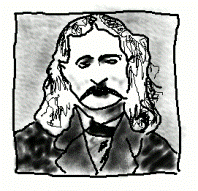
He shrugs.
‘Just so long as I’m not sitting with my back to the door,’ he says.
Takes a slug.
dog show
‘Get out of my house!’
‘Okay. Will you move your scooter for me?’
‘No! Move it yourself!’
It’s not as easy as it sounds. The hallway’s only slightly wider than Geoff’s mobility scooter. When it’s on charge, they have to park it up against the front door to have access to the rest of the flat, to the kitchen, bathroom and bedroom. If someone comes to the door, they move it forwards. I’d been impressed to see how easily he’d moved it back once I was in the living room, draping his hand across the console without seeming to look all that much.
‘Wow! That’s impressive!’
‘I’m used to it,’ he’d said.
The irony was, I hadn’t come to visit Geoff. His wife, Rita was the patient, on our books for obs and bloods, help with washing and dressing and meal preparation. I was there at lunchtime to see what she needed. I’d repositioned her corset – a complicated, strappy affair designed to help with her spondylosis. All she needed was a pair of sunglasses and a hard-hat, and she could be a SWAT officer, one that had taken up position at the end of the sofa and forgotten about these fifty years.
With the corset successfully repositioned, I’d gone into the kitchen to set about preparing Rita’s microwave meal. Whilst it was cooking, I’d come back into the lounge to write up the notes.
‘What about you, Geoff? What do you do for lunch?’
‘Me? I make myself a microwave meal.’
His answer hung in the air between us. I tried not to say anything, but I’d been frantically busy all day – all week, actually – and I just couldn’t resist.
‘Do you think you might be able to make Rita something to eat at the same time?’
‘I’m sorry?’
‘Whilst you’re there. You know – two at once.’
‘I’ve got serious health problems. I can’t be standing on my feet for that long.’
‘I could get you a perching stool. You could rest while they were cooking.’
‘No! That’s what you’re here to do.’
‘I know. But I’m just saying… we’re pretty stretched at the moment…’
‘That’s not my fault. Hire some more people if you haven’t got enough.’
‘I wish we could. The fact is, though, we’re horribly short-staffed. And if you’re already in the kitchen preparing food…’
‘Get out of my house!’
‘I don’t think it’s an unreasonable thing to ask, Geoffrey…’
‘Go on – get out!’
‘Okay. Will you move your scooter for me?’
‘No! Move it yourself!’
It takes me a few goes. The joystick is extremely sensitive, and because I’m standing off to the side I find it hard to judge the angle. After a few awkward attempts, I manage to move it along enough to squeeze past.
I’m going to be writing to the papers, you know! he shouts after me.
When I get back to the office Michaela calls me over.
‘Mr Rawling’s been on the phone,’ she says, a brisk shine to her voice. ‘He said you were rude and aggressive and stormed out of the house.’
‘That’s ridiculous! I didn’t storm. He asked me to leave, so I did.’
‘He also says he fell on the floor.’
‘So what did I do – step over him?’
‘Hmm,’ she says, reading her notes. ‘He’s also asking for more care.’
‘What do you mean?’
‘Meal prep. For both of them.’
‘Oh come on! He’s doing it out of spite. He’s perfectly able to make his own meals. He goes out every day on his scooter. He told me he wouldn’t be there tomorrow because he was entering the dog in a dog show, for goodness sake.’
‘Nice dog?’ she says, closing the folder.
‘Lovely, Michaela. Very cute.’
‘Well that’s something.’
‘Yep. I’m good with dogs. Maybe I should quit and re-train as a veterinary nurse.’
‘Don’t say that, Jim! It’ll be fine! Don’t worry! But you know we do have to be open and take these complaints very seriously.’
She holds my gaze.
I have an unsettling image of myself as Geoff’s dog at that show. I half expect her to bend down and pull back my lips to check my gums. But she just smiles and touches me lightly on the shoulder.
‘Don’t worry,’ she says. ‘That’s all for now! I’ll be sending out a senior clinician to investigate. Thank you, Jim!’
And she takes a step backwards to watch as I trot round the office.
the tv room
‘Are you from the hospital?’
‘Yes! My name’s Jim. With the Rapid Response Team.’
‘Not quite so rapid, then, are we? What’s poor Lenny supposed to do? Curl up and die?’
Lenny’s neighbour, Barry, is obviously, worryingly furious, his face the size and colour of a boiled ham.
‘Erm…’
‘Erm, yes, well, erm,’ he says.
It’s not an auspicious start. I was banking on Lenny being a quick in-and-out. Half an hour tops, then back to the hospital to catch up on admin. We’d had so many referrals with significant care needs it was all-hands to the pumps – (hoists, actually). Ever since I’d got in at quarter to eight I’d been frantically busy, double-up calls from one end of town to the other. When you’re in a rush to get out first thing in the morning, there’s a tendency not to get the full story behind each referral. I was regretting that now.
Two cleaners from a specialist company are working round us, doing their best to bring some semblance of order and hygiene to what is obviously the flat of a serious, long-term hoarder. Half a dozen old TV sets have been excavated from a corner of the room. One of the cleaners, a startlingly tall, wild-looking kid in a death metal t-shirt, gestures to them proudly and smiles with a rack of teeth that might be better employed in a wrecking yard: My children! he says.
‘I can’t be doing with this anymore,’ says Barry, snatching up his keys and phone. ‘I’m not a well man myself.’
‘Let me just have a quick look at the notes…’
Lenny has had a recent diagnosis of cancer. Admitted to hospital recently but self-discharged and non-compliant since. Known to the palliative hub. Referred to us by the GP as a last resort. He needs so much it’s difficult to know where to start. Equipment of every description. Physiotherapy, nursing support. Carers for toileting, personal care, medication – none of which he seems to want. He’s been deemed to have capacity, though, which makes it all worse. One of the most difficult things to understand – for clinicians as much as friends and family – is that sometimes someone can choose a course of action that’s not in their best interest. Sectioning isn’t always appropriate. People are just difficult, sometimes. It’s complicated.
Meanwhile, the cleaners have made incredible progress. Lenny had already said he didn’t want the televisions throwing out, so they’d cleared out a deep closet to put them in. The kid in the t-shirt has just managed to stack the last set in there. He stands proudly beside them all, smacking the dust from his hands.
‘Behold!’ he says. ‘The TV room!’
a wanted man
The heavy red drapes across the windows give the place a hectic, closed-in feel, like I’ve blundered into a giant womb – a particularly nightmarish one, given that the shelves are lined with dozens of Victorian dolls, all in flouncy dresses and hats, each with a stupefied expression, bow lips, flushed cheeks. The ticking of the clock on the mantelpiece makes it sound like they’re all chewing gum, stopping when I turn to catch them out.
‘D’you like my lovely gells?’ says Helena.
‘Yes,’ I say. ‘Oh-hmm.’
Helena has been referred to us because her gout has flared up and she can’t make it up the stairs.
‘I’ve been going in the bucket,’ she says, nodding at something terrible draped in a towel. ‘Sorry. It’ll need emptying and sluicing about with some Dettol.’
‘No worries.’
‘Do you have gloves?’
I pull them out of my pocket.
‘I’m sorry to ask you to do all these things, but I’m completely hopeless, as you can see.’
I’ve brought her a commode, which will make it safer for her in the short term. I set it up, run a set of obs, give her the meds she needs, complete the notes.
‘Anything else I can help you with?’
‘Yes,’ she says. ‘There are a few bits and bobs I want fetching from upstairs if you wouldn’t mind.’
‘Okay.’
‘In the front bedroom, not the back bedroom, you’ll find two small pots of face cream on the side table. One’s purple with a white top, and the other’s yellow with a green top. I’ll need a couple of pairs of knickers. You’ll find them in the second drawer down of the cabinet next to the dresser. In the back bedroom there’s a camel-coloured dressing gown hanging behind the door. Not the brown one. That’s too thick. In the bathroom there’s a towel hanging on the rail – the top rail, not the second rail down. And there’s an old towel draped across the taps. Could you bring them both?’
‘Okay. Anything else?’
‘Yes. I want a tube of Steradent, a toilet roll, the Dettol, when you’ve cleaned out the bucket, my toothbrush and toothpaste, and the cerise flannel that’s under the sink.’
‘Got it.’
‘I’ll need a nightie of some description. You’ll find some in the top drawer of the dressing table. And could you bring me down the cardy that’s on the back of the chair? And if you’ve got room, the Lee Child’s book on the chair by the bed. I’m half way through. He’s very good, you know.’
In the end I’m up and down the stairs six or seven times. Turns out, I don’t know what colour cerise is; I don’t know what colour a camel is; I bring the wrong towel from the rail, and I have trouble locating the Dettol. The book’s easy though.
‘My mum’s a fan,’ I tell her, handing it over.
‘Is she?’ says Helena. ‘Well – he is very good, you know.’
‘Right! I think that’s everything. You’re pretty well set. The next thing is to get you better so you can manage the stairs yourself.’
‘Yes,’ she says, sadly. ‘You know, I always thought gout was an old man’s disease. You know – lay off the port and pate and that sort of thing. But I don’t even like port. And I can’t remember the last time I had pate.’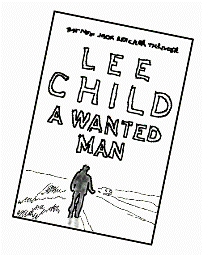
I shrug.
‘I don’t know enough about it,’ I say.
‘Hmm,’ she says. ‘Well, thank you for all you’ve done.’
‘Next time it might be quicker just to carry you upstairs.’
She laughs and slaps her tummy.
‘Really?’ she says. ‘Well you’re a better man than I am, Gunga Din!’
the novelty bird clock
I’ve seen dead people; Rita isn’t one of them.
It’s not because she’s holding her eyes shut, and her mouth closed, and it’s not because her skin is a lovely pink colour. And it isn’t because even from the doorway I can see she’s breathing. It’s because someone buzzed me through the main door when I rang, and she’s the only one in the flat.
‘Rita? It’s Jim, from the hospital. I’ve come to see how you are.’
No response.
‘How are things?’
I put my bag down and go over to her.
*
It was supposed to be easy. A handful of calls first thing. A quick trip back to the hospital to catch up on admin. Out again without lunch, all the omens good for a prompt finish. Father’s Day and all that. Cake and cards…
‘Could you just ring this patient before you go?’ says Michaela, handing me a file, super energised as usual, despite the chaos. ‘We need to know how she’s getting on with the equipment that was delivered yesterday. Thank you, Jim!’
Michaela has a way of getting you do stuff even though you’re exhausted. I don’t know how she does it. Drugs, mind control, religion – even if I had the time, I’d be too scared to ask.
I skim the notes. All pretty straight-forward. Elderly woman, independent, no package of care. Family involvement. Low to moderate health problems. Toilet frame and kitchen trolley dropped round the day before. Nothing to report.
I pick up the phone.
‘Hello? Is that Rita? Hello, Rita. My name’s Jim. I’m calling from the Rapid Response Team at the hospital.’
‘Yes?’
‘How are you today?’
‘I’m ill.’
‘Oh. I’m sorry to hear that. In what way are you ill?’
‘What?’
‘Are you in pain? Do you feel short of breath?’
‘No. Look – I’m far too ill to talk about it.’
And she hangs up.
I re-order my calls as I drive over there. I might just make it…
*
All Rita’s obs are fine. In fact, many are better than mine. But despite encouragement she still sits in the chair like a WRVS version of The Death of Chatterton. (It’s not a stroke. Her neuro obs are as sound as everything else. And I’m pretty sure it’s not arsenic).
I hardly know how to put the next question to her, but I’m horribly conscious of the time, something the novelty bird clock on the wall behind her cruelly accentuates with a cuckoo.
‘The button to open the main door downstairs – it’s in the hall, isn’t it?’ I ask, leading her on like some shabby prosecutor.
She nods.
‘So how did you manage to get from the chair to the button and back again before I came in?’
‘I crawled,’ she says.
‘You crawled?’
‘Yes. I crawled.’
I try to picture how that would have looked. A marine would’ve been sweating, covering that amount of carpet and back in the time given.
‘I’ve never felt so unwell,’ she says.
‘Rita? What we need to do is find out exactly what you mean when you say unwell.’
‘Unwell! I don’t know how else to describe it.’
‘Do you feel sick?’
‘No.’
‘Short of breath?’
‘No.’
‘Dizzy?’
She shakes her head.
‘And you don’t have any pain anywhere?’
‘No.’
‘Any strange sensations of any kind anywhere at all?’
‘Yes.’
‘What?’
‘I feel ill.’
I pause, write something – anything – down.
‘I want to go to hospital,’ she says.
‘Why?’
‘I’d be safe there.’
Well – that’s true. You would be safe there. But you’re doing pretty well here, too. You’ve got your red button to press if anything happens. You’ve got your son a few streets away. You’ve got the telephone in easy reach. The thing is, Rita – it’s difficult to find a reason to send you in to hospital. Especially today. It’s incredibly busy down there. You’d probably end up on a trolley for ages, and then sent home with nothing changed.’
‘I just want to die,’ she says. ‘I’ve had my time. Sorry to be a nuisance.’
‘You’re not a nuisance, Rita. And I’m sorry you’re feeling so low.’
Her eyes snap open and she looks straight at me.
‘There’s nothing wrong with my mind,’ she says. ‘There’s nothing wrong with the way I feel.’
‘No! Absolutely! It’s perfectly understandable and natural to get fed up sometimes and want someone to talk to.’
‘Just leave me. Just leave me to die.’
She closes her eyes again and reverts to pose.
Maybe if I had an easel – and the time – I’d set up and paint her. I could do with the practice and she could do with the company. But I’ve got a lot to get through, and my dream of an easy day is fast disintegrating.
‘What are we going to do, Rita? Hey? What are we going to do?’
But Rita doesn’t say anything, and keeps her eyes closed. And a silence fills the room, the dizzying breadth and depth of it marked by a sudden burst of skylark from the bird clock on the wall.
hot and cold
I’ve been well-briefed about the situation.
‘Try very hard not to get drawn in,’ the social worker said. ‘Just go in, be reassuring but business-like. Do her obs, make her a cup of tea and something to eat, then so long as everything’s okay, leave. She’ll make out she’s dying and she’ll try to get you running around to the doctor’s and lord knows who else, but don’t fall for it. She does have capacity, even though you might not think so. Don’t worry. She’s on the radar. The plan is to get her in for some privately funded respite and therapy in the next few days. In the meantime, we’ll just keep her safe. Oh – and she’ll be wearing everything at once, her entire wardrobe, pretty much.’
He wasn’t kidding. Even though the flat is stiflingly hot, Marie is under a duvet and two throws, wearing a thermal one-piece, a pair of pyjamas, a jersey and a cable-knit cardigan.
‘Help me!’ she says. ‘Please!’
I manage to calm her down long enough to agree to come through to the lounge. I serve her tea, a sandwich and a little custard tart from a box she has in the fridge. It’s strange to see her eat with such quiet focus, methodically working her way round the pastry, from the serrated rim of it to the centre. Then she dabs up the crumbs with a wet finger, looks up, hands me the plate and says: ‘I’ve never felt so bad! Please – do something! Please! You won’t leave me like this before I’m better, will you?’
‘I’ll certainly make sure you’re okay,’ I say, feeling shifty.
She agrees to an exam. It takes five minutes just to free an arm for the cuff.
‘You make me feel hot,’ I say.
‘Well I’m cold.’
‘I can see.’
Incredibly, all her obs are completely fine. Even her heart rate is normal, despite her heightened state.
‘What are your symptoms, Marie?’ I ask her, packing the kit away, struggling to maintain my poise in the oppressive, orchid-house atmosphere. ‘What’s the worst thing?’
‘My back,’ she says. ‘It’s never been so bad. Please!’
‘What about your back? Is it painful?’
‘No! It’s cold. It’s cold!’
And unable to bear it any longer, she stands up, pulls the outer dressing-gown cord so tight she looks like a gigantic cottage loaf, asks me to bring her more tea, and takes herself off to bed.
 jim clayton