the great escape

A couple of days later I’m back to see Jeremy for a follow-up appointment. There’s a van parked outside, sheets laid out on the paving slabs underneath the windows and around the front door, and two sun-burned guys in overalls sitting on the garden wall, smoking. The oldest one, Terry, has long grey hair tied back in a pony-tail and leathery brown skin; his assistant, Mick, is a younger version, looking more like a painting and decorating marine, with a shaved head and tattoos you can barely make out beyond the tan.
‘He’s upstairs,’ says Terry, licking along the edge of his roll-up, nodding instead of pointing. ‘Pauline’s nipped out to the shops.’
‘Mind as you go in,’ says Mick. ‘Don’t touch nothing.’

Inside, the door between the kitchen and the rest of the house is shut. As soon as I open it, a blurred white shape races out.
‘Shit! Brian…’
The dog has run straight out into the back garden. He stands out on the sunny decking and watches me to see what I’ll do next. When I take a step towards him, he takes a step back. I crouch down, hold my hand out, lower my head submissively and make kissy-kissy noises; when I look up again, he’s standing exactly as he was, his head crooked slightly on one side.
‘Brian…?’
His ears prick up.
‘Come on, Brian! Let’s see who’s upstairs….’
He turns round and trots off into the garden.

The first thing I do is go outside again and speak to the painters.
‘Ah – don’t worry,’ says Terry. ‘He’s all right in the back garden. He can’t get out. It’s the front you’ve got to worry about.’
‘But we can’t shut the front door. It’s wet.’
‘Yeah – but – we can put this plastic table across the front…’
Mick produces a flattened white plastic garden table and props it up against the kitchen cabinets.
‘And I’ll secure it with these saucepans,’ says Terry. ‘How’s that?’
I go up to see Jeremy, leaving the connecting door open in the hope that Brian will follow.
He doesn’t.

Jeremy’s much the same as before. But despite his illness he’s warm and welcoming. When I tell him about Brian he bats the air.
‘Oh well,’ he says. ‘So long as the garden gate’s shut,’ he says. ‘It is shut, isn’t it?’
I go back down to check.

Brian is parading round the far side of the garden like he’s at a show.
I check the gate. It’s firmly closed.
I try a few more tricks to coax Brian over – ‘innocently walking away’ – ‘finding something interesting in the flower bed’ – ‘putting my hand in my pocket and saying what’s this?’ – but each attempt is treated with equal disdain. Seriously? Did you honestly think I’d be persuaded by such amateurish tricks? How little you know me.
I give up and go back inside.

Ten minutes later I’m halfway through the examination when I hear a cry from the kitchen.
‘Pauline!’ says Jeremy.
I tear off my stethoscope and hurry back down.
There are two shopping bags in the middle of the floor; the plastic table is angled away from the door, the saucepans are up on the counter, and on the freshly-painted wooden step, two neat paw prints.

Terry is rolling himself another fag.
‘It’s all gone tits up, mate’ he says. ‘I was round the side, Mick was in the van, and we didn’t see Pauline come back from the shops. ‘Course as soon as she moved the table Brian ran out. He’s high-tailed it down the road, Mick’s gone after him, and I think Pauline’s heading them off at the pass.’
‘Do you think I should have a drive round?’
‘Nah! They’ll be all right,’ he says. ‘Brian’s got previous. He always comes back.’
But then he spoils it by saying: ‘He’s a smart dog all right. I reckon he’s been planning this. I wouldn’t mind betting he’s got a system of tunnels, like in that film.’
He plants the fag in his mouth and wanders around the driveway shaking the legs of his overalls to illustrate how Brian got rid of the soil.
‘Yep. A very smart dog. Mind you,’ he says, taking the fag out again and picking a strand of tobacco from his bottom lip, ‘it wouldn’t be so bad if he had the road sense to match.’

I go back upstairs to tell Jeremy the bad news.
‘That dog’ll be the death of me,’ he says. ‘But don’t worry. I’m sure he’ll be fine.’
He doesn’t seem easy about it, though. And neither am I.
I finish the exam.greatescape
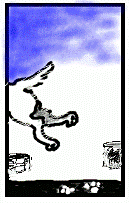
Just as I’m writing up the results, I hear a commotion down in the kitchen. Pauline’s back, with Brian on a lead, frowning and looking furious.
‘I’m so sorry,’ I tell her. ‘I didn’t think. As soon as I opened the door he was off.’
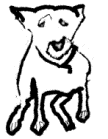
Brian looks up at me.
Snitch he says.
okay brian

As Pauline leads me through the house she fills me in on Jeremy’s past medical history. The operations and treatments, consultations and confirmations, missed appointments and misunderstandings. Things had picked up for a while, she says, but then three weeks ago Jeremy’s health took a marked downward turn, and now here we are, confined to bed, awaiting developments.
We’re accompanied up the stairs by their little dog, Brian.
‘We didn’t call him that,’ she says. ‘But he’s seven and we thought it’s too late to do anything about it.’
I don’t tell Pauline, but I wouldn’t say he looks like a Brian. He’s such a curious mongrel mix, though, I’m not sure what would work. The tight white curls of a sheep. The soft black eyes of a seal pup. The spindly legs of a Windsor chair. At a push I’d say he was more of a Barnaby.
‘Through here,’ says Pauline, stopping on the landing.
Brian stands behind her and gives me a look.

Even from here I can tell Jeremy’s very unwell. His skin has a grey quality, his nose pinched, the prominence of his mouth, the hollows of his eyes – everything a testament to disease and decline. I was told before I came out there were anomalies on the most recent chest x-ray. I wonder what conversations they’ve had on the subject, and I’m conscious of the words I should use.
Despite his sickness, though, Jeremy’s pretty chipper. He jokes about getting caught in the crossfire between the GP and consultant, about the tragic-comedy of the patient transport service, and most particularly, about his fervent desire never to set foot in another hospital again.
‘It’s the endless waiting around! Days pass into weeks, and let me tell you – you really start to notice the cracks! No thank you. I’d far rather take my chances here. What d’you think, Brian?’
Brian responds to his name, sits back on his haunches and angles his head up at Jeremy. Then after a moment he looks round and rests his eyes on me. He’s such a funny little dog, and the room is so bright and peaceful, I wouldn’t be all that surprised if he put a paw to his muzzle, cleared his throat and spoke.dog
I’d really appreciate it if you could do something for Jeremy. I’ve grown rather attached to the old chap, and I’d hate to see him suffer.
I get my obs kit out, loop the steth around my neck, and open Jeremy’s folder to the obs page.
‘Okay Brian,’ I say. ‘Let’s have a look…’

the NHS arcana

In an average day I’ll see six or seven patients. Sometimes the contrast between their situations is so striking it’s like I’m dealing cards from an NHS-themed tarot pack: The Wronged Man. The Fool. Fortitude. King of Catheters. Death.

For example, my first patient: The Sofa.

It’s not only Stanley’s bloods that are deranged. The carpet is covered with discarded newspapers, letters, flyers, menus, books, crisp packets, remote controls, glasses and a hundred other things. At the heart of it all is the sofa where Stanley has been sleeping and living the past few months, the uncovered duvet thrown back, pillows yellowing, the whole thing looking like a burst artillery shell of loneliness.

Stanley has chronic kidney disease, diabetes. The renal unit call him in once a month to review his bloods. He’s at that liminal stage where the slightest movement south on his U&Es will mean he has to start dialysis. For now, he’s getting by the best he can at home. Getting a taxi to take him shopping, occasionally, although that’s been impossible the last week or so (as the pile of empty microwave meal containers in the sink testifies). Beyond his usual ill health, it’s hard to establish what’s acutely different, though. His bloods are poor, but nothing more than normal.
‘I just feel so exhausted all the time,’ he says.
‘Is there anyone around who could help out?’ I ask him. ‘Family, friends…?’
‘No. There’s no-one.’
Our job as the Rapid Response team is to get him back to something approximating normal. A guy to come in and clean the place up. Carers to do his shopping, make his meals and help him with washing and dressing. A Mental Health nurse to assess his state of mind. A pharmacist to review his obs. OTs to put in equipment. Physios for an exercise regime. Nurses to review his obs and liaise with the GP. We’ll do the best we can, but sometimes it’s overwhelming. Stanley didn’t end up like this in a matter of days or weeks. The breakdown in social connection often takes years to work its way out like this, into these extremes of social isolation.
‘What do you need from the shop?’ I ask him.
He gives me a list, and a ten pound note.

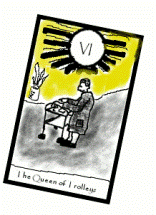
And then on to the second patient. Queen of Trolleys.

I haven’t been here before. A lovely block of flats, immaculate gardens, and the kind of residents who seem comfortable saying hello.
I’ve come to see Agnes. It’s a very temporary referral. The only reason she’s on our books is because of some strange, unanticipated failure in her care package. I don’t know the ins and outs, but I don’t get the feeling we’ll be coming in long.
Getting access to Agnes’ front door is a major intelligence test. In the end I have to call Agnes’ daughter, who explains that I have to retrieve a key from the lintel in the hallway, use that to open a service door, and then locate and open a keysafe.
‘All right?’ she says. ‘Found it?’
‘Yep! Thanks very much.’
‘Call me if you need anything else. And thank you for stopping by today.’
I let myself in.
A welcoming, meticulously tidy flat.
Agnes is in the living room, watching Loose Women. They’re sharing their wedding experiences, which Agnes watches with an open mouth. Her wedding photo is just by her on the bookshelf, but it’s not something she acknowledges.
I’m there to make her something to eat. Everything’s laid out – the ready meal, the dessert, instructions on how to use the microwave – in fact, carefully written instructions taped on just about everything, from the front door to the fridge and cooker. The butler sink has a scrubbed look, with a laundered tea towel draped on a rail and a selection of cutlery laid out in neat lines.
Whilst I’m waiting for the cottage pie to turn through its minutes, Agnes appears at the doorway, pushing her kitchen trolley. On the trolley is a little knitted bear, a remote control, and a box of tissues.
‘Are you all right, Agnes? What can I get you?’
She stares at me for a moment, then makes an approximate kind of smile.

‘Oh – nothing. Nothing, really.’
‘Lunch is almost ready. Would you like a cup of tea with it?’queen of trolleys

‘That would be … erm… yes. Yes, please.’
She turns and heads back to her seat.

Back out in my car, I write down the time, cross through Agnes, locate the next call.
I turn the wheel, and move off.

I flip the card.

churchill’s dog

Aileen is lying on the bed with one arm crooked up over her eyes.
‘This can’t go on,’ says Jackie, her sister-in-law. ‘I mean, look at her. Paula’s got enough on her plate as it is.’
Paula is Aileen’s elder sister. She smiles and shakes her head. ‘I’d like to do more,’ she says. ‘But it’s not the world’s biggest flat, as you can see, and David’s laid up with his back.’
‘I’d just like to know what you think you’re going to do about it,’ says Jackie, leaning forward for emphasis. ‘I’m sorry. I’ve got to say it how it is. One of the nurses told me, in confidence. She said you won’t get anything without making a fuss, darling. And she was right. We’ve tried playing along, it hasn’t got us anywhere, so now I’m damn well going to make a fuss.’
‘It’s okay, Jackie,’ says Paula.
‘No it isn’t!’

I haven’t met any of them before. I’ve been sent to conduct the basic health screen, and as usual, all I’ve been given are the basic facts: seventy-eight year old, multiple ambulance call-outs with shortness of breath, anxiety, abdo pain. All Aileen’s obs are fine. I’ve taken some blood, dipped her urine, and now I’m writing up the results. It’s a stressful situation, difficult to negotiate, particularly as there’s a great deal of back-story I just don’t know.

Aileen starts to cry again. Paula sits next to her on the bed and rubs her shoulder in a straight-armed kind of way.
‘Seriously though,’ says Jackie. ‘This can’t go on. We’ve been promised this, that and the other before, and nothing ever happens. She can’t go home like this. She needs someone to sit with her tonight. The family can’t do it no more. We’re all exhausted. I mean, we appreciate you coming out and everything, but who’s to say you won’t be like everyone else and promise things that never materialise?’
‘I’m sorry you’ve had bad experiences in the past, and you’re right, it can’t go on like this. Our focus is to prevent people going in to hospital unnecessarily, so we’ll do everything we can. But I’ll be honest with you, Jackie – night sitters are in huge demand, and we don’t have access to that many in the first place.’
‘Well there you go.’
She sits back and folds her arms.
‘It’s a funding issue,’ I tell her. ‘With all the cut-backs there just isn’t the money. So things like night sitters get rationed pretty tight, and they tend to go to those patients with really acute medical needs.’
‘It shouldn’t be like this,’ says Jackie.
‘Absolutely. It shouldn’t. But I’d rather be realistic about what you can expect. Anyway, looking on the bright side, there’s still lots we can do.’
‘Oh yeah? Like what?’
‘Like making sure that physically everything’s okay. That’s why I did all those tests. Then I can get one of our social workers to talk to you about your living situation. That’s another thing. And if you need some care support in the short term, people popping in to make sure Aileen’s okay, eating and drinking, taking meds and the rest of it – we can sort that out, too. And I can ask one of our mental health nurses to come and talk to you.’
Aileen suddenly pushes herself away from Paula into a sitting position.
‘Mental health? What does he mean, mental health? He’s not going to put me in one of them places, is he? I’m not sick in my head, am I?’
She groans and presses her fists to her temples.
‘Try not to get yourself worked up, Aileen,’ says Paula.
‘It’s okay, Aileen. There’s nothing to worry about. It’s just someone with special training who can talk to you about how you’re feeling. And you know – lots of people have problems with things like anxiety and depression. Some really famous people have struggled with it. Winston Churchill used to get depressed. I think he called it his black dog. But he did all right, didn’t he? Churchill?’
‘I wonder how he did cope,’ says Paula, gently picking some loose strands of hair away from Aileen’s face.
‘Brandy and cigars, weren’t it?’ says Jackie. ‘Maybe you should write her a scrip for that.’

ten out of ten

Harold is bearing up pretty well, considering he’s ninety, and fell all the way down the stairs a couple of weeks ago.
‘I managed to get him up,’ says his wife, Janice, perched on the arm of his chair. ‘I used three stools – one small, one medium, one large. But I have to say I’m feeling it a bit now.’
They didn’t call the ambulance. Instead, Janice bathed his head, gave him paracetamol, and helped him get about over the next few days. When that grew too much, she called in the GP, who, after deciding Harold’s back pain was probably musculo-skeletal, and ruling out any need for an X-ray, referred Harold on to us.
‘I must say I’m impressed,’ says Harold. ‘I had no idea this kind of thing was out there.’
He smiles in brief flashes, as if his teeth are too big for his mouth, and he’s worried they’ll pop out into his lap.

All the tests I run are fine. Whilst I write up the results, Harold tells me about the time he fell over in the street a year ago.
‘Not quite as spectacular as the stairs,’ he says. ‘This time it was a tree root. You know how they push up through the pavement and make everything humpity-bumpity? Well that’s what did for me. And this is the result…’
He holds his left hand in the air and turns it this way and that. I can’t see anything wrong with it, but I tut all the same.
‘The pain you feel in your back, Harold. If you had to give it a mark out of ten, with ten being the worst and nought being none, what would you give it?’
I hold my fingers horizontally and move my hand up and down like a gauge. ‘Marks out of ten for the pain, Harold.’
‘Nought when I’m sitting still like this, ten when I’m walking about.’
I write it down.
‘And may I say,’ he says, smiling broadly, and then pressing his lips together again. ‘I very much enjoy your concision.’

mews m.i.b

Turns out, the Old Bakery Mews is a densely-packed development of chi-chi flats on the waste ground behind (wild guess) what used to be the bakery. The flint walls and red-bricked fascias are nicely done, but they have that earnest, rather stilted feel that high-end new-builds are prone to. Maybe it’ll work in a hundred years; for now, it just looks fake.
I park up, and head towards number twenty-two, struggling under my usual burden of rucksack, weighing scales, yellow folder and diary.
‘All right?’ says a man in black, standing at the door of a business that backs on to the car park.
‘Yep. Fine. How are you?’
‘You’re not parking there,’ he says.
‘I’m a health visitor. From the hospital,’ I say. Then add, a little pathetically, ‘There’s a sick person who needs help.’
‘Private property,’ he says. ‘You’ll have to move it.’

It’s one of the occupational hazards of working in the community, of course. Back pain. Needlesticks. Parking. I’m quite prepared to compromise on the parking, of course, but sometimes there’s very little practical alternative. Each time I’m confronted with that I don’t make the rules attitude, I’m overwhelmed with the same sense of injustice. The world’s difficult enough, for God’s sake, without these petty demonstrations of property law.
I go over to him.
‘What if it was someone in your family who was sick?’ I tell him. ‘How would you feel then?’
‘I’m going to make a phone call,’ he says.
‘Good. You do that.’
I follow him to the back door.
Inside, a young woman is typing. She risks a glance in my direction. A rough-haired lurcher gets up out of its basket and heads in my direction. She grabs its collar.
‘No, Trampus!’ she says.
‘It’s okay,’ I tell her, putting my stuff down. ‘I like dogs.’
She lets him go; Trampus trots over and gives me a thoroughgoing sniff. He helps me calm down, though I can’t think for the life of me think how such a lovely dog can exist in the same room as the Man in Black without reverting to wolf and tearing his throat out.
Meanwhile, MiB is explaining the situation on the phone.
‘He says he’s from the hospital. The Hospital. Apparently there’s a sick woman somewhere. No! One! A sick woman. He says he wants to park here.’
‘Half an hour, max,’ I tell him.
Half an hour, he says….. Max. No, Maximum. Hang on, I’ll ask him.’
He puts his hand over the mouthpiece.
‘Who did you say you worked for again?’
‘The Rapid Response Service.’
He relays that to the person on the other end, someone who I can only imagine lives in a castle decorated with skulls and pelts and a hundred other souvenirs of their long and compassionate time on earth.
Trampus goes back to his basket.
‘You’d think it’d be all right just for half an hour,’ I say to the girl. ‘Imagine if it was someone in your family who needed help.’
‘Yeah, but we don’t make the rules,’ she says. ‘It’s private round here.’
MiB puts the phone down and walks over again.
‘Move it,’ he says.

the fridge

I’m wearing overshoes, an apron and a pair of gloves, and still it doesn’t feel enough. Mind you, Gladys and Henry’s house is so dreadful, I’d probably feel twitchy in a biochem suit.

Henry is supposed to be looking after Gladys, but his health has taken a turn for the worse and nothing’s been done for a good long while. They’ve been referred to social services in the past, but each time they’ve declined any interventions or meaningful packages of care. They have full mental capacity, so of course they’re entitled to live how they want. And if that means repeated ambulance call-outs for falls amongst the clutter, or acute episodes of diarrhoea and vomiting, well that’s just the price the wider community has to pay for their refusal to accept help in the longer term. They’re trying to be independent, and that’s a good thing. Except, they’re not succeeding. And not only is it harder to put things right when they’ve gone so wrong, the cost of providing acute interventions is higher than if they’d accepted more timely help.

To hear Henry talk, you’d think there wasn’t anything particularly amiss.
‘Things ‘ave gone a bit to cock,’ he says, scratching his head. ‘I can usually make it on the bus to go down the supermarket for the ready meals and whatnot, but I ‘int been able to do that lately what with my hip and everything. And then the neighbour who sometimes brings stuff in has gone on holiday. And so has my son! So we’re up the creek without a paddle.’

He lies back on the bed.
‘You couldn’t get me some toast or something, could you? I’m starving.’

Which is why I’m heading to the fridge.

My overshoes are almost pulled off step by step as I walk across the kitchen floor. There are mounds of unwashed crockery, exposed food in dishes that were probably microwaved weeks ago and then abandoned. Decrepit salads partially covered in tin foil. Half a can of chicken in white sauce, chuckling with bacteria. And there, standing in the corner of all this horror, the crowned Prince of Carnage, Glady and Henry’s fridge.

Even the flies don’t seem confident. They fly towards it, cut a ninety degree turn, head towards it again, cut back…

I bat them away, reach out a hand, and open the fridge door.

I remember reading about the labours of Hercules. One was to kill a particular lion, one was to kill the Hydra, one was to stop the NHS from being privatised, I think – and one was to clean out a gigantic stables filled with horses and cows and so on. But Hercules was smart as well as strong. He used his lion-hatted head, and diverted a nearby river to run through the stables, flushing them out.

Well. It sounds like that was pretty effective.
But standing here, gacking in front of this fridge, I’m here to tell you, Herk. You’re going to need a bigger river.

cracking the code

There’s certainly no shortage of game shows. There must be a factory somewhere, a giant warehouse, with a fork-lift backing up day and night with crates of flat-pack sets, catering-size tubs of contestants, and – arriving by special courier – cartons of snap-fit hosts (a specialist team to assemble – “I think we’ll have another Mockney male. This suit, that tie, those eyes.”). The show Lily’s watching seems to be based on safe cracking. God knows what happens if they get the code right. Meanwhile, the Host ruthlessly corals his nerds with one eye on the camera and one on the studio clock, looking so stiff if you tore his shirt open you’d probably spill cogs.
Dame Judi Dench,’ says one of the contestants, choosing a category (I didn’t catch the theme – Bond characters? People with a life?)
‘Dame Judi Dench!’ says the Host. ‘Good ol’ Dame Judi.’
He raises his hand and a digital clock starts running.
Lily is avidly watching the show from the ruin of her armchair. It’s just as well the room is super-heated – she’s surrounded by three, free-standing radiators, all turned up to the max – because Lily is naked, her fingers laced across her flaccid breasts, one leg jauntily crossed over the other, head craning forward, bottom lip curled up in an expression of extreme concentration.
She looks over at me.
‘Hello Lily!’ I say.

*

The bright morning sun still hasn’t penetrated the gloom at the bottom of the basement steps. It’s so chill down here I wonder if it ever does.
The front door is blistered, battered. There are three notices roughly taped-up to make them waterproof and then thumb-tacked into the panels:
YOU HAVN’T BEN INVITD SO KEEP OUT!!!!
THE BELL DONT WORK. IF I DONT COME WHEN YOU KNOCK GO AWAY YOUR NOT WANTED!!!
THIS IS PRIVIT PROPERTY!!! IF YOU COME IN WITHOUT PERMISHON YOURLL GET WHAT FOR!!!
There’s a keysafe, though. I retrieve the key, open the door and peer inside.
A long corridor, banked up with junk on the left hand side, doors leading off on the right. All dark, except a light on in what must be the kitchen at the far end.
‘Hello? It’s Jim from the Rapid Response. From the hospital. Come to see Lily.’
No voice in reply, just the muted blare of a TV in a room further along, near the kitchen.
‘Helloooo? Rapid Response…’
I leave the door open, thinking it’ll be quicker to run out if I have to.
What makes the whole thing worse, of course, is that strictly speaking, I don’t have PERMISHON. But then, the referral from the hospital was quite unequivocal – not coping at home, hallucinating, ?capacity, needs urgent assessment. Sometimes there only seems to be a fine, legal margin between ‘Best Interest’ and ‘Breaking & Entering’; I’m tiptoeing along it now.
‘Helloooo?’
I glance into each room as I pass, just in case. I’m like a character in a bad thriller – hopefully the hero, but knowing my luck, probably the guy who gets whacked in the first scene and put in a freezer.
‘Hellooo? Lily?’
The TV gets louder as I move down the corridor. She must be in there. So many of the patients I visit have hearing problems and sit close to the TV with the volume up. But those notices on the front door have made me jumpy.
I knock on the closed door and after a pause, gently push it open.
‘Hellooo?’
A wave of heat and sound.
Now I understand you’re in MENSA?
– That’s right
That sounds fascinating. So tell me – what do you have to do to get into a thing like that? Apart from be very very brainy of course?
– Well. Erm. No. That’s about it.
I see! Great. Well see just how well those brains are working for you today as we go into the next round…
Lily looks at me from the armchair.
‘Can you help me to the toilet?’ she says, gesturing vaguely to a dustbin in the corner of the room.
‘The dustbin? You’re not going to the loo there, are you Lily?’
‘No-one’s told me where the proper loo is.’
‘I can show you, if you like.’
‘Will you?’
‘Of course. Let’s put a dressing gown on you first.
On the way there I try to get an idea of her situation. Someone obviously comes in now and again. Her tablets are up in a blue crate on top of the kitchen cabinets; there’s a pack of fortifying drinks on the side (untouched); some unused pressure area equipment. Notes in a different, more moderate hand on the fridge, reminders of what’s in there, when to eat, when Barry’s next in. A phone number (I write it down).
‘How long have you lived here, Lily?’ I ask as I help her back into the front room.
‘Ooh, not long. I’ll tell you what happened. I got pregnant and they didn’t want me to keep it. But I did, you see. I did. I kept the child, and I worked – I worked damned hard – all my life. And the next thing you know, they’ve packed me off to this place.’
She pinches my arm and leans in.
‘Don’t let them,’ she says. ‘Don’t let them leave me here.’
‘I’ll see what I can do.’
I help her back into the armchair. Bring her a mug of tea with some biscuits. There’s a knock on the front door. A community mental health nurse has arrived. I give him a quick handover, then introduce him to Lily.
It seems the MENSA guy hasn’t been able to crack the code. He looks shamefaced as the Host wraps things up.
‘Sadly this is the point we have to say goodbye,’ he says. ‘But you’ve been a smashing contestant. Please give my very best to the good people of MENSA, and tell ‘em the application’s in the post. Okay then? All right! A big hand ladies and gentleman!’
I say goodbye to Lily, but she looks at me with the same bewildered expression she’s been giving the TV.
‘Who’s that?’ I hear her say to the nurse.
‘It’s Jim. A colleague,’ he says.

Outside, walking back up the basement steps into the sunshine, everything feels so overwhelmingly fresh and sharp I stop when I reach the pavement and look around.
I see an elderly woman holding onto the railings whilst she gets her breath; a guy washing windows with a squeegee on the end of a ridiculously long pole, and two guys talking intensely, argument or agreement it’s hard to say. One of them has an Irish terrier on a lead. The terrier is staring at me, quivering intently, its tail arched over its body in my direction like some kind of transmitter. The guy holding the lead suddenly jerks it a little; the terrier’s paws skitter delicately on the pavement, and it ends up pointing the other way, at the man with the squeegee. If the men don’t move soon, they’ll get wet, I think. Squeegee man will have to say something. Why are they leaving it so late?

Meanwhile, the old woman has walked off.

I load my stuff into the car, cross Lily off the list, and drive.

getting it

Matt, Henry’s grandson, meets me at the door. There’s an air of lean and focused competency about him that the lanyard round his neck only accentuates. ‘Luckily I only work round the corner,’ he says. ‘Mum would normally be here but she had to go abroad on business. She’s left me a list of things to ask…’ He waves his phone in the air. ‘I don’t want to scare you, but it’s pretty comprehensive. Anyway, let me make the introductions.’
Henry is sitting in a plush leather armchair. Behind him is a bookcase neatly filled with history books, mostly on warfare as far as I can tell. Jane’s Fighting Ships, Stalingrad, Winston Churchill: The Early Years, and then on a lower shelf, a spread of thrillers by Ludlum, Harris, Forsyth and so on. Henry himself could’ve stepped fully-made from any of those books. There’s something about the way he sits, his stick resolutely planted in front of him, his back straight, his eyes sighted along his nose, his hair geometrically combed and parted. Even his cardigan is ironed.
‘Good morning!’ he says. ‘Excuse me if I don’t get up. It’s this damned hip!’
Matt sits down on a chair midway between us, his phone in his hands, waiting for the right opportunity to jump in. ‘Do you mind if I record this?’ he says. ‘It’s quicker than typing.’
I tell him I don’t mind, although it makes me a little self-conscious.
I begin by explaining who I am and what I’ve come to do. Henry nods and listens, closing his eyes at one point and dropping his chin, so he can concentrate more fully on what I’m saying.
‘Right,’ he says. ‘That’s fine. Excellent. Let’s crack on, shall we?’
I carry out the assessment and record his obs, fielding Matt’s questions as I go. What exactly is the Rapid Response Service? Is it strictly three days, or are there extensions sometimes? Will we be able to advise on packages of care? Will a physiotherapist be visiting? It’s actually quite refreshing to explain all these things. It makes me realise what a great service it is.
‘Thanks!’ he says, pressing the phone. ‘That should do it!’
‘The family look after me very well,’ says Henry. ‘I couldn’t ask for better.’
‘You’re worth it, Grandpa,’ says Matt.
Henry suddenly looks downcast and I ask him if there’s anything wrong.
‘It’s my wife, Jean,’ he says. ‘She has dementia. I’m afraid it all got too much and she had to go into a home.’
‘A good one,’ says Matt. ‘We looked at a lot. Really, it’s the best.’
‘Yes, yes. They’re all very kind,’ says Henry. ‘It’s just – well, I normally make it over to see her every other day. But after the fall I was in hospital for a few weeks, as you know. And now I’m stuck here, hobbling about like a damned fool.’
‘I’ve offered to take him in the car but he can’t manage getting in and out,’ says Matt. ‘Anyway, small comfort, I know, but at least she doesn’t realise he hasn’t been. She doesn’t even recognise him when he’s there.’
Henry raps his stick on the carpet and snaps at him.
‘Matthew! We’ve been married sixty-five years. Sixty-five! It’s immaterial whether she recognises me or not. She’s still Jean, you know. She’ll always be Jean.’
Matt shakes his head.
‘Sorry, Grandpa. Sorry. Of course.’
‘If you can sit in a chair you can always get a chair-friendly taxi to take you round’ I tell him, bringing things back to the practicalities. ‘Worth a thought.’
‘Good idea!’ says Henry. He brightens, and glances over to Matt, who immediately waves his phone in the air and smiles.
‘Got it!’ he says.

the reunion

Lola the poodle has lost interest and taken herself back to her crate, turning round and round on her blanket, then plonking down in a heap.
There’s not much space in the front room these days, so Bernard’s collection of World War Two fighter planes, the Stukas and Messerschmitts, Spitfires and Hurricanes, have all been dumped together on top of her crate. Temporarily.
‘I don’t feel unwell,’ says Bernard, running his hand backwards and forwards across the top of his head. ‘Just bloody knackered. If you’d told me it’d be like this, well…’
Lola looks up at him through the muddle of wings and propellers, then sighs and settles her face down on her front paws, flicking her attention between Bernard and me, and occasionally licking her chops.
It feels strange to be here, like I’ve been sent to assess the Bog Man in the British Museum. I’m just going to do your blood pressure, prising open the display case, putting my stethoscope to the withered arm – How are you feeling? – as security staff hurry over, shouting into radios.
It’s certainly a testament to the tenacity of the human spirit, though. Bernard shouldn’t really be here. If you shut your eyes and ran your finger down the long list of things he suffers from, you could be sure any one of them you stopped on would finish you off in short order.
I have a quick read of the ambulance sheet. Bernard suffered a non-injury fall in the early hours. He’s so underweight, it must have taken him a full minute from leaving the chair to impacting the soft, shag-pile carpet. He would barely have dented the fibres.
The crew got him up again and referred him on to us.
‘I’m so annoyed with myself,’ he says. ‘This’ll be the first reunion I’ve ever missed.’
‘Don’t worry, love,’ says his wife, Elsie, coming into the room with another folder of notes.
(Lola looks up).
‘There’s always next year.’