here to help

It’s a cliche that dogs look like their owners. But whilst I wouldn’t say it was true, even someone as cynical as me would have to admit that Ralph the Shih Tzu is a dead spit for his owner, Robert. They have the same overhanging mullet, the same bug-eyes, the same extravagantly friendly, panting smile – to the extent that if I picked up this squeaky banana toy and threw it across the room, I’m not sure which one of them would get there first.

‘So what happens now?’ says Robert, sitting on the edge of his chair, whilst Ralph plumps himself down at my feet so I can scraggle his ears.

Robert’s mum is entering the final stages of her illness. The district nurses are organising the End of Life nursing care, and they’ve referred to us for additional care support and any extra equipment that might need providing at short notice.

I explain exactly what it is we can offer, how the system works, what’s going to happen next. Robert writes notes on the front page of the folder I’ve given him. There’s a lot to process – mostly how the teams come together, who does what and so on. It’s taken me a few years to figure it out, so I’m not surprised Robert struggles to understand. I try to simplify it to the basics – what time the carers will come in, what they’ll do.

‘I’m grateful for anything,’ says Robert. Ralph swipes at my leg with a paw. I scraggle his ears some more. His back leg begins to twitch.

‘He’s lovely,’ I say.
‘I rescued him,’ says Robert.
‘From the pound?’
‘From the neighbours next door but one. I think the kids wanted a dog, but then went off the idea. Poor thing. He never got a walk. They used to go out all the time and leave him behind a baby gate in the kitchen. I went round one day to help them with their fridge, and I felt sorry for him. So I said do you want me to take him for a stretch round the block? And they said if you like. So I did, and it became a regular thing. We just kind of clicked. He came and stayed with me for a week when they went on holiday. I didn’t hear from them when they got back, and when I went round and said what about Ralph then? And they said you may as well keep him. So I did.’
‘He landed on his paws.’
‘I think so. We both did. Didn’t we, Ralph? Eh?’
Ralph gives him a glance, then puts a paw out, taps my leg, and bows his head ready.
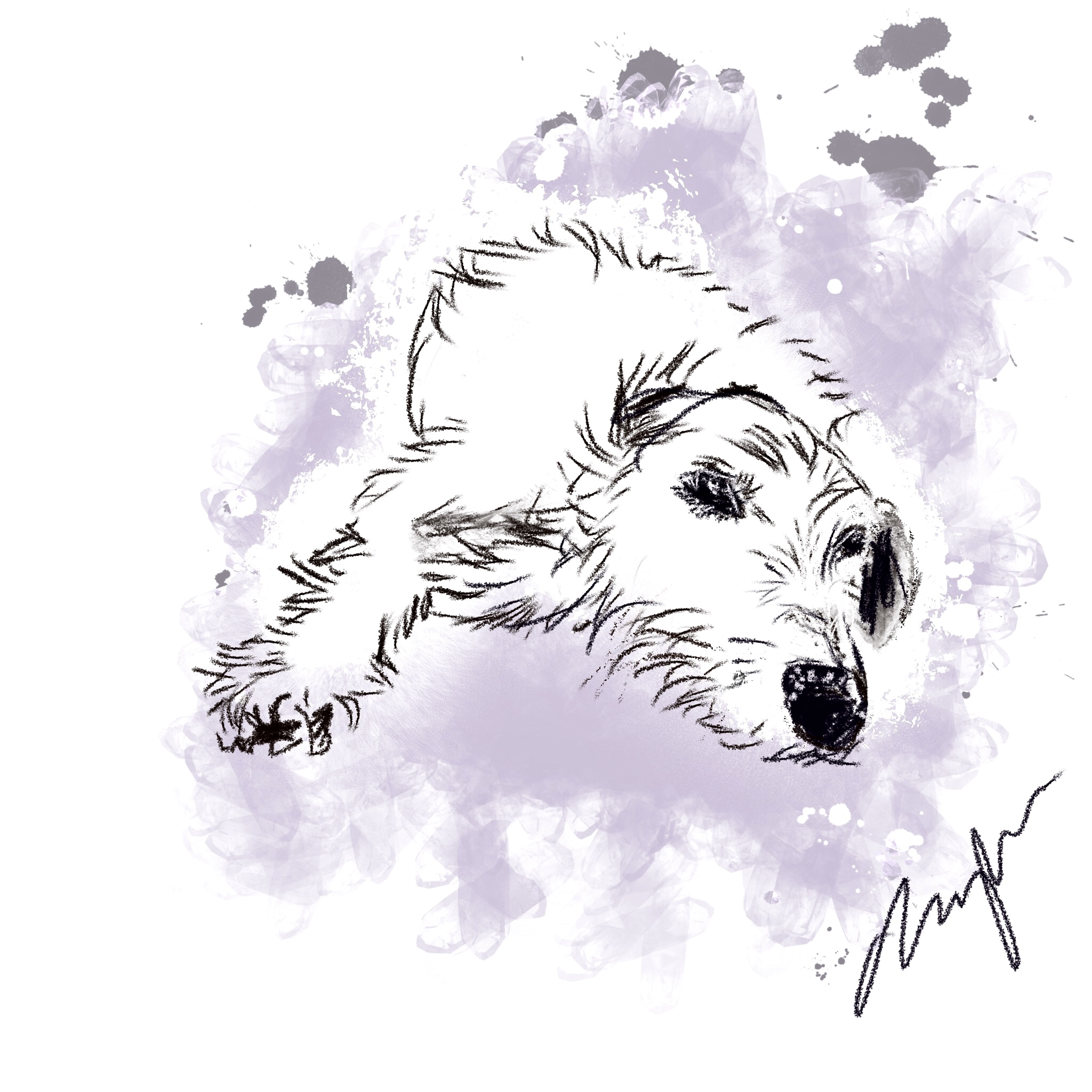
how Stanley howls

how Stanley howls
and growls
with a vexing mix of vocal vowels
and frowns, and scowls
till your patience is broken and your sympathy aroused
and you ask him what all the fuss is for
and you go over there and muss his fur
and he rolls on his back like a fuss connoisseur
all four paws in the air
and you despair
and with one last ruffle you leave him there
and he sneezes and stares
and watches you sit back down in your chair
waits a couple of minutes and then
the whole damned performance starts over again

Stanley v.2

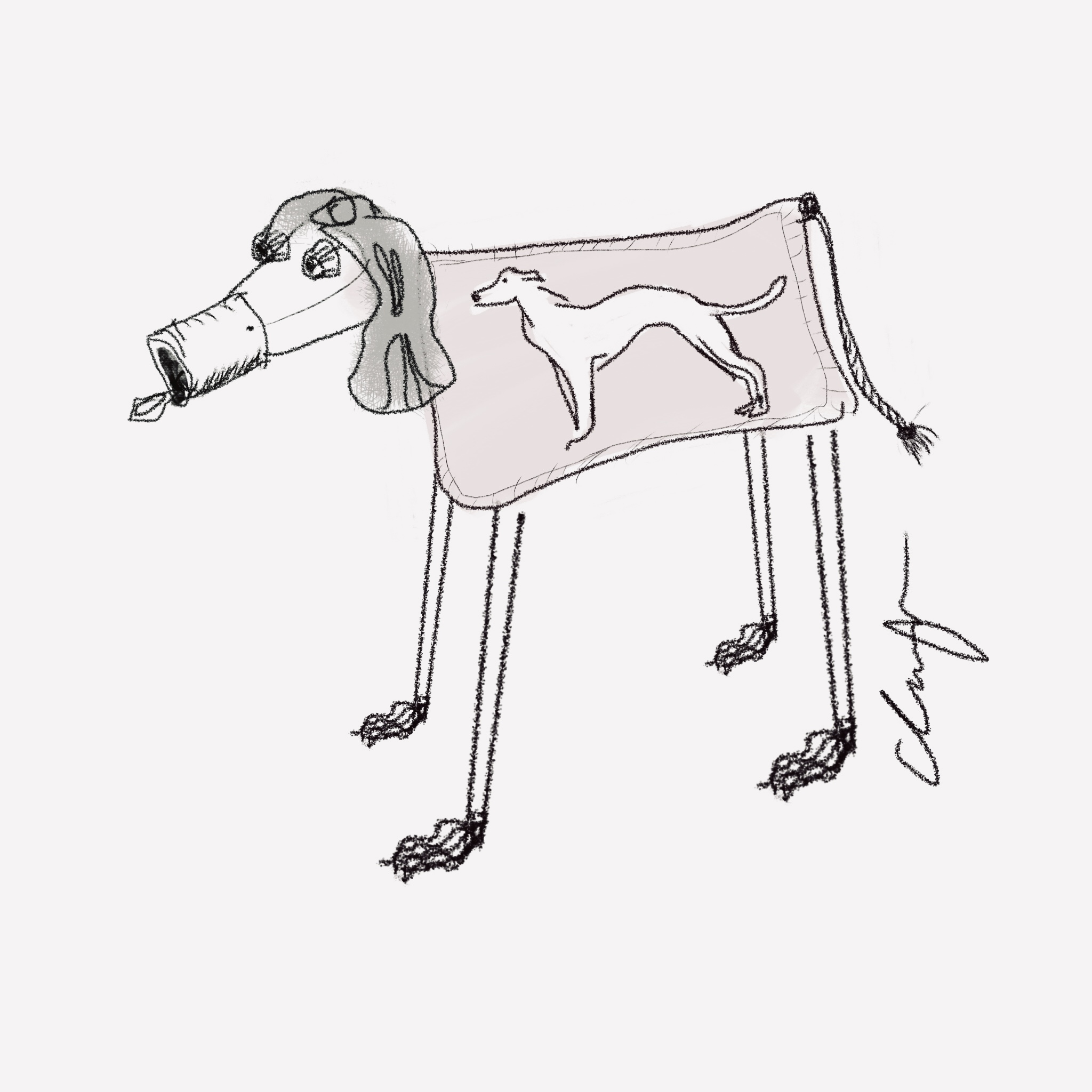
I made a new Stanley from the recycling
basically just experimenting
with everything and anything

his head was a cracked plastic funnel
a baked bean can for a muzzle
his ears a pair of raggedy flannels

for his eyes I used two diet coke tops
his legs were four old floor mops
his claws quartered rubber door stops

his body was a novelty cushion
wires to work every facial expression
a bark from a bootleg jazz session

it turned out better than I anticipated
I hoped he might’ve celebrated
but Stanley growled at the creature I’d created

dog tempest

Be not afeard; the lurcher is full of noises,
a hundred twangling voices
that sound as if they should mean something
but do not
or if they did the dog hath long forgot
as he wakes with a sneeze and a start
and a mournful howl that would break’st thy heart
and rolls about the rug a lot
and his floppy ears begin to swot
with shaggy, importunate paws
and oft time roars
when those grievous and galumphing claws
wrought more damage than he witteth
whereupon he forthwith doth quitteth
to lie in attitudes of bleak despair
in a forlorn heap at the top of the stairs
and moans, and sighs
and everyone’s patience tries
and makes them curse that moment when
they adopted a lurcher from the rescue pen
as he dreams o’ the walk he had last weekend
and wakes, and cries to dream again

peanut takes the fifth

The estate is so perfect it hardly seems real. A collection of the kind of houses you might see on a Monopoly board, except red not green, and made of wood not plastic. I imagine a giant hand reaching down from the sky and carefully setting each one in place, followed by the bushes, the young trees, a cute little twist of driveway. Kids playing in the street.
One of the kids cycles up to me as I park in the drive.
‘Hello’ he says, with a blank expression.
‘Oh – hello! Alright?’
He doesn’t say anything, but leans on the handlebars of his bike and watches as I take my bags out and shut the door.
‘Well… have a nice day!’ he says, satisfied everything seems to be in order. Then jumps up on his pedals and sprints away.
‘You too!’ I call after him.

I’d phoned Maud earlier to say I was coming.
‘The front door’ll be open’ she’d said. ‘Ring the bell, come into the hallway, but don’t open the inner door till I say. Only I’ve got the dog and he’ll run out.’

There are half a dozen wooden steps up to a boxy porch. I ring the bell, then open the door and step inside.
‘Just a minute!’ shouts Maud above the excited barking of a small dog. I close the main door behind me and wait. The moment Maud opens the inner door, the dog hurls itself through the gap, stretches its paws up my leg and stares at me with crazy eyes.
‘Peanut!’ says Maud.

Peanut is about the size of a Jack Russell, but one that’s been cut-and-shut with a Yorkie or a Capybara or something. It has wild, overgrown eyes and a bottom jaw cocked to the side with the tiny teeth showing, giving it a vexed kind of look, the kind of look you might see on the face of an ornery town sheriff who can’t decide whether to shoot you or make you deputy.
‘He’s so cute!’ I say, reaching down to pet his head.
Peanut licks my fingers then jumps back down and hurtles away back into the house. Maud trudges after him, waving for me to follow.

Maud’s front room is as cosy as any I’ve seen, the large patio window overlooking a lush and flowery garden.
‘Take a seat!’ says Maud, throwing herself down into her mission control recliner. ‘I don’t mind where.’
‘That’s the second dog I’ve met called Peanut’ I tell her, putting my bag down.
‘What was the other one like?’ she says. ‘Was that a pest, too?’
‘Actually…’
‘I didn’t name him,’ she says. ‘He was like that when I adopted him. I wanted an older dog. I said to them I said – I’m eighty-six! What do I want with a young dog? But they didn’t have anyone else and he’s only little so I suppose they figured he’d get enough exercise out in the garden. Plus I have a woman come over every other day to take him over the racecourse, and that seems to work.’

I picture Peanut racing alongside the horses. When they jump over the hedges, he dives straight through…

‘…mind you, it’s company,’ she says. ‘I wouldn’t be without a dog. It makes a place, d’you know what I mean?’
‘I do,’ I say. ‘We’ve got two lurchers.’
I show her the pictures I’ve got on my phone.
‘Oh – now!’ she says. ‘Look at that!’
She doesn’t stop long over the pictures, though. She immediately struggles back up again and takes me over to a wall that’s covered in framed pictures of all the dogs she’s ever had, which is quite a number. There’s one she seems to avoid, though – a Bichon Frise in soft focus, reclining on a pink bed, looking as pampered and comfortable as Barbara Cartland. Eventually she comes to it, though.
‘And that’s Billie,’ she says, reaching out to stroke the frame. ‘Billie was just.. I don’t know… Billie!’

Meanwhile, Peanut has taken the opportunity to climb headfirst into my bag, pedaling his back legs furiously in the air to push himself further in. I reach down and gently lift him out again.
‘Tempting as it is to kidnap you,’ I say, setting him upright on the carpet where he stands panting indignantly.
‘You’d be welcome,’ says Maud. ‘Yesterday he ate two marigolds.’
‘The gloves?’
‘No – the flowers!’ she says. ‘He came running in with them sticking out of his mouth, then chewed them down before I could pull ‘em out.’
‘Oh Peanut!’ I say.
He looks up at me, his jaw synched to the left, his bottom teeth poking up, as if he knows exactly what Maud’s talking about but has decided to take the fifth.

wherever there is

The bell activates the dogs. I stand back from the door and listen to what sounds like a bear fighting a pack of wolves. If it is a bear, though, it has learned our city ways, how to curse and swear and slam a gate. A minute later and a paw materialises behind the frosty glass to flip off the latch.

The bear turns out to be Jon, a frazzled middle-aged man in a Motorhead t-shirt, his long, wild hair thinning at the top; the wolves a couple of miniature schnauzers who glare and rage at me from behind a baby gate.

‘Sorry about that!’ he says, pushing the hair back from his face. ‘Come on in! Just ignore them.’

I go past the growls through to a narrow front room where Jon’s wife, June is sitting in an armchair, dozing, her face propped on the flat of her hand. The room is dominated by a hospital bed that must have only landed there recently, everything else pushed to the side to make space, things piled quickly on top of each other.
‘It’s the nurse,’ says Jon, gently touching her shoulder.
She rouses blurrily as he helps her to sit up.

The moment I’ve finished saying hello and explaining why I’ve come, Jon throws himself into a long and frantic description of everything that’s happened recently. It’s a monologue that’s as traumatised as the room, big things mixed in with small, a jumble of information that’s hard to get straight. Jon scarcely seems to breathe as he talks, everything spilling out in a rush. The best I can do is nod and say Yes or Right or I see, letting him vent.

These are the closing hours of a fiercely hot day – the last of a run of hot days. Outside the sky is thickening with storm clouds, the air oppressively close. The windows in the little front room are all open, but nothing moves except the traffic outside and an occasional shout from the street. The net curtains hang straight down.

There’s a cushion on the back of the sofa behind me – a photograph of a schnauzer in close-up, eyes wide, mouth open.

I start to sweat.

I can’t gauge how much Jon is accepting of June’s recent End of Life diagnosis. The job was given to me when I was out and about, an urgent visit to assess the home environment and give guidance to the carers on what’s safe or not. I couldn’t figure out from the attachments exactly how much had been explicitly stated to June and Jon, and it was too late now to ring the other agencies involved for advice. All of the falls and manual handling struggles Jon describes could be put down to June’s declining health. But maybe as a family they’ve opted to do as much as they can to normalise the situation, which would be completely understandable. So I find myself trying to do three things at once: piecing together a timeline of events from everything Jon’s describing; trying to figure out if any of this shows they know and have come to terms with the diagnosis, and worrying how I’m going to talk about safe manual handling for the carers without acknowledging the most significant detail.

June slaps the top of her head and groans.
Jon goes over to her to comfort her.
‘Don’t worry, love,’ he says. ‘Don’t worry. We’ll get there – wherever there is.’

Stanley & Lenny

yes that’s right another goddamn dog poem
howlellujah, sings Leonard Cohen
watching with sad, sad eyes as Stanley licks his scrotum
not Lenny’s – I mean his
what kind of a poem do you think this is?

what I’m trying to say is
another day is
just beginning
and I’m struggling
to think of something
that rhymes with beginning
sinning?
forgiving?
anything?

but all I’ve got
is a dog with a name that’s not
all that easy to lever
into a poem that hauntingly hangs together
and seems to be talking about something other
than a scruffy dog on a sunny sofa

well – sofa so good
I’d write something better if I could
I wish Lenny were here with his Spanish guitar
to drop Stanley in a stanza about the way things really are
but unfortunately he’s not
so we’ll have to make do with whatever we’ve got
which is Stanley, obscenely snuffling a lot
and some pissant poet losing the plot

nero

When I phone to check if it’s okay to visit, a dog barks so loudly it’s as if the dog has answered and not Eileen. There’s the sound of a desperate struggle – which is either Eileen trying to wrestle the receiver out of the dog’s paw, or Eileen dropping the phone, grabbing the dog by the collar and dragging it off into the kitchen. I’m guessing it’s the later, because after a long pause when all I can hear is the sound of muted, non-specific threats, more barking, doors slamming, and then the sound of slippers and heavy breathing approaching, the phone gets swept up again and Eileen answers with a gasp: ‘Who is it?’
‘My name’s Jim. I’m a nursing assistant from Rapid Response at the hospital. I’ve been asked to come take some blood this afternoon, if that’s okay.’
‘Fine,’ she says. ‘So long as you don’t mind dogs.’
‘I like dogs.’
‘Do you?’ she says. ‘You might change your mind after this one. I’ll put him in the kitchen before I let you in.’
‘Honestly – I’m good with dogs.’
‘Yeah?’ says Eileen. ‘Well there’s dogs and there’s dogs.’
We settle on a time.
I look forward to proving her wrong.

*

From the outside at least, the bungalow looks innocent enough. None of those chintzy warnings you sometimes see: I LIVE HERE! with a picture of a dachshund or something; a door mat with a fake bite taken from one corner: Beware of the Dog! , or one I saw recently, which was a silhouette of a doberman against the words: I can make it to the door in two seconds. Can YOU? and so on.
I knock, and take a step back. There’s an urgent skittering of paws, a crash against the door, and an enormous barking so resonant I feel it more than hear it.
‘Nero! Nero!’ shouts Eileen. ‘No Nero! C’mere!’
More scuffling and cursing. It’s strangely subdued, though, like the violence is quite routine, two bad tempered wrestlers going through the motions.
‘Jes’ a minute! Jes’ a minute!’ wheezes Eileen – although whether to me or Nero it’s impossible to say.
It takes about ten minutes for her to drag him away and bang him up in the kitchen. Eventually she shuffles back to the door and opens it.
‘Hello,’ she says, straightening her wig. There’s the sound of an enormous nose sniffing under the kitchen door – which is actually more of a flimsy screen, and would struggle to hold a rabbit.
‘He’s a bastard,’ says Eileen. ‘He’s not even my dog.’
‘Whose is he then?’
‘My son’s, but he’s away.’
‘How long for?’
‘Too long. C’mon in. Let’s get this done quick before he wrecks the place.’

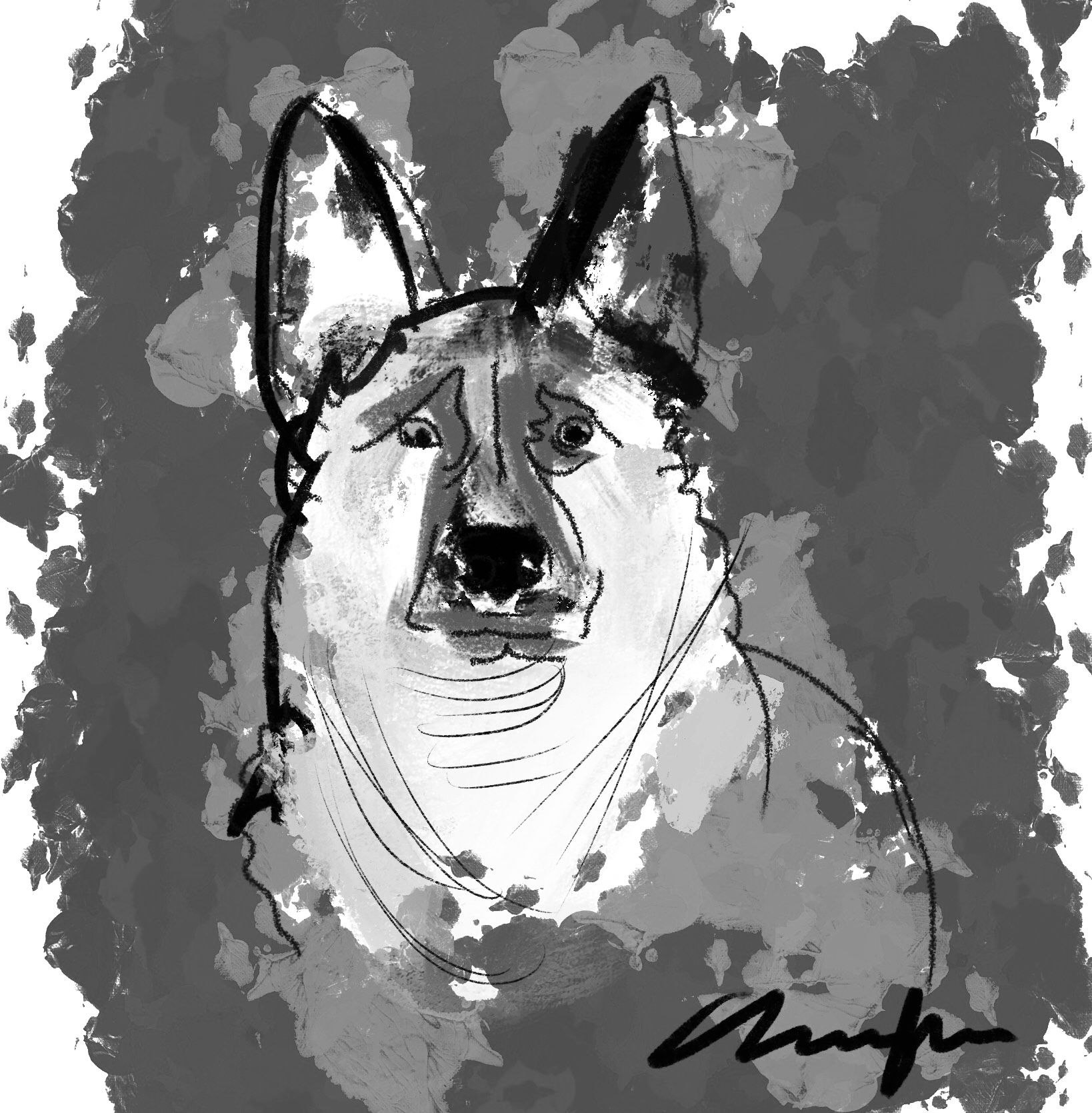
The sitting room is dominated by a gigantic portrait of an Alsatian, and I wonder if Eileen’s baby-sitting this, too. It’s such a funny, formal pose – upright, three-quarter length, the kind of outraged frown you might see on a High Court judge. I wouldn’t be surprised to see the artist had added a houndstooth waistcoat and a pocket watch.
‘Yeah. That’s ‘im,’ says Eileen, collapsing back on the sofa, her legs kicking up so violently her slippers almost fly off. ‘His eyes follow you. Like real life.’
‘He certainly looks like a Nero,’ I say. ‘Very intelligent.’
‘You think? Well if he’s so smart, how come he failed the police exam?’