
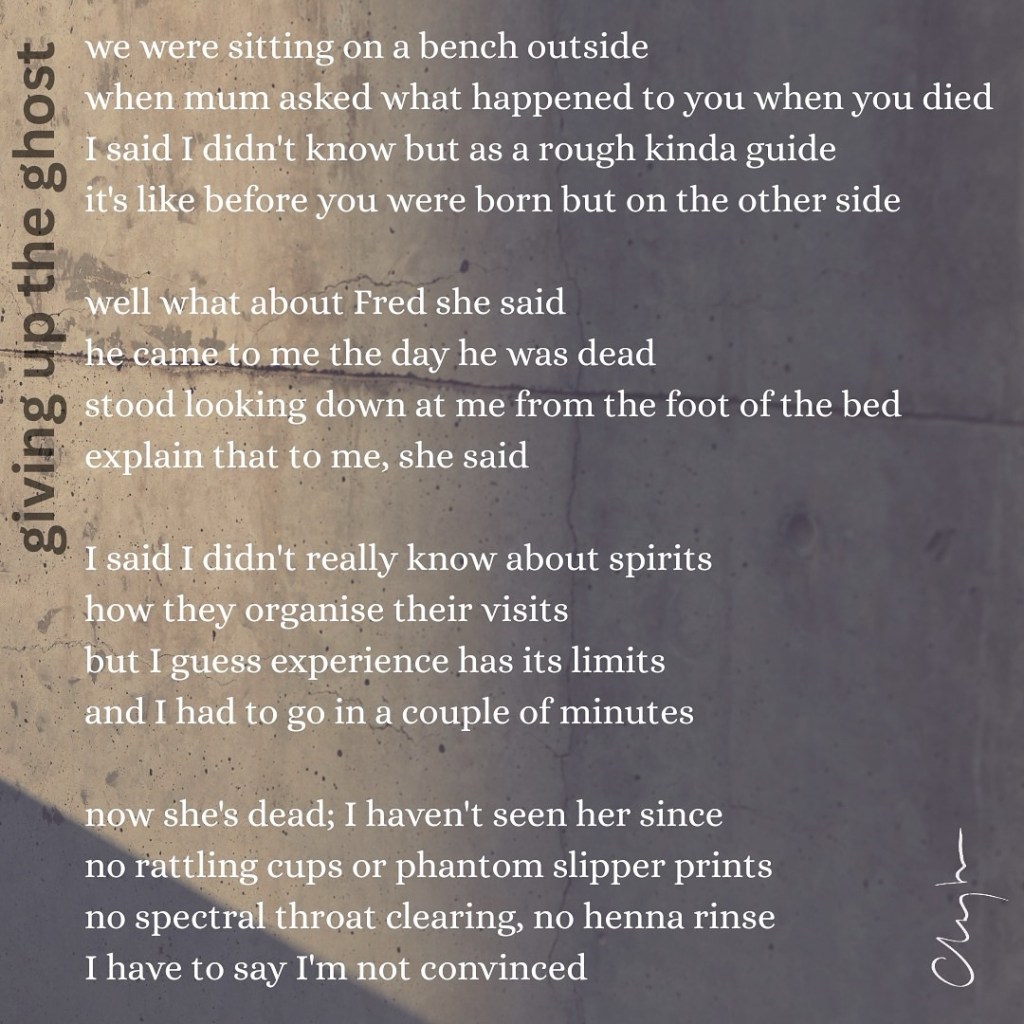
giving up the ghost
it was finally quiet on the clinical desk
the end of the day with nothing much left
we were slumped around it talking about death
I remembered the chats I had with mum
about life and death and what you become
she wanted hope; I tried to give her some
but it’s hard when you don’t believe in spirit
just every natural thing has a limit
and the really magical thing is physics
her proof of course was the ghost of Fred
who appeared one night at the foot of her bed
and THAT’S the first she knew he was dead
anyway, we often chatted about this
reincarnation versus fiery pits
we’d always end on good terms with a kiss
I was shopping in Sainsbury’s (the vegetable aisle)
when my sister rang to say she’d died
in bed that night with the dog by her side
so after all those talks about maggots
angels and spirits, atoms and planets
I lost the connection weighing carrots

mum liked to go to hunstanton
a day out by the sea
she’d go for a walk on the wide, wet sands
then head to a cafe for tea
once she saw a whale there
stranded when the tide went out
people dug teeth for souvenirs
took selfies by the snout
she didn’t like to see it, poor thing
it looked so lost on the beach
something so private and alien
suddenly in reach
but everything dies: whales, mums
it’s just the way things go
everyone tries to take life as it comes
and stay buoyant I suppose
it’s funny how these memories fall
what shadows move beneath
wide, wet sands of nothing at all
a stranded whale on a beach

mum was a certified sales witch
something which
ordinarily shoulda made her rich
but sadly didn’t
she had to keep her magical skills hidden
because of a certain stringent clause
in the local retail witching laws
I know all this, okay,
because sometimes on a Saturday
I used to stop
at the grotty sports shop
where she worked
and I’d lurk
at the back
while she tended the racks
of rackets and bats
and sporty shit like that
I remember one particular customer
morbidly muscular
tattoos & bruises
like life had used
him very cruelly
but he wasn’t bothered unduly
being usually
the meat meting out the cruelty
mum smiled
poor guy
DARTS! he said
scratching his head
like he’d rather be using a dart instead
I blinked
time seemed to shrink
but before he or I had time to think
he was staggering back through the door
with a Winmau pig bristle dartboard
Viper tip tungsten darts, of course
dumbbells, shuttlecocks, trainers & shorts
like he played about a million sports
including snooker, as I watched him disappearing,
judging by the fancy cue he was swinging

one day
away
on holiday
when we were small
we accidentally kicked our football
into the sea
and watched the waves take it out gradually
mum swam after it
and after a bit
she was so far out
we couldn’t figure out
what was the ball or what was her cap
so we hurried back
to the promenade
and tried really hard
on tippy toes
to use one of those
cast iron penny telescopes
but gradually the jokes
died away
as we watched her swim further off into the bay
and wondered if she’d ever come back
or mum was gone and that was that
fifty years later she’s really dead
and – what’s left to say?
except I remember her swimming far out
out, and out – impossibly out – far out into the bay

It doesn’t help that Moira takes out her hearing aid the moment I put it in.
And when I kneel down next to her chair to shout in her ear and explain why we’ve come to see her, I kneel on a tack strip.
‘Are you alright dear?’ she says as I swear and leap up again.
‘Fine. I’m fine,’ I say, rubbing my knee, tentatively exploring the small hole in my trousers.
Moira stares at me, her jaw bobbing up and down, like a ventriloquist’s doll on satellite delay.
It’s not a great hospital discharge, that’s for sure. It’s going to take a while to figure out what’s what, and even whether it’s safe for Moira to be here. For a start, her landline’s out of action, which means the Carelink alarm box is also redundant. Not only that, the phone is in the middle of the carpet, the power line one side of her chair, the phone line snaking across the carpet and off into the socket in the hall. Not so much a trip hazard as a trip trap. Someone’s obviously taken the view that Moira should stay downstairs. There’s a bed in the corner, a commode and a zimmer frame, but the bed’s unmade, the bedrail on its end against the wall, and the commode in the middle of the room. She’s wearing pads but no sign of any fresh ones. The fridge has the barest minimum – a loaf of bread, a tub of spread, a pack of cheese slices, a pint of milk. The freezer has a pizza and a few oven meals whose date I haven’t checked but from the packaging look fairly antique. All in all, it doesn’t seem as if much has happened since Moira was taken into hospital two months ago. And although we’ve arranged for carers to come in four times a day, it’s debatable whether that’s sufficient. In fact, looking at Moira sitting in her chair, surrounded by not much, I’m wondering if they’ve started outsourcing the discharging of patients to an online delivery company. Although, I’m sure if they DID, at least you’d need a signature, and in this case, she’d have gone back to the depot.
‘What’re you going to do now?’ she says.
‘I need to sort your phone out.’
‘My what?’
‘Your phone. It’s not working, Moira. It’s too dangerous left on the floor like this.’
‘Don’t you go breaking it.’
‘I won’t.’
The first thing I do is call the Carelink people. They say they’ll send a technician round within the hour to install a box that works off the mobile signal until the landline is up again. Luckily there’s a power socket in the hall, so I plug the phone in there and put it safely on a table, ready to be fixed.
‘What’s your son’s number?’ I shout.
‘My what?’
‘John. What’s his number?’
‘Who’s it you say?’
‘John…’
I make the international sign of the phone.
She immediately races through the number.
‘Oh – hang on a minute,’ I say, getting out my mobile. ‘Okay. What’s it again?’
‘The what?’
‘John. His number.’
She stares at me.
I go to kneel down by her but stop myself at the last minute.
I lean in and shout in her ear.
‘WHAT’S JOHN’S NUMBER?’
She races through it again. I repeat it to myself as I put in the area code.
‘What about the telly?’ says Moira, pointing a crooked finger Grim Reaper style at the screen. But John’s picking up, so I hold up my hand as if to say ‘shan’t be a second’ and walk into the kitchen to speak to him.
The man that answers sounds utterly spent.
‘I was round there for hours and she never showed,’ he says. (I want to ask him what he did for all those hours, but I let it ride). ‘I’m in my seventies myself,’ he says. ‘I’ve got my own problems.’
‘It’s difficult,’ I say.
‘I give her some of the stuff outta my fridge, but she wouldn’t have it. Mum’s not easy – I don’t know if you’ve found that out yet? She was always difficult. Old age hasn’t done nuffin’ to improve on things.’
‘She won’t put her hearing aids in.’
He laughs.
‘Yep. And that’s the least of it. I could go on, but you don’t want to hear it, and I don’t particularly want to say it.’
‘We’ve got to get her landline fixed,’ I tell him. ‘Without it, the personal alarm won’t work.’
‘My son’s sorting that out,’ he says. ‘Or should be. I’ll give him a nudge. ‘Course – he’s busy with his own life.’
‘There’s the TV as well. It doesn’t seem to be working.’
‘Yep. He’s looking at that n’all.’
‘Great. We’ll be putting carers in four times a day, and we’ll have various clinicians and therapists coming in and out. Can I give them your number?’
‘Why not?’ he says. ‘Although I’m not sure what I can really do.’
I ask if he’ll do a shop to stock up on the things she might like, microwave meals and so on, plus a supply of pull-up pads.
‘Righto,’ he says. ‘I’ll drop them round tomorrow morning.’
He rings off.
Back in the sitting room Moira is staring at the blank TV. I turn it on, but it just goes to a fuzz and nothing I try makes it any better.
‘John’s sorting it out,’ I tell her.
She holds out her hand and makes a flapping motion with her fingers.
‘Where is it?’ she says. ‘What’ve you done with it?’
I hand her the remote.
She points it at the screen, flips it on and off. On, off. On, and then off.
Fuzz.
Each patient record has a reminder area on the home page. It’s supposed to draw your attention to essential details or dangers, such as the need for double-up visits, the contact numbers of the relatives you must liaise with first, the keysafe code, any environmental dangers you should be aware of. So the first thing I write is:
Two small dogs – friendly, but bark when you knock
It’s only when I read it out loud I see the problem with the sentence. So I delete and write instead:
Two small dogs. Loud to begin with, but soon settle down.
Mrs Albright is ninety-seven. She lives alone in a ramshackle bungalow, top of a narrow lane of cottages and heavily-buttressed flint walls leaning out at extraordinary angles, an ancient church under scaffolding, and a strange, round building with worn stones and arrow slits standing alone in a paddock, that looks like maybe it’s the last thing standing of a castle, currently serving as a chicken house.
Like most of everything else down the lane, Mrs Albright is old and falling down. But although physically she’s reaching the end of her ability to cope, intellectually she’s as formidable as ever.
‘Apart from the carers coming in twice a day, and your family popping in when they can, do you manage to see anyone else?’
‘Anyone else? Do you mean socially?’
‘Well – yes, I suppose I do.’
‘I run an ancient history group once a week, if that counts. Does that count?’
‘I think that counts.’
‘Excellent. Then – yes. Every Wednesday I have a dozen or so people round and we discuss a broad range of topics. Last Wednesday Sally did the Assyrians. This Wednesday it’s Margaret on Alexander the Great.’
Whilst we’re talking, Mrs Albright’s dogs – two bug-eyed pugs – have plopped themselves down to sleep around her feet.
‘Yes – I’m afraid they do that a lot,’ she says, peering down. ‘They like to be near me in case I drop anything overboard, a bit of crumpet or what have you, which I’m afraid to say does happen from time to time. The problem is I forget the damned things are there and when I get up to spend a penny, I go flying. It’s a miracle I’ve lasted this long without breaking anything. Not so much as a cup.’
Mrs Albright’s son Richard is sitting with us at the table. He’s already mentioned that the family are looking at residential care, something Mrs Albright seems happy to think about.
‘I’ll miss the old place,’ she says, planting both hands firmly on the table and looking around. ‘But – you know, one thing that became very apparent to me very early on in my career, is that nothing lasts forever.’
Jean’s living room is freezing – and no wonder. The patio doors are open, set a few inches apart down the centre, a chilly wind blowing straight through.
‘I’ve got … claustrophobia,’ says Jean. ‘I can’t bear … to be shut in.’
‘They stay open all the time,’ says her son, Garry. He’s sitting opposite Jean on the sofa, his hands buried deep in his jacket pockets, his right knee bobbing up and down. I’m not surprised he’s still wearing his outdoor clothes, including a knitted bobble hat with ear flaps, so cute I half expect to see mittens on cords when he takes a hand out to rub his nose. ‘It’s permanently winter in this place. I’m not kidding. You get snow blowing in. Snowmen. Penguins. The lot.’
‘I don’t mind,’ says Jean. ‘I have to see … open sky.’
‘I’ve sorted it so you can’t pull the doors any further,’ says Garry, jumping up to go over and demonstrate. He hauls on the doors so violently the panes shake, obviously one of those guys who likes to test things to destruction. ‘It’s pretty secure,’ he says. ‘I did a bang up job.’ He gives the doors another almighty tug that almost shatters the glass, then shrugs and comes to sit back down. ‘You’d have more chance squeezing through a letterbox.’
‘He’s very good,’ says Jean. ‘With his hands, anyway. Very practical. Aren’t you, Garry?’
‘Yeah,’ he says. ‘Practically insane.’
Jean is sitting on the side of her electric bed, her nasal cannula connected to a spool of green plastic tubing that snakes across the carpet to an oxygen concentration unit. The unit whirrs and rattles; Jean’s shoulders rise up and then drop back down again in a mechanical, gasping kind of rhythm that you’d think was activated by the machine – which, in a way I suppose, it is.
‘Good ‘ere, innit,’ says Jean.
Suddenly there’s a flash of white and orange at the window, a raucous cry, and a huge seagull lands just the other side of the patio doors. It flaps its wings once or twice, then stares at us through the gap.
‘Steven!’ says Garry. ‘It’s Steven Seagal. Geddit? Steven Sea-Gull? Seagal? Yeah?’
‘That’s a good one!’ I say. ‘Like it!’
‘What is it, Steven? You want some food? Let’s see what we’ve got for you today.’
Garry goes into the little kitchen, starts opening cupboards and slamming them shut again. I wouldn’t be surprised to see Steven hop through the gap and follow him, but he seems content to stay where he is.
Jean stares at the seagull; the seagull stares at Jean.
‘Funny creatures … aren’t they?’ she gasps. ‘Look at him!’
‘They’re pretty fierce, close up. I wouldn’t like to get on the wrong side of one.’
‘Oh – they’re alright!’ she says. ‘Smarter’n … some I could … mention.’
I wonder who she means, but she stops talking and concentrates on her breathing again.
Garry comes back in with a single slice of white bread.
‘There you go, Steven!’ he says, posting it through the gap. ‘Wrap your beak round that!’
The bird backs away a little, then raises its wings, jabs forwards with its head, grabs hold of the slice, bends down, and springs away into the air.
‘How he can fly with that thing in his gob I don’t know,’ says Garry, standing at the window, watching him go. ‘Now look! All the other birds are taking off after him! Nah! He’ll be alright though. He knows Kung Fu, don’t he? He’s a black belt seagull.’ Then he turns round and does a comedy chop in mid-air with the edge of his hand. ‘Hiya!’
‘Yes,’ gasps Jean. ‘Funny old … birds.’
Mrs Heywood is ninety-seven but looks older. She’s lying in bed tucked up to her chin, hands gripping the quilt either side of her face, blinking anxiously and rapidly, like an ancient dormouse in a converted matchbox in an illustration by Beatrix Potter.
‘Please help me,’ she squeaks. ‘Phillip hasn’t been in. I can’t remember the last time Phillip was in. Not the carers, not anyone. Please help me.’
I might be worried – if I hadn’t passed the carers on the front door, just leaving, and if the carers hadn’t told me that Phillip had been in that morning and was due back at lunchtime. And even without those things, I would still have guessed Mrs Heywood was mistaken about things, by the warm mug of tea, cup of fresh water and plate of bourbon biscuits on the trolley by the bed, the newly-ordered and spotless shine of the commode, the neatly folded clothes on the armchair, the general air of everything having been done.
‘Don’t worry, Mrs Heywood. I’ll do your blood pressure and what have you, make sure you’re alright, then I’ll call Phillip and we can have a chat about things. How does that sound?’
‘I’m terribly ill,’ she says. ‘No-one’s been in.’
She’s so thin, I have to change the cuff for an infant size. Despite her frailty, though, all her observations are good.
‘Let me write it down before I forget,’ I say.
Mrs Heywood pulls the quilt more tightly about her, frowning and pouting, like a child who’d been put to bed for no reason, and I was writing a letter to the teacher or something.
Flipping through the folder I notice that her surname has been spelled in two ways – Heywood and Hayward. I ask her which is right. She levers herself up on both elbows, lowers her chin and fixes me with a severe expression: ‘It’s Heywood!’ she says. ‘H-E-Y-W-double O-D!’ Then, after a pause to satisfy herself I’ve received the information, she carefully lowers herself flat again, and draws the quilt back up to her chin.
Just then the front door opens and a man’s voice says: ‘Hello? Mum?’
‘Phillip!’ says Mrs Heywood, sitting up again.
A second later and Phillip clumps into the room. He’s a heavy, hearty-looking man in his mid-sixties, with a chin so square and scrubby he could kneel down and sand the floor with it. As he stands there looming over us in his vast fluorescent yellow tabard, dusty combat trousers and beaten Caterpillar boots – it’s impossible to think of Mrs Heywood ever giving birth to such a figure. We shake hands, mine getting lost in his hefty builder’s paws, calloused and capable, a grip that could dent a pipe.
‘I tried ringing you before I came but it just went to voicemail,’ I tell him, in case he’s cross I’m here without him.
‘Yeah – sorry about that,’ he says, swiping off his beanie and scratching his head. ‘I got the message, but reception’s terrible. Anyway – I was only working round the corner so I thought I’d pop in and catch you.’
After we’ve settled his mum we go into the kitchen to chat. His demeanour rumples a little when he talks about their situation. His dad died a couple of years ago, it hit his mum hard, her dementia’s getting worse. She’s got carers four times a day and Phillip comes in as often as he can, but he doesn’t think it’s enough. She’s up and down, often unhappy, doesn’t remember things. It’s becoming dangerous.
‘She’s had a few falls,’ he says. ‘The only reason she hasn’t hurt herself is ‘cos she’s so light it’s like dropping a feather. Thing is, all this time she’s always been dead against going in a home. Don’t you go putting me into one of them places she says. I’m not going into no old people’s home. But I can’t think what else to do. I know you can get live-in carers, but she wouldn’t want someone strange in the house. It was hard enough getting her used to the carers. It’s a worry, that’s for sure.’
‘Maybe you could try getting her in for a spot of respite. Just for a couple of weeks. See how she goes. My bet is she’ll settle right in. There are people there all the time, keeping her company and making sure she’s safe. There’s a lot of resistance to the idea of residential care, but it’s not what they think. She’d have her own room, nice n’ cosy, familiar things around her. I think she might like it.’
‘How do we go about doing that, then?’
‘There’s nothing to stop you looking around for yourself. Asking people for recommendations. But if you’re worried about the financial side of things I could always get a social worker to talk to you. This is more their domain.’
‘Could you? That’d be great. I just need to get a clear idea of where we are and what’s to be done.’
‘I’ll do it today.’
I start coughing. Phillip pulls out a packet of Fisherman’s Friends cough lozenges.
‘Try one of these!’ he says. ‘I swear by ‘em. When you’re outside all the time you need something with a bit of a kick.’
It certainly has that – and it stops me coughing.
‘I’ll tell you the best cold remedy,’ says Phillip, putting the packet back in his pocket. ‘Drop one in a glass of vodka. Sloosh it round. Down in one.’
‘A bit like sloe gin for builders.’
‘Something like that,’ he says.
After I’ve said goodbye and let myself out, I notice a huge lorry parked outside the house. On the side of it, in great, big, block white capitals: HEYWOOD & sons.
H-E-Y-W-double O-D
Ella’s son John is furious. Not with us, he says, every now and again, like a cartoon bull kicking and raging around the ring, stamping his hooves, blowing smoke through his nose and ears – then stopping in a cloud of dust to bow to the rodeo clown.
‘Look at her! They may as well have fly-tipped her by the side of the fackin’ road. Like a fackin’ fridge or some’ink.’
‘I know it’s stressful, John, but just try to ease it back a little if you can…’
‘I’m not ‘avin a go at you, mate,’ he says. ‘It’s the fackin’ hospital. And the ambulance. I mean – what was they thinkin’? We’re back to square one. This is exactly the fackin’ situation she was in when she went in in the first place.’ He suddenly seems tangled up in all those ‘ins’ and stands there, breathing hard.
Even though John makes you want to take a step back, and maybe even pick up a cushion or something, I have to admit I can see his point. Ella is a bariatric, self-neglecting patient who’d been admitted after being stuck on the sofa for several days. And even though the flat has had a rudimentary ‘deep clean’ whilst she’s been away, it’s still pretty awful, and here she is, back on the same sofa. The two ambulance crews must have sweated and struggled hauling her in their carry chair up that crooked flight of stairs. And I suppose gravity and the relative height of the chair to the sofa must have worked sufficiently in their favour to make the transfer. But since we’ve been on scene to do the initial assessment and see what Ella needs in the way of therapy, nursing and care support, she hasn’t been able to get up, even with the most enthusiastic, hands-on encouragement. To all intents and purposes, John is right. She’s landed back where she started. If Ella can’t get up from the sofa we’ll simply have to send her in again, as a failed discharge.
It’s a difficult situation, made worse by the fact it’s already six o’clock in the evening. If we call for an ambulance they’ll mark her as low priority. We could be here till midnight.
‘Well I can’t stay,’ says John, reading my mind. ‘I’ve got my own family. I’ve got work in the morning. I’m fackin’ Hank Marvin’ and there’s fack all in the fridge. I mean – where’s the thinkin’? Where’s the planning? Hey? It’s fackin’ pathetic. I told ‘em this’d happen. I told ‘em exactly what’d happen. And what happens? This! This happens! Fackin’ unbelievable.’
I’m here with Drishti, the physio. I know how busy she’s been today, and lately. How much it would mean to her today to finish work on time and get home to her family.
‘There’s no point in us both staying,’ I say to her. Drishti is so essentially kind, though, she won’t have it.
‘No, no,’ she says. ‘Let us remain together and see what we can do. It’s never too late for a miracle.’
The thing I need to do with the most urgency now is redress Ella’s leg. She has varicose eczema. At some point she’s pushed the dressings down and been working away at the scabs. From time to time she reaches down, absent-mindedly pulls off another bloody scrap, and puts it in her mouth. It’s difficult to keep an eye on her to stop her doing it, especially with John ranting around the place.
‘Please don’t do that!’ says Drishti, gently guiding her hand back down and wiping it with a tissue. ‘It’s really not a good thing to do,’ she says.
I clean the leg with saline and re-dress it whilst Drishti calls for an ambulance.
‘Four hours minimum’ she says with a sigh, hanging up. ‘They say it is a busy night. When is it NOT a busy night?’
‘I don’t suppose you’d be able to stay with your mum…?’ I say to John.
‘What? You’re havin’ a laugh, mate? Four hours? I’ve been ‘ere too fackin’ long already. I’ve got my own fackin’ life, y’know?’
‘Has you got anyone else? Any siblings?’
‘I’ve got my sisters, but they’ve washed their hands. They don’t want to know.’
‘What about friends? Neighbours?’
‘There’s no-one. That’s what I told ‘em! She hasn’t been out o’ the flat in seven years! I fackin’ told ‘em all this! I can’t stay, mate. I gotta get up early.’
‘Okay,’ says Drishti. ‘That’s fine. You can go.’
And it’s only when he turns to hurry out of the door that she gives me a steady, sorrowful look.
I call the office to let them know what’s going on and to see if they have any brilliant ideas.
Lawrence is co-ordinating.
‘Ah!’ he says. ‘Oh dear. Erm….Well! Yes. I see the problem.’
If I’d written a film script set in the eleventh century, and there was a scene where a troupe of marauding knights were riding towards a monastery, and the monks were frantically running around, and one of them, a particularly tall and ascetic looking monk, was desperately loading up a cart with armfuls of ancient books and scrolls and things, tripping over his habit, cursing mildly, and then the ass gave a jolt and a wheel fell off, splashing the monk head to sandals in mud, just as the knights came clattering into the yard, swinging their swords, and the monk turned to deliver his line straight to camera: ‘Well. Isn’t that just bloomin’ typical!’ – I’d be sure to cast Lawrence as that monk.
(He already has the haircut).
‘Oh dear!’ he says. ‘Damn and double-damn. Okay. Right. Well. I suppose I could relieve you when the office closes. If you like? I live nearby, so it wouldn’t be so bad for me…’
‘That’s kind of you, Lawrence,’ I say. ‘Maybe it won’t come to that.’
I tell him we’ll keep in touch, and ring off.
We settle in – as best we can, given the environment.
Ella says she’d like to watch some TV. We give her the remote and she flicks through the channels, eventually landing on a reality show about a couple looking to buy a house. They’re standing on a terrace overlooking a fiercely blue harbour dotted with yachts.
‘You won’t see that in Bradford,’ the presenter says.
The couple smile but they look uneasy, shielding their eyes from either the sun or the presenter, it’s hard to tell. I suppose the idea is they could live anywhere. Maybe the next place they show them will be underwater or something.
‘That looks nice’ says Drishti. ‘Hot, you know?’
Suddenly a mobile phone rings somewhere. Drishti locates it in Ella’s hospital bag. She hands it to her.
‘Hello…?’ says Ella, still watching the TV. ‘Yeah. About an hour ago…’
I raise my eyebrows.
‘Ella?’ I say. ‘Sorry to interrupt. Would you mind if I had a quick word with them?’
‘It’s the nurse’ she says into the phone. ‘Okay. Jes’ a minute…’ She hands me the phone, then leans to the side to carry on watching the TV.
The caller is a woman called Stella. She works for a befriending service. Apparently Stella had been expecting Ella home and was planning to come round to see she had everything she needed and so on. I explain the situation, and ask if Stella might be able to stay a little longer until the ambulance arrived.
‘Medically she’s okay,’ I say. ‘It’s just she needs someone to keep an eye on her.’
‘That’s fine’ says Stella. ‘No problem. I’ll be straight round.’
‘Thank you so much,’ I say, then hand the phone back to Ella.
‘Who was that?’ says Drishti.
‘That was your miracle!’
I go to the window, draw the net curtains aside, and look out at the night sky, fully expecting to see a star detach itself, glide gently and magnificently down to earth, hop pointedly across the lawn, and ring the bell.
 jim clayton