mad panda

There’s a few of us gathered back at the office in the late afternoon, most of the day’s visits done, chasing the admin side of things, making referrals, further appointments and so on, waiting on the late jobs, the last minute visits, unforeseen events. It’s rare that it happens like this, a slack, re-grouping kind of time, when you’ve got the space to chat with your colleagues and catch up on things.
Magda is sitting next to me. She’s just had her hair cut – shaved close up one side, the rest in a heavy blonde fringe she scoots out of her face now and again. She looks tired but I don’t say it. Magda is the hardest working person I know. Not only does she pull extra shifts as a nursing assistant, but she works most weekend nights as door security on the clubs and bars in the city.
‘Man,’ she says. ‘I don’t think I can do it anymore. It’s not worth it.’
‘Why? What happened?’
‘Do you ever get those nights when you think – shit! Did I miss something? Did they fly a plane over town and pump it full of crazy spray?’
‘Did you get some trouble, then?’
‘Did I get some trouble? Yes, I got some trouble, thank you very much for asking. The funny thing was, they put me on the door of that comedy club you were talking about the other day. And I was thinking – okay, my only trouble here will be staying awake. But then these four guys show up, enormous guys, the kinds of guys who play rugby or some such shit, and I don’t know, bend girders for a living. Gigantic pain in the arse kinda guys. And when they turn up to the club they’re already pretty drunk. So I say to the bar manager, I say to him: Watch those guys and don’t sell them any more beer if they start getting too loud, y’know what I’m saying? They’ve already had too much. But of course, what do they do? They sell them plenty. And the next thing you know they start getting very loud and very aggressive, particularly this one guy, the biggest and tallest. So I go over to him, and I lay my hand on his shoulder like this, and I say to him: Can I ask you to please keep it down? Otherwise you’ll be asked to leave. And you know what he says to me?’
‘No. What does he say?’
‘He says fuck you.’
‘Wow.’
‘I tell you, man, I was like: Don’t you be saying fuck you to me! Who the fuck do you think you are, saying fuck you to me? And his friends are like: We’re very sorry. It’s his birthday. And I say I don’t care if it’s he’s won the Nobel prize for fucking CHEMISTRY. There’s no call to be so nasty to me. And then the other guys stand in front of him and they say: It’s just the beer. He’s not normally like this. He’s normally kind and quiet and basically a mouse. And I say: Well I’m sorry to have to tell you, but it’s not the beer making him a dickhead. The beer is absolutely fine. It’s your friend being a dickhead that makes him a dickhead. And the guy leans through them, and he says to me: Hey! You! You’re much too pretty to be doing a job like this. So I say to him: Keep your sexist opinions to yourself, my friend or you’ll see what this pretty girl’s capable of. Meanwhile all his stupid friends are crowding round saying sorry, sorry, sorry, please forgive him. And then the guy himself starts saying sorry, putting his hands together doing a pisshead kind of namaste. So I said: Okay. Okay. Against my better judgement, and because it’s your birthday, I’m gonna give you one last chance. And they’re all like thank you, oh thank you very much and everything. And I’m just about to go when I give the guy one last look and you know what he does? He flips me the middle finger. That’s it. I don’t wait for backup. I’m too mad and I’m too tired. I just grab him by the collar and march him out. And all his friends are jumping up and down saying sorry and he won’t do it again and please don’t, it’s his birthday. And you know what I say?’
‘What?’
‘I say Happy Birthday, Dickhead. Now fuck off and don’t come back.’
She sweeps her hair back from her face and takes a long drink of tea.
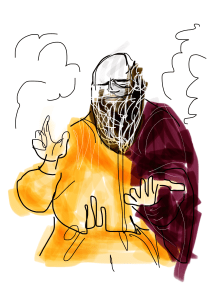
With her large round eyes, accentuated with dark blue-black eyeshadow and heavy black mascara, her pale face, and her sleepy demeanour, she reminds me of a panda. But even though Magda is a good friend of mine, and she’s used to seeing me around, still, I wouldn’t fancy getting on the wrong side of her. No way would I rile her up. I’ve seen how she crunches bamboo; I’ve seen what she can do with those paws.

drishti’s miracle

Ella’s son John is furious. Not with us, he says, every now and again, like a cartoon bull kicking and raging around the ring, stamping his hooves, blowing smoke through his nose and ears – then stopping in a cloud of dust to bow to the rodeo clown.
‘Look at her! They may as well have fly-tipped her by the side of the fackin’ road. Like a fackin’ fridge or some’ink.’
‘I know it’s stressful, John, but just try to ease it back a little if you can…’
‘I’m not ‘avin a go at you, mate,’ he says. ‘It’s the fackin’ hospital. And the ambulance. I mean – what was they thinkin’? We’re back to square one. This is exactly the fackin’ situation she was in when she went in in the first place.’ He suddenly seems tangled up in all those ‘ins’ and stands there, breathing hard.
Even though John makes you want to take a step back, and maybe even pick up a cushion or something, I have to admit I can see his point. Ella is a bariatric, self-neglecting patient who’d been admitted after being stuck on the sofa for several days. And even though the flat has had a rudimentary ‘deep clean’ whilst she’s been away, it’s still pretty awful, and here she is, back on the same sofa. The two ambulance crews must have sweated and struggled hauling her in their carry chair up that crooked flight of stairs. And I suppose gravity and the relative height of the chair to the sofa must have worked sufficiently in their favour to make the transfer. But since we’ve been on scene to do the initial assessment and see what Ella needs in the way of therapy, nursing and care support, she hasn’t been able to get up, even with the most enthusiastic, hands-on encouragement. To all intents and purposes, John is right. She’s landed back where she started. If Ella can’t get up from the sofa we’ll simply have to send her in again, as a failed discharge.
It’s a difficult situation, made worse by the fact it’s already six o’clock in the evening. If we call for an ambulance they’ll mark her as low priority. We could be here till midnight.
‘Well I can’t stay,’ says John, reading my mind. ‘I’ve got my own family. I’ve got work in the morning. I’m fackin’ Hank Marvin’ and there’s fack all in the fridge. I mean – where’s the thinkin’? Where’s the planning? Hey? It’s fackin’ pathetic. I told ‘em this’d happen. I told ‘em exactly what’d happen. And what happens? This! This happens! Fackin’ unbelievable.’

I’m here with Drishti, the physio. I know how busy she’s been today, and lately. How much it would mean to her today to finish work on time and get home to her family.
‘There’s no point in us both staying,’ I say to her. Drishti is so essentially kind, though, she won’t have it.
‘No, no,’ she says. ‘Let us remain together and see what we can do. It’s never too late for a miracle.’

The thing I need to do with the most urgency now is redress Ella’s leg. She has varicose eczema. At some point she’s pushed the dressings down and been working away at the scabs. From time to time she reaches down, absent-mindedly pulls off another bloody scrap, and puts it in her mouth. It’s difficult to keep an eye on her to stop her doing it, especially with John ranting around the place.
‘Please don’t do that!’ says Drishti, gently guiding her hand back down and wiping it with a tissue. ‘It’s really not a good thing to do,’ she says.
I clean the leg with saline and re-dress it whilst Drishti calls for an ambulance.
‘Four hours minimum’ she says with a sigh, hanging up. ‘They say it is a busy night. When is it NOT a busy night?’
‘I don’t suppose you’d be able to stay with your mum…?’ I say to John.
‘What? You’re havin’ a laugh, mate? Four hours? I’ve been ‘ere too fackin’ long already. I’ve got my own fackin’ life, y’know?’
‘Has you got anyone else? Any siblings?’
‘I’ve got my sisters, but they’ve washed their hands. They don’t want to know.’
‘What about friends? Neighbours?’
‘There’s no-one. That’s what I told ‘em! She hasn’t been out o’ the flat in seven years! I fackin’ told ‘em all this! I can’t stay, mate. I gotta get up early.’
‘Okay,’ says Drishti. ‘That’s fine. You can go.’
And it’s only when he turns to hurry out of the door that she gives me a steady, sorrowful look.

I call the office to let them know what’s going on and to see if they have any brilliant ideas.
Lawrence is co-ordinating.
‘Ah!’ he says. ‘Oh dear. Erm….Well! Yes. I see the problem.’

If I’d written a film script set in the eleventh century, and there was a scene where a troupe of marauding knights were riding towards a monastery, and the monks were frantically running around, and one of them, a particularly tall and ascetic looking monk, was desperately loading up a cart with armfuls of ancient books and scrolls and things, tripping over his habit, cursing mildly, and then the ass gave a jolt and a wheel fell off, splashing the monk head to sandals in mud, just as the knights came clattering into the yard, swinging their swords, and the monk turned to deliver his line straight to camera: ‘Well. Isn’t that just bloomin’ typical!’ – I’d be sure to cast Lawrence as that monk.
(He already has the haircut).

‘Oh dear!’ he says. ‘Damn and double-damn. Okay. Right. Well. I suppose I could relieve you when the office closes. If you like? I live nearby, so it wouldn’t be so bad for me…’
‘That’s kind of you, Lawrence,’ I say. ‘Maybe it won’t come to that.’
I tell him we’ll keep in touch, and ring off.

We settle in – as best we can, given the environment.

Ella says she’d like to watch some TV. We give her the remote and she flicks through the channels, eventually landing on a reality show about a couple looking to buy a house. They’re standing on a terrace overlooking a fiercely blue harbour dotted with yachts.
‘You won’t see that in Bradford,’ the presenter says.
The couple smile but they look uneasy, shielding their eyes from either the sun or the presenter, it’s hard to tell. I suppose the idea is they could live anywhere. Maybe the next place they show them will be underwater or something.
‘That looks nice’ says Drishti. ‘Hot, you know?’
Suddenly a mobile phone rings somewhere. Drishti locates it in Ella’s hospital bag. She hands it to her.
‘Hello…?’ says Ella, still watching the TV. ‘Yeah. About an hour ago…’
I raise my eyebrows.
‘Ella?’ I say. ‘Sorry to interrupt. Would you mind if I had a quick word with them?’
‘It’s the nurse’ she says into the phone. ‘Okay. Jes’ a minute…’ She hands me the phone, then leans to the side to carry on watching the TV.
The caller is a woman called Stella. She works for a befriending service. Apparently Stella had been expecting Ella home and was planning to come round to see she had everything she needed and so on. I explain the situation, and ask if Stella might be able to stay a little longer until the ambulance arrived.
‘Medically she’s okay,’ I say. ‘It’s just she needs someone to keep an eye on her.’
‘That’s fine’ says Stella. ‘No problem. I’ll be straight round.’
‘Thank you so much,’ I say, then hand the phone back to Ella.
‘Who was that?’ says Drishti.
‘That was your miracle!’
I go to the window, draw the net curtains aside, and look out at the night sky, fully expecting to see a star detach itself, glide gently and magnificently down to earth, hop pointedly across the lawn, and ring the bell.

ETOH

It’s quite a contrast to see the two of them together – Alex, wraith-like, matted hair, scooped eyes, shivering, hugging his legs in bed with a filthy duvet piled up around him; and Graham, the support worker from the alcohol and substance abuse team, shaven-headed, gym-fit, in a smart grey reefer jacket and leather man bag, perched on the arm of the sofa with his hands in his pockets. It could be a fashion shoot for an edgy magazine.
‘You’ve got this far, yeah?’ says Graham. ‘Hats off to you, mate. It’s no easy thing you’ve done there. Don’t go and spoil it now. After all we’ve been through. You got to realise – this is a disease we’re talking about, yeah? There are all kindsa toxins and shit floatin’ around your body right now. You can’t just expect to jump up and be cured. It’s a long, hard process. And you’re doin’ great, man! Isn’t he? This guy’ll tell ya…’
‘You are. Graham’s right. Alcohol addiction’s the hardest thing.’
‘See what I mean?’
Alex doesn’t seem convinced. He draws his legs closer to him, gives his head a peremptory shake.
‘I don’ know, man. I jus’ feel like I’m wastin’ everyone’s time. I mean – I brought it on myself.’
‘You can’t afford to think like that,’ says Graham. ‘Everyone’s different. You’re totally worth it, man.’
‘Is there a social worker involved?’ I ask Graham, flipping through his folder.
‘No,’ he says. ‘When they see they’re still drinking they pull out.’
He shrugs, scuffs his shoes in the trash.
‘It’s hard, but it’s just the way it is.’
‘It’s not like I’m not trying,’ says Alex.
‘Yeah – but there’s trying, and there’s doing, Alex. You’ve got to be in a position to accept the help. It’s just how it works. You know that.’
‘Yeah.’
‘We’re here for you, though.’

There are several bottles within easy reach of Alex’s bed – a two litre bottle of cider, a couple of quarter bottles of vodka, some other, less obvious stuff in bottles with the labels torn off. A dull yellow light filters through the filthy windows. The flat is an apocalyptic mess; it looks like an extemporary shelter somebody hollowed out with their hands in a landfill site. Here and there you can just make out traces of the orderly life Alex once used to live. There’s a mountain bike in the hallway, quietly fossilising under a press of junk; over by the window-ledge, a tool box, some work boots.
‘We’ve got to find a way to keep you out of trouble long enough to detox properly,’ says Graham. ‘Yeah?’
‘Yeah,’ says Alex. He doesn’t sound convinced.
Graham shrugs, pushes his hands deeper into his jacket.
‘How long’ve we known each now?’ he says. ‘Gotta be nine, ten years.’
‘Is it?’ says Alex, rubbing his face. ‘Fuck, man! Nine years? No! That’s like…’ He screws up his face to figure out what percentage of his life that represents: ‘…that’s like… a fuck of a long time, man!’
‘I think so,’ says Graham. ‘First time I met you you’d just been beaten up and taken to hospital. You were in a bad way, my friend.’
‘Was I?’ says Alex. ‘I don’t remember.’
‘Yeah – well – you don’t remember much, to be fair. You didn’t remember I was here yesterday, so maybe that’s not headline news.’
‘No. You’re right. Probably not.’
‘I’ve seen you in and out of hospital a hundred times. Lost sight of you for months on end when you took yourself off somewhere. You’d always turn up again, half dead, some new injury. And now look.’
He’s right. I’m reading through the latest discharge summary. For someone so young, Alex has a terrible list of things wrong. In fact, it’s a miracle he’s still here at all. Looking at him on the bed, though, it would be easy to think that maybe he wasn’t – that maybe he’d died that last time in hospital, but his spirit was so cussed it dragged itself back across town to find rest in this cold, cold bed.
‘It’s like training, yeah? You can’t just jump on a treadmill and bang out ten K. You might feel great at the end of it, but the truth is, if you don’t get the intervals right you can be setting yourself up for a lot of trouble. It’s all about the interaction between the sympathetic and the parasympathetic nervous systems, the way your body metabolises the shit and tries to get straight again. Jim’ll tell you. Hey?’
They both look at me – Graham as if he’s about to pick me up and bench press me, Alex with a haunted, shivery look.
‘That’s right,’ I say, ‘Uh-huh.’

cecil & the badgers

I was out on a dog walk, hanging around that corner of the woods where the badgers live (or some of the badgers, I should say. In fact, I’ve only ever seen one, hurrying home like someone weighed down with shopping bags, late for an appointment). I was impressed by the amount of work the badgers had been putting in, major excavations by the look of it, a great tract of sandy soil kicked out from one of the burrows, along with all the leaves and twigs they’d been using as bedding. It looked pretty deep. I thought if this was anything to go by, we were in for a hard winter.

I’d just rejoined the main path when I saw Jenny striding along, her pug Cecil waddling out in front. I waved, and waited. Cecil reached me first, checking me over in that abrupt, flat-faced way he has, a border guard demanding my papers.

‘Oh for goodness sake!’ says Jenny, waving him away. ‘Leave the poor man alone!’
‘How are you, Jenny?’
‘I’m fine, thank you,’ she says. ‘I only wish I could say the same for Cecil.’
‘Why? What’s wrong?’
‘What isn’t wrong, more to the point. He’s on antibiotics. For his ears. And now he’s completely off his food. He’s just not interested. I’ve tried everything – even his favourite, raw mince.’
‘Raw mince?’
‘Nothing. Not a sniff.’
‘Sorry to hear it.’
I look down at Cecil. I’ve never seen such a healthy-looking dog. Sleek lines, muscular back. I can imagine him in the Olympics, shoving a javelin through the air, or wrestling another pug flat on its back.
‘He’s wasting away,’ says Jenny. ‘Poor thing!’
Cecil is bored by all the attention. He starts eating some grass, with great relish, his slobbery tongue slapping at the leaves.
‘Cecil no!’ yells Jenny, hauling him away. ‘For goodness sake! You’ll kill yourself at this rate!’
He huffs indignantly, then waddles further ahead to eat the grass there, in peace.
‘He slept with me last night,’ says Jenny, dragging her hair back, making a mime of putting it into a non-existent scrunchie, then releasing it to spring forwards into exactly the same position. ‘It’s so unlike him. I didn’t mind, though. It meant I could keep an eye on him. Anyway. How are you?’
‘Yeah. I’m fine. I was just looking at the badgers. They’re digging deep. I wonder if it’s going to be a hard winter.’
‘Badgers’ says Jenny, glancing over her shoulder with a shudder. ‘I don’t think Cecil is all that good with badgers.’

sig

the works

There’s a builder’s truck blocking the mews. It’s up on hydraulic stabilisers as the driver operates the winch, dropping off enormous bags of sand and gravel, the engine labouring as the next load gets taken up, the back of the truck lurching with the sudden change of weight. I can’t imagine what building project would require such a massive delivery – maybe one of those basement excavations you read about, an underground pool and cinema and gym, perhaps. A lift shaft to a cocktail bar and viewing platform at the earth’s core. Whatever the reason, the contrast with the ancient backstreet couldn’t be more extreme. Two hundred years ago these would have been a row of stables with offices, lofts and basic accommodation above; now they’re a mixture of chi-chi businesses, full-scale conversions, and the cobbled street curves down right and left not to straw and manure-heaped gutters but expensive planters, artisanal signs and cutely painted old bikes with geraniums in the basket.

We’ve had to park at the far end by the equipment van that’s here to deliver a hospital bed. They could only have beaten us by fifteen minutes and yet they’re already half-way through. Once again I’m in awe of their efficiency and sheer work ethic, like scaled-up ants in yellow jackets. A hospital bed is no light thing. It comes in sections, of course, but the main frame is pretty heavy. A feature of the flats in these mews is a steep and narrow staircase running straight up from the front door – no doubt originally to a hay loft. To make things even more awkward, the house we’re visiting has a stair lift, so really there’s hardly any room at all to get the bed in. When we stroll up, though, they’ve already got the frame delivered, and all that’s left are the mattress, a cantilever table and a few other bits and pieces.
‘What did you do – commandeer the truck?’ I say to one of them, who is so red-faced I want to lean in and loosen his collar.
He laughs, slicks his antennae back.
‘Maybe you could take the table?’ he says.

The whole thing is something of a rush job. The GP had visited George late last night. George is a ninety-five year old man with a recent palliative diagnosis who has declined rapidly and unexpectedly straight into an End of Life scenario. He was refusing hospital, so the GP had prescribed anticipatory meds, made referrals to the District Nurse and Palliative teams, and to us for urgent review first thing in the morning. Katrina had gone straight there from home and was busy by eight. By nine she’d phoned in to make her report: it was bed care only, so George needed a hospital bed with pressure mattress and slide sheet to be delivered the same day, with someone to be there to help with a pat slide; George needed care support four times a day, double-up; he needed pads, pressure cream, foam lollipops for mouth care – the works. I said I could meet Katrina there at lunchtime to get the whole thing done.

George’s wife Valerie greets us at the top of the stairs.
‘Forgive my hair,’ she says, patting it. ‘I must look a fright. But as you can imagine I’ve had quite a night.’
Both Valerie and the flat have the shocked look of something hit by lightning. Everything is essentially as it was – the pictures, the chairs, the collections of antique pill boxes and books, the Moroccan rugs and tables and lamps, the family pictures on the walls – everything so perfectly placed and orderly the housekeeper must have a tape measure in their pocket. But the furthest end of the flat – the main bedroom end – has a sprawled, disrupted appearance, with a wreckage of discarded packaging, plastic strapping and so on spilling across the hallway, whilst through the open door the sound of construction and the movement of heavy furniture adds to the feeling of emergency. The noise from the builder’s truck outside sounds like a fire engine.
‘What a business!’ says Valerie. ‘But you know, everyone’s been so kind. We really are most grateful.’

There’s a large tabby cat staring at me from the middle of the living room rug. It’s as perfectly groomed as Valerie, and I half-expect it to reach up with a paw and pat itself delicately on the head, as she did.
‘Grammaticus is very put out,’ says Valerie, walking over to him. ‘He’s nineteen, you know? Like us – old and worn out. He can’t tolerate the fuss.’
She bends down stiffly and painfully, scooping him up to cradle him in her arms, just exactly as you would a baby, pressing her nose to the top of his head, rocking him up and down, swinging her hips a little from side to side. He maintains his stare, making little adjustments to accommodate the motion.
‘He looks good for his age,’ I say.
‘Do you think?’ she says. Then – still rocking the cat – she looks off towards the window. Down in the street, the noise from the builder’s lorry has eased. It sounds as if all the deliveries might have finished, and instead there are shouts and raucous laughter, the plaintive whining of hydraulic legs being lifted, the off-kilter clattering of a concrete mixer.
‘Good God,’ says Valerie. ‘When will it all end?’

nobody whistles in cars these days

nobody whistles in cars these days
marking their spots in the parking bays
ending their stops, starting their stays
nobody whistles in cars these days

everyone’s hurrying to shuck the corn
and scatter the leaves on the garden lawn
and kiss the crib where the kid was born
everyone’s hurrying to shuck the corn

you say everything comes to those that wait
the sistine chapel, the garden gate
the jack-in-the-box, the slave-in-the-crate
everything comes to those that wait

I hear somebody’s selling a hand-me-down
a torch for the sun, a bone for the ground
a saddle of meat and a bridal gown
somebody’s selling a hand-me-down

anything different is just the same
we spend the rent and spare the blame
and learn the rules and cheat the game
anything different is just the same

nobody whistles in cars these days
marking their spots in the parking bays
ending their stops, starting their stays
nobody whistles in cars these days

IMG_1116

Death comes to call (via mail merge)

Dear {first name} {last name}

Please excuse this communication
but we’re going through a rationalisation
and as you may have seen in social media
we’re modernising the whole procedure

Where formally you’d expect San La Muerte in a cloak
or a Banshee keening in a swirl of smoke
or Thanatos carrying your shade to a boat
– I’m sorry, but these were early adoptions
and currently no longer available as options

Not to mention Ankou in his corpse laden cart
collecting you when you were ready to depart
with his long white hair and cold, black heart
– well, we’ve withdrawn this model from circulation
(subject to the usual confirmation)

There was Azrail, beautiful or monstrous depending
on the quality of life the client was ending
Giltinė in her black cloak, Śmierć in white
Jogging round the boneyard in the middle of the night.
– picturesque but hardly cost-efficient choices
rarely leading to timely invoices

We had Pesta with her broom, Maaijeman with his rake
Yama on a buffalo with a lasso like a snake
Charon on the Styx for a couple of danake
– all very well but a bit out of date
Now we have fibre optic cables
clean data sets in Excel tables

So if you’d kindly fill in the attached receipt
and I’ll be back to upload you early next week

Yours facelessly,

D.

IMG_1104


holy bananas

I’m sorry to have to say this, but it’s all Pete’s fault.

‘There you go! Thought you might want something big and hot inside you!’ he says, slopping a huge Arsenal mug of builder’s strength tea onto the desk, then walking off, laughing in that filthy way he has, high and wild and raucous as a drag tea lady in a pantomime.

Pete is the world’s best tea maker – a county-level performer, meticulous, prolific. It doesn’t matter how much I resolve to be the first in with the drinks round, somehow he always manages to beat me to it. It’s in his blood. His DNA sequence is PGT. His mother was a teapot and he was born under the Constellation of the Great Urn. If you x-rayed his torso you’d see two tea bags where his kidneys should be. Pete is the Caffeine King, the Tannin Chief, the author of the Beverage Report. He put the tea in terrific and the milk and two in you. And so on. I have no doubt one day they’ll raise a statue by public subscription (mostly funds re-streamed from tea clubs across the world). A life-size bronze in the marketplace: Saint Peter of the Kettle, mug raised high for seagulls to perch on and provide the laugh.

Anyway. Nobody’s forcing me, I don’t HAVE to drink it. I know it’s going to be a busy morning so if I finish the whole mug I’ll be busting for the loo half way through. But Pete’s tea isn’t something you can pass over easily. Rational thinking doesn’t come into it. By the time I’ve left the department to start my visits, the mug is empty. I rinse it clean, put it upside-down on the draining board, and leave.

 *  *  *

By the time I get to Ralph, my second patient, my bladder is as taut as a helium balloon with Arsenal printed on the side. I finish dressing Ralph’s wound, doing his obs and so on, and I’m just about to ask him if it’s okay if I use his loo, when he says his daughter is due back any minute. She’s just popped out to get a repeat script of antibiotics. I don’t want to be in the loo when she comes in because I think it might look odd. But then I think – maybe it doesn’t matter, because I remember there’s a rehab unit in the next street. They have toilets there. I can use them. Everything’s fine. I pack up my things, say goodbye to Ralph, and leave.

It’s only after I’m parked up and walking to the unit that I realise it recently closed. (A political decision; don’t get me started). But there’s a car parked outside, and I think maybe there’ll be people there packing up or something – even just a security guard. In fact, standing up against the door and shielding the glass with my hand, I can see a mug of tea (how ironic) and a fluorescent jacket dumped on the counter. I ring the bell, knock, ring again. No-one comes. I’m tempted to find some nook or cranny, somewhere discreet I can go without being seen. But I worry the security guard will suddenly appear, doing their rounds, and besides, the unit is surrounded by flats that overlook the place as closely as watchtowers round a prison.

My next visit isn’t for another hour – a double-up with a physio at The Pines, an extensive, sheltered housing place the other side of town. I decide to get there early and use the visitor’s toilet.

The Pines is a busy, friendly block. There are always residents sitting in the gardens, wandering in and out, things going on. A manager in the office. Today, though, it’s eerily quiet. The fact that it’s Sunday means there’s no-one on duty. The weather is bad, sharp and autumnal, so no-one’s sitting out. I can’t buzz the patient’s flat – we’re doubling-up because they have a history of mental health issues and need careful handling. All I can do is wait to see if anyone appears in the lobby. After ten minutes of nothing, I buzz the remote site office. Eventually, after a twenty millilitre pause, they answer. I explain my predicament, trying to sound as warm and authentic as I can.

‘Well – as we have no camera on the door…’ the voice says, ‘… and there’s no way of verifying that you are who you say you are, I have no alternative but to say no. I’m sorry. Goodbye and good luck with all your endeavours.’

The intercom clicks off.

I rest both hands flat on the console, wondering whether to buzz again and try begging. Then I pick up my bags and hurry back to the car. I figure if I drive fast enough I can just about make it back to base, use the loo, then turn around and drive straight back in time for the visit.

For some reason, there is a stationary queue of traffic on the road heading in. I’ll never get there at this rate. I see myself exploding behind the wheel like a hyper-inflated space hopper, and when the emergency services force the door they’ll jump back in horror as my idiotic grin floats out on a torrent of piss.

As soon as I can I make a u-turn and head back to The Pines. It occurs to me that there’s a clinic just round the corner from it: they’ll definitely have a public loo. I can use that, then relax for twenty minutes until the appointment.

I’m forgetting it’s Sunday. Of course the clinic is closed. There are plenty of attractive bushes in the landscaped quadrant just in front of it, but unfortunately they’re overlooked by a community hall, and in the hall are lots of elderly people gathered together for a meeting of some kind. I toy with the idea of banging on the window and asking if they’ll let me in to use their facilities, but it’s just too public and humiliating, so instead I go back round to the main entrance of The Pines, hoping beyond hope there’ll be someone to let me in this time.

There is. An elderly man in a black felt, flowerpot hat, wearing so many disparate and ill-matching clothes it looks like he’s put on everything in his wardrobe at once, for a bet. He is sitting on a bench in the foyer facing the doors, methodically peeling a banana. I stride up to the doors, smiling as warmly and reputably as I can. Put my ID card flat against the glass. Wave and nod for him to come over.

He takes a cautious bite from the very tip of the banana, and stares at me.

I wave at him again, going through such a pantomime of encouraging shrugs and winks and nods I must look crazy.

He takes another bite of the banana, then carefully replaces the skin flaps – one, two, three, four – like he wants to fool someone into thinking it’s an untouched banana. He places it on the bench beside him, stands up, brushes the front of his mac, licks his lips, touches the corner of his mouth with his finger – first the right, then the left – repositions his hat – then makes the four thousand mile journey across the carpet towards the door. I hope he might come via the big silver door release button on the wall, but instead (and – to be fair to the man – quite correctly) he walks in a straight line to the door and pushes his face up close to the glass to read the card, his banana breath fogging on the pane. Then he looks round the side of the card and glares at me. I smile. He looks back to the card again.

‘I’m early for an appointment,’ I say, overly pronouncing my words in an effort to be heard. ‘I’m waiting for my colleague so we can go in together. The thing is, I’m desperate for the loo, and I wondered if you could let me in so I can use the facilities?’

He raises his eyebrows, lowers them again, turns around, and starts walking slowly back. For one, terrible minute I think he’s just going to sit down and carry on eating his banana, but at the last minute he changes course and touches the silver button. The doors slide open.
‘Thank you SO much!’ I say. ‘I can’t tell you how much I appreciate that!’

He shrugs, waves his hand in the air. I hurry round the corner to the loo, and a few minutes later float back out.

The old man has gone. He’s finished his banana and left the skin of it on the bench. It’s peeled into four large petals, white flesh up, yellow skin down, like a sloppy lotus flower blooming on the green baize. It’s a rapturous image. A holy relic. I could kneel before it, kiss it, put it on display in a glass box.

But I don’t. I’m over it. I throw the peel in the bin, and head back out to wait in the car.

now, honey – you KNOW it’s not my time

I’m an easy going bloke
but when Death slips off his cloak
dumps his scythe
outside
with a clatter
is all like ‘Death’s here and nothing else matters’
hard-heels it into my hotel room
and then ‘Boom!’
throws his bony arse down on the bed, uninvited
starts bouncing around like he’s utterly fucking delighted
honestly? I’m not the least bit excited
‘Honey?’ I tell him ‘Enough of this shit.
Stop it. Just quit.
Grab your stuff and git.
So you’re the Scourge? The Reaper? The Flail?
Well, good for you, girlfriend. Cheque’s in the mail.
I’m sorry for any disappointment
but next time – okay? – make a motherfucking appointment

IMG_1099


The story about Alf & Picasso

A day off at last.

It’s pouring with rain, though, so the early morning dog walk is delayed. Instead I have a cup of coffee and take a gentle stroll around Twitter & Instagram, taking the air with my virtual boots and my virtual dogs and my tablet cocked on my arm, before I put the cup in the sink and turn myself reluctantly towards the stairs, ready to go up and write.

The rain has stopped, though. I can take Lola out after all.  Lola doesn’t seem that keen, but it’s good to get it over with. Maybe it’ll freshen me up and help get my thoughts in order.

Turns out, Lola was right. The break in the weather is actually the eye of the hurricane. It’s exhilarating, in an annihilating kind of way, but we both get thoroughly soaked. I stand at the kitchen sink wringing water out of my pants.

It takes a while to dry off. Whilst I’m doing that, I notice the extractor fan over the oven is really greasy and horrible. I think it needs cleaning right away. It takes a lot of scrubbing, but after an hour I have to say it looks pretty incredible. I did a good job there. And so finally, with nothing else to do or say about it, I drag my bare and sorry carcass upstairs to the bedroom, and the monk-like wooden chair and table where I write. Lola follows me, throwing herself down on the rug to steam while I flip the laptop lid, rest my hands on the keys, and prepare.

IMG_1093
fig. 1

Facing me above the desk is a cork board I hung in a faraway and more innocent time when I was at grave risk of buying something like that. My plan was to cover it with things that might resonate with whatever project I was working on: photos, pictures, cuttings from magazines. I could pin up a sequence of cards to map out the structure of the book. Needless to say, the board is still bare, just the drawing Jess made of a little purple ghost I use for my avatar, a friendship band, a Sergeant Pepper pin, a Jack Skellington pin, a pen pin with the word ‘mightier’ down the middle, a business card with a typewriter motif (not mine), and the label that fell off the cat carrier (see fig 1.)

Sometimes I stare at the empty cork and try to see visions in the speckles of light and dark, but the truth is I don’t need cork for that. The bare wall’s just as good. I’ve had a lot of practice, being the sort to stare at nothing in particular quite happily for long periods of time. Maybe I should volunteer for a deep space trip. So long as there was a window, snacks, stationery, and a reading light for the sleeping shelf, I’d be more than happy. I wouldn’t mind a robot, too – who’d be bad-tempered but dry & hilarious. The misunderstandings we’d have, all the way to the Kuiper Belt. Oy Vey!

I take a breath to try to root myself in the moment, and in doing so realise  I haven’t done my morning meditation. I launch the app, do a ten minute session, followed by some exercises, press-ups, scrunchies (crunches?), stretches, etcetera, then a shower, then a cup of tea, then lunch, and when all that’s done and cleared away, drag myself back upstairs, flip the laptop, rest my fingers on the keys, wriggle them expectantly, and prepare.

The first thing I do is review how much progress I’ve made with the book. I play with the table of contents, trying to decide whether something I intend to write should be in bold and what I have written in italics. Make the change through all the documents. Then go back and undo it. Widen the margins. Enlarge the font. Then I take a breath, rest my fingers on the keys – and immediately realise that the single most important thing I have to do is Google Cubism.

The thing is, (and I admit, there is always a thing), I want to write up a little story I remember about Fred’s dad, Alf, something that happened to him in the war, and Cubism is a part of it.

One thing I do know about Picasso was that he had a Blue Period. To be honest, I’d rather he called it a Blue Phase. Blue Period just makes me think of those sanitary towel adverts where they demonstrate the absorbency of the pad by pouring windscreen wash all over it. The fact that Picasso also had a Pink Period doesn’t help, either. His Cubism Phase came immediately after and lasted a surprisingly long time – from 1907 to 25 – although I’d guess he was producing other, non-Cubic stuff at the same time, like ceramic hats and so on. The one thing I know about Picasso was that he was prolific as hell; the only thing that could distract him was a corked bottle of wine, or maybe a bull breaking free of the studio.

In this Cubist Phase, around 1910, Picasso painted the portrait of a guy called Ambroise Vollard. Ambroise was a French gallery owner who promoted a lot of artists early on in their career – Van Gogh, Gaugin, Renoir – so he ended up being one of the most painted men in the history of French art (although judging by the portraits, not the happiest).

It’s a brilliant study. Ambroise comes across as a brooding presence, simultaneously wide awake and profoundly asleep (a condition I sympathise with). It’s more than just the effect of looking at someone through a distorting prism; it’s as if Picasso’s taken a stack of angles and changes of light and perspective, and painted them into one dimension, so that you’re looking not just at a man sitting for his portrait, but at who he was, and thinks he is, and who he’d like to be.

So what does this have to do with Alf?

Alf was the hardest man I ever met. He was a pitiless, dessicated old Cockney, exiled to the Fens, bruised and bitter. He had his schemes and his dodges, his nice little earners, one of them being to work as a rose budder for six weeks every summer. He had a scarred face, flat and uncompromising, with a nose rolled so flat the nostrils were like two finger holes jabbed in a pie crust. His eyes were cut-in, ice blue. He smoked spitty little fags, talked out of the corner of his mouth – when he talked, that is. Mostly he just worked, trampling the roses down with an East End curse, brutally efficient, getting the work done, making progress.

I was terrified of him.

The story, then.

Alf was a despatch rider in Italy during the war. One day he was following a convoy of American trucks when they were ambushed. He ended up losing control of his bike and crashing face-first into a tailboard. Luckily, there was a young American surgeon travelling with the convoy. Ever since medical school, this surgeon had been reading up about maxillo-facial reconstruction, hoping to start his own exclusive practice after the war. He took Alf on as a project, using as his guide the photo of Alf from his military identity card.

‘Are you sure it weren’t a picture of one of them Picasso paintings instead?’ someone said.

And whether Alf smiled, or sneered, or did both at the same time, it was impossible to tell.

sig