sea storm

The concrete marina wall does a pretty good job of protecting the boats from the worst of the weather. But when it’s as rough as it is today, there’s still enough of a swell pushing through the mouth of it to move them all restively up and down at their moorings, and for spouts of wild white water to jump up from time to time at different points, and fall back again in a spattering of foam.

Rita’s flat overlooks the marina. Watching the boats all move together like that, it’s easy to imagine this block is a boat, too, and we’re just waiting for a break in the weather before we open the patio doors, unfurl the tablecloth and set sail for someplace else.

I think Rita would settle for anyplace she could breathe more easily. She’s diagnosed with COPD and a history of infective exacerbations. For some reason this year’s been particularly bad, though, and she’s only just come out of hospital after a long stay with pneumonia. After I’ve finished the examination she sits in that characteristic way you often see with respiratory patients, inclined forwards with her back straight and her arms resting on her knees, to ease her breathing. She has a puffy, steroidal look, and her arms are bruised from countless needling.

‘What’s the verdict?’ she says. ‘And don’t you dare say hospital.’
‘We…ell’
‘Oh God. Here we go.’
‘It’s fifty-fifty whether you stay or go.’
‘In that case I’ll stay.’
I go over the facts and figures, the risks, the realities. She nods or shakes her head, depending, and when I’ve finished, gives her face a brisk rub with her hands.
‘It’s not as if you’re so bad I’m reaching for the phone while we speak,’ I tell her, trying to be as nonchalant as possible. ‘On the other hand…’
‘…on the other hand don’t start any long books.’
‘What I’d like to do is talk to your GP and see if they’ll come out and review the situation.’
‘Good luck with that. They never come out.’
‘I think they have to some times. It’s not as if you can go to them, is it? You get out of breath just standing up.’
‘You don’t know my GP. You’d have to be dying before they’d come out, and even then they’d probably just send a hearse.’
‘Let’s see what they say.’
I use Rita’s house phone. For some reason I haven’t got the bypass number for this surgery, so I opt to use the main number and take my turn like everyone else. I’m hanging on hold for some time, watching the boats riding up and down at their moorings.
‘I wouldn’t mind having a boat,’ I tell her, for something to say.
‘Yeah?’ she says. ‘Done much sailing, have you?’
‘Only once. I went sea fishing with a friend. I felt so seasick I wanted him to throw me overboard.’
‘The omens aren’t good then, are they?’
‘No. Not really. Although Nelson wasn’t supposed to be all that as a sailor. Y’know? Not in terms of defeating the French. I mean in terms of not throwing up.’
‘Yeah – but look what happened to him,’ says Rita.
‘You’re right. Maybe I’d be better off sticking to cars.’
‘Kiss me Hardy!’ She laughs, which immediately degrades into a thick and rumbly series of coughs, like a heavy storm massing in the distance. When it passes, she rubs her face again.
‘Mind you,’ she wheezes, ‘I think I know what he meant.’

birthday girl

I was asked to deliver a cake to Enid, a woman who was born on Armistice day in 1918. The nursing home had put out a general call for help on social media: Enid had never had children, and as the years had gone by her friends and family had died or moved away, so now she had no-one, and the staff were worried she wouldn’t have enough cards. Plus it was one hundred years since the ending of World War One, so it seemed the right time to take action. There was plenty of interest locally. A florist offered to provide a bouquet and a cake maker a cake. Kath collected the flowers the Saturday before, but the cake wouldn’t be ready until eleven on the Sunday, so I volunteered to collect it and take both things plus a card to the home by about midday on the day itself. I put the radio on and pulled into a layby when Big Ben struck eleven. The rain had stopped, the sun was shining brightly. I was surrounded by yellow and golden leaves and everything seemed pretty peaceful and perfect, but to be honest I was preoccupied with thinking about the pick-up and where to drop it off and the timing of everything, so I can’t say I was overly focused on the war.

The baker lived in a cottage with a yellow door, white window frames and perfect red bricks, the whole thing looking like an immaculate self-build of gingerbread and icing.
‘Why did you lock your car door?’ she said, holding the cake box with one hand underneath and one to the side. ‘You’re standing right there.’
‘Habit,’ I said.
‘Well. I’ve only just iced the decoration so don’t do anything stupid.’
‘Okay.’
‘Put it in the footwell’ she said. ‘No sudden braking.’
‘No. I’ll be careful.’
‘Yes,’ she said. ‘It’s fragile.’
I told her I’d be sure to wedge it with my coat, but she wasn’t reassured.
‘Granny driving only,’ she said. ‘Easy on the corners.’
‘Of course. Do you want me to take a photo of Enid with the cake?’
‘Nah,’ she said. ‘I already got some pics.’

There were lots of detours in place because of the big Centenary Armistice commemorations going on, so I had to take a cross-country route. When I got there I found a dozen people already queuing outside the door to the home, including a cub scout in uniform holding a large card with a poppy made of crepe in the middle and Happy Birthday Enid written in glitterpen.
‘Do you know Enid?’ said the woman, straightening his cap. I thought she must be his mum.
‘No,’ I said. ‘There was something on social media. I didn’t see it. I’m just delivering some cake and flowers.’
‘That’s nice,’ she said.
Someone else asked the guy nearest the door if he’d rung.
‘Yes,’ he said, but then self-consciously rapped the large brass knocker.
‘At least it’s not raining,’ I said to the cub scout’s mum.
‘Yes,’ she said. ‘We’ve been lucky.’
Eventually there was movement behind the door: an orderly in a white tunic, who frowned at us all then stood aside just sufficiently so we could file in.
‘This is for Enid’ I said.
‘You mean Mrs Westerman?’
‘I suppose so.’
‘Does it have to go in the fridge?’
‘I don’t know. Maybe. Probably. It’s fresh to day.’
He took it.
‘The decorations are quite fragile,’ I said, but he was already marching off down the hall and shouldering backwards through a door marked ‘Kitchen’. I stood in the hallway with the vase of flowers and the other visitors, who – I found out – had all come to see Enid as well. We didn’t know what to do and certainly didn’t want to impose. After a while someone I guessed was a manager appeared. She had a brisk and efficient smile, and collected all our cards and flowers without committing to anything overmuch.
‘Enid’s had a busy morning and she’s just gone to bed,’ she said. ‘But I’ll make sure she gets all your presents.’
‘Wish her a happy birthday from us,’ said a guy with a camera round his neck.
‘Did you want a photo?’
‘Oh – no!’ he said, stepping back, horrified. ‘She needs to rest.’
‘Fine. Well. Thank you all so much.’
And she disappeared into the kitchen, too.
We all turned to go.
A man with two snappy dogs appeared, so abruptly it seemed as if the manager must have pressed a secret button somewhere. The first dog, the one that was urgently pulling on the lead, barked and snapped at the cub scout who drew back behind his mum.
‘Don’t do that!’ shouted the man, leaning over the dog. ‘How many times have I told you?’
The dog didn’t care though, and was already pulling him on, so the man passed along the corridor, throwing apologies over his shoulder as he spun round at the far end and was dragged off deeper into the home.

Sheepishly our little group retraced our steps back to the front door.
‘Isn’t there a button you push?’ said the guy who had originally been at the front to come in but was now standing right at the back. Maybe he was glad it was someone else’s turn to get the door stuff wrong.
‘There’s a pad,’ I said. ‘You need a code.’
We waited a while longer – so long I wondered if we really did need a code.
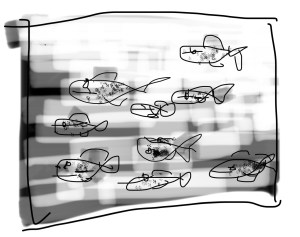
There was a fish tank right there and we stood and watched the fish for a while.
‘Look at the lovely tank’ said the mum to the cub scout. ‘All the lovely fish.’
A little while longer and the guy in the white tunic appeared again. He didn’t say anything, just came to the front and jabbed at the buttons whilst shielding them with his hand.
‘Ah hah!’ I said ‘Now I know!’P1120320
He frowned at me.
‘Know what?’
‘The secret code.’
‘You’re not supposed to know,’ he said.
‘It’s okay,’ I said. ‘I didn’t really see.’
‘Okay then.’
He opened the door and held it whilst we all filed out.
‘It’s no wonder she’s exhausted,’ said the mum, buttoning her coat and straightening in the fresh air as her son sprinted off across the car park. ‘All this attention.’

sig


a cool blue laminated lanyard

swipe right on a mountain of skulls / picked over by gulls / and rats / and souvenir hunters armed with sticks and bats / the whole thing as efficiently organised / as any of the best, most highly-rated genocides / all the wages promptly paid / promotional posters displayed / boots & buttons neatly polished / international banking norms acknowledged / shining lines of communication / cutlery, pots & ammunition / and twirling happily at your chest / the thing that marks you out from the rest / that bulletproof badge of the beautiful vanguard

a cool blue laminated lanyard

or this

a nondescript detention centre / smeared with blood & dried placenta / loose & lazy lines of police outside / arms-folded on armour-plated rides / bagels & babyccinos on the side / and the only thing YOU have to decide / is how in hell you’ll make it out alive / now the King of the Cocks / has cancelled your passport and changed the locks / and doctored clips of you and a fox / and cleared your flat and DNA’d your socks / and cleaned from your numerous offshore accounts / all those improbably sized amounts / you thought would see you safely through / to that country pile in that country purlieu / but the cruelest blow of all / the thing you absolutely cannot deal with at all / the thing that leaves you scared & scarred

the taking of your cool blue laminated lanyard

because

there was nothing you could not do / with your laminated lanyard swinging in full view / no queue you could not jump / no deal trump / or waste dump / no vote you could not turn or policy gazump / it was your Get Out of Moral Responsibility Free card / your Access All Areas for the Die-Hard / your personal, interplanetary-limit platinum card / your Golden Pass to the stars and tsars sipping cocktails in the coolest bars at the sharpest, tippiest top of the London Shard – the loss of which you now lament so VERY hard

your cool blue laminated lanyard

the proposition

when you’re dead, you’re dead / with one definitive snip of the thread / away you float / head first down eternity’s capacious throat / or / maybe death is just a door / maybe you die and you go somewhere else / your consciousness melts / and you get sucked into another realm / Valhalla, maybe, with Odin posing at the helm / or Nirvana / Jannah, Trāyastriṃśa / Aukumea / variations on the idea of the holy layer / domes & levels / supervised by countless angels & devils / where finally you might get rewarded / for all those good deeds you meticulously hoarded / or punished for those you forgot / and pitched headfirst to somewhere hot / where all the tormented entities / gargle lava & prod each other with horrible utilities / like long-handled toasting forks / (according to the most reliable reports)

fact is / no-one understands it / as Shakespeare rightly pointed out in Hamlet / death is an undiscovered country from whose bourn no traveler returns / or blogs about their concerns / no pics on Flickr / Instagram or Twitter / or anything that might shed light on the guff / behind all that Life Ever After stuff / which is probably why these myths are so persistent / with so many contradictory versions co-existent

anyway / at the end of the day / it’ll probably just be like before I was born / people shopping and mowing the lawn / or things a little more obnoxious / with me, happily unconscious / circling the earth in a random atomic cook-up / just waiting for my mum & dad to hook-up

smoko

There’s a small enclosed porch at the front of the house, and that’s where Karen goes to smoke, a bit like an air-lock in reverse. The porch only has three things in it (not including Karen): an ashtray, a pack of cigarettes and an enormous plastic pipette. Quite what that’s for I don’t know, but I don’t hang around to ask.

‘Dad’s in the kitchen having his porridge,’ says Karen, taking another deep drag and nodding behind her as she blows out.

Her father Keith is sitting at the kitchen table. A tall, lean man in his seventies, he struggles to his feet to shake my hand and thank me for coming. He’s had a long spell in hospital, discharged home with a summary of his complex health problems and a request to sort out equipment and therapy. His handshake is warm and firm, and despite his illness he still has an air of quiet competency about him.

‘Sorry about Karen’ he says. ‘She’s adopted the porch as her smoko and we can’t persuade her to stop. She’s got learning difficulties,’ he adds. ‘She’s a good girl.’

I set up shop at the table and we go over how things are and what Keith might need.

‘You wouldn’t think to look at me now but I used to be so fit,’ he says. ‘I played football, tennis. Swam in the sea. Built this house, worked full time. There weren’t enough hours in the day. And if you’d have said to me after all that I’d have ended up like this I’d never have believed you.’ He works the porridge around in his bowl a while then adds: ‘Never smoked. Not a one. Mind you – I think Karen’s taking care of that side of things all by herself.’
And as if summoned by her father, Karen strides into the kitchen, bringing with her a palpable cloak of smoke.

‘All right?’ she says.

the longest hour

Joan is lying in bed, a beanie wrap-around cushion supporting her neck, her long white hair wild on her shoulders.
‘I’m quite alright as I am, thank you,’ she says fussing ineffectually at the sheets. ‘I don’t want anything.’

Joan is ninety-five, tiny, translucent, tethered to the world by her watch and her will and the pictures on the wall.

‘I had a twin brother,’ she says, not to me, I don’t think, particularly, or anyone else in the room I can see. ‘Flew with the RAF. Never came back.’
‘Sorry to hear that.’
She doesn’t react.

I’ve come to see how Joan is after her fall yesterday. The ambulance picked her up, although a mouse could’ve done it. I can’t imagine Joan falling – or at least, only as a dried leaf might fall, slowly, with a soundless settling to the forest floor.

‘I was an hour older,’ she says, closing her eyes, to bring it clearer to mind. Then adds: ‘It’s a little more than that now.’

behind the glass

The almshouse cottages are laid out on three sides of an immaculately kept croquet lawn. The white enamel paint is a little chipped on the hoops, showing patches of dark iron underneath. Maybe that’s through being struck with croquet balls over the years, but I’ve never actually seen anyone play. In fact the most life I’ve ever seen on the green is that crow, hopping around in the misty rain like a sexton in a frock coat, his hands under his tails, inspecting the lawn for worms.

Helen won’t be out playing croquet anytime soon, rain or shine. It’s enough of an adventure just making it from the armchair to the bathroom and back. I can imagine she would have been good at it though, sometime before the war, bobbing down to line up the final shot, giving the ball a hearty thwack, snatching off her cap, throwing it in the air, and then jogging over to the judging desk, the croquet mallet balanced on her shoulder. But of course, she wouldn’t have been living in an almshouse then. She would have been in nursing accommodation in London, excitedly practicing the air raid drill, hurrying out to dances, learning her craft.

Seventy years or more have passed since then, and Helen’s world has contracted to the size of a single room. It was small to begin with, but in an effort to stop her from falling the bed has been brought into the living room, leaving just enough room for a commode, a zimmer frame, an armchair and a side table. She still has her shelves of books, of course – one case devoted to Miss Read, whose name is repeated with dizzying regularity up and down the spines – but if you wanted to fetch one out you’d have to move a stack of things first.

Helen has been sitting this whole time with her head resting on the open palm of her right hand. She straightens now and again to look between her daughter Karen and me with an anguished look on her face.
‘I simply don’t understand what it is I have to do,’ she says.
‘You don’t have to do anything, mum. We’re just talking about things we can do to help you get better.’
‘Is it money? I think I have enough. But if you need more I can get another job.’
‘No, mummy. Don’t fret. We’ve got enough money. You’re job is to rest and focus on getting better.’
‘But all these people,’ says Helen, frowning at me. ‘I don’t know who they are or what they want. What do they want, Karen?’
‘They want what’s best for you, mummy. Like we all do. Try not to worry.’
‘But I do worry! I can’t stop worrying!’
Karen goes over to give her mum a hug, but Helen irritably pushes her away and then slumps forward again.

It’s an impossible position for Karen. Not only does she have the grindingly practical business of caring for an elderly mother whilst running a family of her own, she has to do it without the one person she’d naturally have turned to for advice and support, as she did all through her childhood, adolescence and beyond, the single parent who’d trained and worked as a nurse, the woman who’d seen things and suffered things and come out the other side with her hands and her uniform clean, who’d always somehow managed to be just as strong and as resourceful as she needed to be, the woman that was somehow in the room and yet out of it at the same time, as remote as that black and white photograph of a newly qualified nurse in a pristine uniform, sitting with a straight back behind the glass.

‘Anything you could do to help would be great,’ says Karen, smiling weakly at me. Then reaches over to squeeze her mum’s shoulder.

polaroids of pets and their owners

1.
Geoffrey has two cats. Suki is a heavyweight, silver grey affair, sprawled on the seat of Geoffrey’s four wheeled walker like a luxuriously furred but rather bedraggled cushion, one paw draped over the side, an expression on her face of the purest hatred for the world and everything in it, especially Harry, the kitten. Harry is as hyperactive as Suki is inert, seemingly on a mission to destroy the bungalow, in such random bursts of activity it’s like watching a film that slows one minute and speeds up the next. Harry attacks the curtains, my bag, a pile of rubbish, the TV cables, winding himself up for each assault with a tensioning wiggle of his hips, whipping his tail from side to side, then skittering across the carpet – this time to take out a little stuffed dinosaur, rolling over and over with it, coming to a stop on his back with the dinosaur in its teeth and front paws, brutally pedalling it to death.

‘He’s having a funny five minutes,’ chuckles Geoffrey from his riser-recliner throne, King of Catland, packets of fishy favours to hand on the cantilever table.

But I’ve already been here ten.

2.
‘Are you okay with dogs?’
It’s an article of faith to say yes, because Leila’s brindle staffie Frankie is hurling himself against the baby gate so violently you’d think he hadn’t eaten in a week and a leg of mutton just walked in the door. Before I can answer either way, Leila unlatches the gate and Frankie bursts out. I stand my ground and ignore him – and, thank god, it works. In fact, it’s extraordinary how quickly he changes mode: from Hound of Hell to Snuffly Chump.
I scraggle him behind the ears, and he seems to like that. Then suddenly he’s reminded of something, and hurries off into the sitting room.
‘Oh no,’ says Leila. ‘Wait for it.’
There’s a plaintive squeak or two, then Frankie comes trotting back into the hallway to sit at my feet with a blue ball clamped in his jaws.
‘Oh for God’s sake,’ says Leila. ‘Him and that ball. I wish I’d never got it.’
Frankie bites down on it twice in quick succession, to emphasise.
‘It was funny the other night, though,’ says Leila. ‘He fell asleep with it in his mouth. Then he started dreaming, doing that spooky eye-rolling thing they do, twitching and jerking, and then the ball squeaked, and woke him up, and scared the bejeesus out of him. He fell off the sofa and the ball squeaked some more and he dropped it and ran behind the curtains. I thought that might’ve cured him. But no, he was straight back on it. Poor ol’ Frankie. He’s like me – an addictive personality.’

Dracula: Doomed forever to keep on auditioning

Okay – so – er-hem: Dracula
Don’t you think it’s all a bit too creepy & crepuscular?
And this obsession with all things cardiovascular
To be honest it’s just weirdly irregular
and won’t make you popular
We’re struggling with the medieval vernacular
And although we think your musculature
Is really quite spectacular
for someone of your – how shall I say? – vintage stature
this ancient blood vengeance rapture
just comes across as a chip on the dusty old scapula

So we’d like to thank you for auditioning here
and wish you all the best with your future career
We hope you’re not too upset; it’s what show business is all about
and don’t forget to close the window on your way out

halloween checkout jokes

The checkout girl started telling me Halloween jokes just after she told me a rival supermarket was selling the same two tubs of sweets for eight pounds instead of the five pounds each I’d just laid out for.
‘Why are ghosts so bad at lying?’ she said.
‘Erm…’
‘Because you can see right through them!’
‘That’s a good one.’
‘What does a witch use to keep her hair up?’
‘I don’t know. What does a …’
‘Scarespray!’
‘Yeah!’
She didn’t give me time to think of the answer, which is fair enough. I tried to think of one I could say myself, but all I could think of was the one about the skeleton who goes into a bar and asks for a pint of beer and a mop. It didn’t feel quite right, though, and anyway, the girl was laying out the jokes faster than she was scanning the items, which was pretty damn fast, and I didn’t stand a chance. I wasn’t sure if this wasn’t something they’d been asked to do or not, but she was so enthusiastic I thought maybe she would’ve done it anyway. I got my wallet ready with the reward card and the tokens.
‘Why didn’t the skeleton go to the ball?’ she said, swiping the card.
It was one I knew, so I said ‘Because he had no body to go with!’
‘Yes,’ she said. ‘That’s right.’
She handed me back my card, and stared at the machine that printed out the receipts and vouchers, and looked so sad I felt guilty.
‘Know anymore?’ I said.
She glanced up at me, then said: ‘What does a skeleton like to eat?’
‘I don’t know.’
‘Spooketti!’
I pointed at her, smiled in a faux-cheesy way, and said Goulish.
‘Oh’ she said. ‘Yes. That would have been better.’
I didn’t really understand, until I’d packed the trolley and moved away, and only then did I realise that she thought I’d said Goulash.
Which would’ve been pretty slick, if I’d actually meant it.

sig