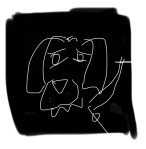
 here lies a family dog called monty
smooth & cool as belafonte
smart as nicholas negroponte
cursed by terrible orthodonty
Author: jim clayton
close encounter
I got tired of waiting / so I posted some pics for online dating / me in this cute / astronaut suit / I hired complete / for the week / from a fancy dress place / short leg, 36 waist / for a selfie on the patio / in flagratio / sprawled on a lounger with my helmet flipped / tubes unplugged & respirator ripped / scenes of innocent, Star Whores depravity / timing the shutter to fake the gravity /
because hey – I’d been through all the usual trials / the ingenues & crocodiles / the sushi bars & supermarket aisles / the drunken dials / through tear-stained piles / of ex-files / (the truth is IN there) / racking up failure like so many airmiles / I’d spent a lifetime accruing / I mean – what was I DOING? / it felt like I’d sat for a million years / nursing bottles of overpriced beer / like Greg Kinnear / or some other sad-eyed silver fox / in a seamy, steamy sweat box / in Vauxhall / Wild Cat / Canal Street or Nollendorfplatz / or wherever the hell I woz / and looking back / as far as I was concerned / that was a lesson a long time learned / I mean – the music’s always way too loud / I feel lonely in a crowd / alcohol makes me hazy / pills make me crazy / sleepy / half the men too perfect; half too perfectly creepy /
unassailably unavailable
incredible
inedible
so anyway / unfortunately / the responses were far from complimentary / the usual deadbeats & derelicts / fake profiles and dick pics / but just when I was feeling sexually & spiritually bereft / RSI from swiping left / I got a like I liked the look of / I particularly liked the pics he took of / his black, clacking beak like a hook / I mean – the guy was hysterical! / chimerical! / so fly he was flip / as lean as a whip / I mean cracking / as a cosplay Kraken he wasn’t lacking / he’d taken such trouble / with his ray gun and shimmering nitro bubble / those rows of stark white teeth / a proboscis tossing around underneath / emitting (how fitting!) a weird & warbling song / that went on and on / and then changed into English / by a fiendish / bit of kit / a cross between a fitbit / and a Britney / strapped to his back like an external kidney / reconstituting the lines as he said ‘em / like everyone did back in Armageddon / (he said / slapping his head / with a tentacle / and in an effort to appear more conventional / produced a map and tapped a star / ‘if you go past Betelgeuse you’ve gone too far’
all in all I was very impressed / we chatted by text / arranging to meet the week after next
I knew straight away he was something special / his silver ship shaped like a giant pretzel / wobbling down onto Hampstead Heath / scattering the screaming people beneath / except a local priest / who sadly was flattened / from hat to hosiery / saying his prayers and fumbling his rosary / a PCSO / screamed in her radio / for the military / and really / they should’ve been more conciliatory / the tanks and planes / all crashing in flames / & after desperate, transatlantic talks / they flew in fleets of tomahawks / but honestly / you might as well throw trays of forks / because when the dust cloud cleared / the crowds all cheered / then stopped / totally shocked / because the ship was still parked / completely unmarked / as sweetly as before / the alien waving from behind the door
I stepped out alone / showed the generals my phone / which they huddled around / astounded / confounded / impounded it / for GCHQ / to take a security long-view / and meanwhile, in lieu / of anything better to do / & no doubt to save face / on behalf of the entire human race / asked if I’d negotiate / which was great / I mean – it was my date / and after all the shenanigans I was running late / so yeah – I went forward unattended / up the ramp the alien extended / the door shushed aside / & I tiptoed inside
a chill ran through me / the ship wasn’t roomy / it was all a bit clustery, dark and doomy / echoing and boomy / banks of fancy dials and levers / frantic assistants that looked like beavers / only with helmets and gloves / up and down ladders that descended from above / to be honest – it wasn’t that fantastic / not what you might call high-end galactic
the alien lurched into view / wearing a kaftan of shimmering blue / draped a tentacle over my shoulder / so finally we meet he smouldered / come sit on the bridge and talk with me / the space beavers scuttling frantically / to make the place ready / I thought it’d be / just you and me / he said coquettishly / but your friends are behaving quite aggressively / sorry I said / they just misread / your intentions / they’ve never seen a craft of such dimensions / and anyway, it’s a bit of a sci-fi convention / to greet an alien visitation / with outright suspicion / and half-arsed military interventions / hmmm he said / shaking his head / they’re really are impossibly thick / I mean – how do they think I got here so quick? / look at all this technology! / I think they own me a big apology / I could I could put on quite a show / with all these levers and other things you know / but there you go / come, sit with me awhile / and let’s talk about your darling little profile / it gave me such a chuckle / a little near the knuckle / but it certainly got my attention the other day / sashaying / along the milky way / a hundred thousand light years away
I’ll draw a veil over what happened next / (basically interspecies chemsex / passionate, complex) / and afterwards, fanned by a couple of beavers / we talked about all the unbelievers / the naysayers, game players and betrayers / the dreamers and schemers / the moralistic, opportunistic, institutional inbetweeners / I just wish I wasn’t the gosh darned captain / he sighed, pulling on his kaftan / but there’s a place I’ve really got to be / and the wormhole closes early at three / look – promise we’ll meet again soon / your place or the moon / I don’t care / I’m pretty much easy anywhere… / and he gave me his fitbit and britney / and after the beavers made sure it fit me / he showed me to the door / where the armies and generals were lined up as before / and the gesture he made to them was sharp and severe / his disaffection perfectly clear / so I hurried down the ramp & waved goodbye / just as the spaceship leapt into the sky
I was taken to a secret location / twenty four hour examinations / unethical sedations / guarded by alsatians / kept in isolation / for fear of contamination / really – it was beyond imagination / but at night I’d lie there staring through the bars / up at the glittering planets & stars / and wish by the light of the waning moon / my alien knight would rescue me soon
he never did. typical alien / never saw hide nor tentacle again
eventually / the military / afraid of exposure / released me on condition of non-disclosure / confiscated my phone & tablets / advised me to cultivate less risky habits
* * *
so that’s my story and every word is true
but enough about me – what about YOU?
the community witch
To begin with, I’d had an unsettling dream. Lola, our lurcher, was stuck in mud down in a ditch, and I’d struggled with a short hose to wash her out of there. She’d accepted my help with a boneless kind of resignation, lapping at the water more to please me than anything else. I’d woken up exhausted. Found myself downstairs having coffee and toast, driving into work, parking, tapping out the code for the security door, swiping my card and passing through into the frenetic office – the whole thing so toneless and heavy-eyed I wouldn’t have been surprised to find I was still in my pyjamas.
I sat down and started to plan the day, struggling against the feeling that I was out of place, faking it. To be fair, it was a feeling I’d had before, that I was an imposter, acting out a role, and it was surely only a matter of time before I was found out. I could see it all, the sudden fall of silence, the turning of faces in my direction, the manager standing over me with her arms folded, tough detectives just visible in her office, smiling, shaking their heads, cracking their knuckles.
A disconnected, dizzying kind of feeling. I forced myself out of it by focusing on the task at hand, probably in the same way you might dampen down vertigo on a cliff face by describing in detail the tiny wildflower growing close to your face.
All this is to say I had a muzzy headache when I sorted out my list of patients for the day and went outside.
It was the perfect day for a headache. Even the pigeons were off, either comatose on the ledges or pitching forwards, gliding a little, slamming into the ground. The sky was a hard, preternatural blue, with that artificial depth you only get in cheap, 3D pictures.
My first visit didn’t go well. I’d already established – or thought I had – that I’d be visiting early today to take blood before Mr Williams had taken his digoxin. When I rang to give him the heads up I was on my way, there was no reply. I tried the mobile. Same thing. I texted the mobile to say I was coming, and headed over. They had a keysafe, so access wasn’t an issue. At least, it shouldn’t have been. Outside the block there were only two keysafes. One was so crapped up it looked like it had been salvaged from the Titanic and stuck on the wall as a talking point. The other was obviously the one I needed – pristine, the label still bright. Which was fine, except the number didn’t work. I went round the back of the block, to the courtyard parking area. The early sun was angling in, falling on a pot of large, white lilies, which seemed like a sign, although of what, I couldn’t say. There was no access, so I returned to the front and used the tradesmen button, which seemed appropriate, anyway. It worked. Two floors up, I knocked on Mr Williams’ door. I knew he couldn’t get up to answer it, but he lived with his son Nathan, so that was okay. After a while I knocked again. I heard some shouting, and I guessed Mr Williams hadn’t told his son about the visit. Still – it was nine o’clock by now, so I didn’t feel too bad. I left it a good while before I knocked again, just in case Nathan was in the shower and needed time to dry off. All in all it was probably twenty minutes. At last, the sound of movement in the hallway, latches thrown, and the door was suddenly wrenched open.
‘What?’ said Nathan, round eyed, furious, peering round the edge of the door with one hand either side of his face like a malevolent Kilroy.
‘I’ve come to take some blood,’ I said. ‘I rang and sent a text.’
He stared at me for a long second, like he was running through the consequences of tearing me to pieces – (on the run; helicopters, hounds, handcuffs; the cells; the dock; the nick; stepping out into the broad bright world with a brown paper parcel under his arm twenty-five years later with a long beard and a crooked back…).
‘On you go, mate,’ he snarled, and released the door.
I was thinking about all this when I was sitting in a slow line of traffic on my way to the next patient. It added to the fugged stew of the day. What was I doing with my life? Was it a struggle simply because I was forcing myself to do something that wasn’t a good fit? What was a good fit? How was it possible that I had got to this age, having done so much, still struggling to orientate myself in the world?
The traffic loosened a little and we all nudged forwards. I sighed, pulled on the handbrake again, glanced in the rearview mirror at the car behind me. It was a battered old Micra, the red pinking out, a line of plastic animals along the dash. The driver was a middle-aged woman, her hair in a Little My bun so high on the top of her head it flattened against the roof. She was wearing white plastic sunglasses which made her look like an owl on acid. As soon as she noticed me she spread the fingers of either hand widely with the thumbs still hooked in the wheel, like she was flaring her wings. I smiled awkwardly and looked forward again – only to find the traffic had moved on. I fumbled the gears, stalled, started again, caught up.
But then – a strange thing. I thought: what if she wasn’t annoyed with me? What if she was actually a witch, dedicated to casual acts of magic wherever she went. What if the Micra was her familiar? That flare of her fingers – maybe that was the spell being released, sparkling through the air from her to me like that beam of sunlight on the pot of lilies?
I decided that’s what it was. And strangely enough, as soon as I did, the day got better. The next patient and his family were as warm and welcoming to me as if I were the son they never had. I sat between them, sunk deep on the ludicrously comfortable sofa, taking notes, making them laugh. And the patient after that, who I’d found hanging half-in and half-out of his bed, who I’d treated as best I could till the ambulance came – well, I could see he appreciated it, too. And when the ambulance did turn up I knew them, and it was like a reunion. And it was all warm and easy and right. And I finished late but I didn’t care.
And it was all down to that witch.
the life & sudden death of the tinder outlaws
this here’s the likeness o’ billy the kid
smile as cute as a crack in a lid
hooks the butt of his colt in his chinos
leans in to fondle his palominos
::::: swipe left
this is a portrait of jesse james
likes to play with banks & trains
sips his whiskey, shines his buckles
wipes his tash, cracks his knuckles
::::: swipe left
this here fella’s one wild bill hickok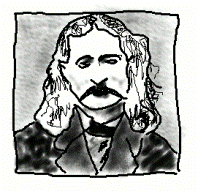
wears a brace o’ pistols half-cocked
waves ‘em about; shoots some plates
carries on playing his aces & eights
::::: swipe right! ::::: swipe right!
too slow, my friend… too slow
do not destroy
Eric has had three falls in forty-eight hours, the last one early this morning. According to the notes he refused hospital, so the ambulance crew referred him to us to follow up first thing and see what we could do. This being the case, it’s worrying the key from the key safe won’t open the front door.
I stand in the porch jiggling it around, trying all the usual feints – pulling the door towards me as hard as I can, pushing it away, rattling the key frantically, easing it backwards and forwards VERY slowly to get a feel for what the mechanism is doing, or not doing, cheating the key up, cheating the key down, pausing, looking around, repeating everything again with exaggerated focus.
‘Can I help you, please?’
There’s a carer standing behind me. He’s fierce looking, wiry and intense, the kind of beard you might draw on a photo with a black marker, tattoos on his forearms, geometric patterns and numbers that look like clues from a Dan Brown novel.
‘I’m Jim, from Rapid Response, at the hospital.’
‘Aleksy,’ he says, shaking my hand.
‘Eric had a fall this morning.’
‘I know this.’
‘The ambulance referred him to us but I’m afraid I can’t get the key to work. I think he may have flipped the latch.’
‘Come. Give here.’
I step aside and let him try. I’m guessing Aleksy has been here many times before. He probably has the knack.
Aleksy jiggles the key around some, then hands it back to me.
‘He flip latch,’ he says. ‘Why he would do this, I do not know.’
‘Okay.’
We both step back from the porch and scan the front of the building. All the windows are firmly shut. There’s a high wooden gate to the left screening off the back of the house, but that’s locked, too.
‘Any good at climbing?’
‘I am excellent climber,’ he says. And without even taking a run up he springs forward, catches the top of the fence, presses himself high enough to swing his left leg over, pushes off the top and disappears over the other side. There’s a pause, the sound of a bolt being thrown, and the gate swings open.
‘You weren’t kidding’ I say to him.
He shrugs.
‘I have can-do attitude,’ he says.
The back of the house is as securely locked-up as the front. There is one window open, though. Too high and central to climb, I would think, even for Aleksy.
I stand on a garden wall and shout up at the window.
‘Eric?’
A weak voice answers.
Yes?
‘It’s Jim. From the hospital. Aleksy’s here, too. Are you alright?’
No.
‘Have you fallen over?’
No.
Are you unwell?
Yes.
‘I’m sorry to hear that, Eric. The thing is – the key won’t open the front door. We think the latch might be down.’
Nothing.
‘Is there any way you can make it downstairs to open the door?’
Silence.
‘Otherwise we’ll have to break in.’
Silence.
‘Do you think you can come down and let us in?’
Nothing.
‘Eric?’
‘He has stair lift,’ says Aleksy. ‘But he might have heart attack and cannot move.’
‘Is there a ladder anywhere?’
I check the outhouse at the bottom of the garden, but it’s locked, too. Meanwhile Aleksy has rung his office to report the delay and ask for advice.
‘No ladder,’ I tell him.
‘My office will ring his daughter, but she is far from here, and even if she arrive with key, this is same position. Truly.’
‘It’s difficult. At least he’s talking, so that’s something. He clearly said he was unwell, though. And he’s had all these falls. Anything could be going on. We might have to break in.’
Aleksy frowns.
‘You have license for this?’
‘Well. Only in as much as we think there’s someone unwell we can’t get to. We’ll get the police and the ambulance running, but they’ll be a while getting here, and it might be too late. Besides. I quite like breaking in.’
‘You do?’
‘There aren’t many perks.’
I take a look at the back again. There’s a sliding patio door that’s part of a dilapidated conservatory. The metal door and lock are still good and won’t budge, but the wooden frame is wormy and it wouldn’t take much to pull it down. There’s an inner door to get through as well, though. It might end up being a serious demolition job, so I don’t launch into it immediately. Whilst I’m wondering what to do, Aleksy has climbed onto a water butt to look through the kitchen window. There’s a net curtain blocking his view, so he puts his ear to window instead, his hands splayed on the glass like the suckers of some hypersensitive reptile.
‘I hear lift,’ he says. ‘Eric coming. Do not destroy back of house.’
careful
The three of us are sitting at the kitchen table. Charles is leaning forwards, propped up on his right hand, his fingers splayed on the magnificent bald dome of his head.
‘I know what it looks like,’ he says. ‘I know I look like a man in despair. But I’m happy. And honestly? I don’t care. It’s comfortable. That’s it.’
His wife Irene sits opposite, methodically working her way through a fat file of notes.
‘Charles!’ she says, without looking at him, licking a finger, turning a page.
‘Like I said. I don’t care.’
Behind us, two patio doors open out onto a garden saturated with colour: a fierce yellow cloud of forsythia, vivid red splodges of tulip, diminishing dots of daisies, and in the middle of it all, like the richest and most exuberantly white wedding dress, an old apple tree in full bloom.
‘Don’t even look at it,’ says Charles. ‘It’s shameful.’
‘It’s beautiful.’
‘Are you a gardener?’
‘We’ve got a garden. I get out sometimes.’
‘Hmm,’ he says. ‘As soon as I’ve finished this cycle of chemo I’ll be back. You’ll see.’
‘You rest, hun,’ says Irene. ‘That’s your job. Now look – here’s that list you wanted.’ She hands me a list of medications. ‘Good luck with the spelling,’ she says.
There’s a radio up on the counter playing classical music. The second movement of Gorecki’s Symphony of Sorrowful Songs.
‘I don’t mind telling you – this is far and away the loveliest consultation I’ve had in a long while,’ I say, listening to the music. ‘The last one, I was in this smoky, super heated flat, all the windows shut, curtains drawn. And the patient was wearing a fluffy red dressing gown, sitting on a sofa surrounded by all these creepy porcelain dolls. And she was puffing away on this fag. And they were all staring at me with the same expression, just waiting for me to faint.’
‘You poor thing!’ laughs Irene. ‘I think you had a touch of fever. But you know what? Some people just like it hot. She must be one of those. A hothouse flower.’
‘I like it hot. But not that hot. When I came back outside it actually felt cold. For a while, anyway.’
‘Do you remember when we had all that snow?’ says Charles, still propped up on his hand.
‘When was that, darling?’ says Irene.
‘Years ago. When we first came here. Or maybe not so long. It was snowing anyway. And I was walking down the street. And I lost my footing or something and I just flipped, straight up in the air, and then straight down again – flat! – on my back. So I was lying there, properly winded, and groaning and so on. And these two old woman came waddling over. They’d been chatting on the street corner, all bundled up, you know? And they came over, and they looked down at me. I can see them now, clear as I can see you. And they said: Careful. Just like that. Careful, they said.’
‘Oh darling!’ says Irene. ‘How funny!’
‘Careful! they said. Just like that.’
‘And what did you say?’
‘I said: Why – thank you. I’ll be sure to take your advice.’
walking home
There are two single beds side by side in the middle of the room, the nearest one occupied, the furthest one empty with the bedclothes rucked up. Ted’s wife Rita is in the nearest, lying on her back with her arms by her sides on the top of the covers, perfectly aligned with the legs beneath, as graven and still as the alabaster figure of a woman in a tomb – albeit one that was irritated her partner had got up after a thousand years and gone to sit in the Windsor chair by the window.
‘She’s on that many pills,’ whispers Joan, their daughter, standing in the bedroom doorway and looking in on the tomb with her arms folded. ‘If I took what she took you could tie a string round my leg, take me outside and fly me.’
Ted is staring out at the communal gardens below. There’s an empty perspex bird-feeder suckered to the window just the other side of him.
‘Do you want me to put some seed in the feeder?’ says Joan. ‘It’ll give you something to look at.’
‘I’m alright’ he says, batting his hand. ‘They’re alright, too, I ‘spect. They’re birds.’
‘Suit yourself.’
It’s hard to know what to do about Rita. Degenerative illness means she suffers from chronic pain. Even if there was a total body replacement available, at ninety one she’d never survive the op. Joan had given me the heads-up downstairs in the kitchen. ‘‘She’s become her illness,’ she said. ‘She doesn’t talk about anything else – except when she’s being snippy about my cooking. I thought coming to live with us would help, but it’s been a nightmare.’
‘Do you want to speak to a social worker about it?’
‘A social worker?’ she’d said, frowning and leaning back. ‘Why? What could they do?’
‘Well – if things are too stressful here, they could talk about alternatives.’
‘What d’you mean, alternatives?’ she says over her shoulder as she filled the kettle at the sink. ‘D’you mean put her in a home?’
‘Some kind of residential care, yes. Somewhere set up for someone with complex needs. You never know – she might like it.’
‘And what about Dad? What would he do?’
‘Maybe he could go, too.’
‘Put Dad in a home?’ says Joan, slamming the full kettle onto its stand and jabbing the switch. ‘You might as well shoot him.’
Whilst I’m with Rita, taking her blood pressure and temperature and so on, Ted divides his attention between us and two dogs that have run into the garden to play tug-of-war.
‘I met her when I was back on leave,’ he says, as if the dogs brought it all to mind. ‘I went to the picturehouse, and there she was, having her hair pulled by these kids sitting behind her.’
‘My friend hadn’t showed up so I went in alone,’ says Rita, her eyes still shut, her eyelids flickering like the film she saw has started playing the other side. ‘I didn’t know what else to do.’
If Ted hears, he makes no sign.
‘So what I did was,’ he says, shifting forwards in the chair, ‘I snuck up behind them, like this… and I reached out… and I banged all their heads together, like this! Then when she ran outside I followed her. And I said to her, I said I’ll walk you home…’
‘I didn’t want him to,’ says Rita. ‘I said I was perfectly capable of walking home by myself, thank you very much.’
‘When we got there, I didn’t try to kiss her or nothing. I just shook her hand, all gentlemanly like, and I said I hoped she had a nice time and everything, and maybe could I see her again. Two years later the war was over. I come back from Italy. We got married. And that was seventy-four years ago.’
He chuckles, settles back in the chair, and stares out of the window again.
The dogs have gone inside.
‘I didn’t want him to walk me home,’ says Rita. ‘I said to him. I said, I’m perfectly capable of walking home by myself, thank you very much.’
display purposes only
Henry doesn’t come to the door so much as slowly coalesce from the shadows beyond the glass.
Henry is frail but not physically unwell. I know his story pretty well by now. He’d been living in Portugal for many years until things started to go wrong, his marriage ended, he was hit by severe financial problems, lived a while in his car, was sectioned following a suicide attempt. After a great deal of toing and froing, his daughter Diane managed to repatriate him, temporarily setting him up in a basement flat whilst she sorted out something more suitable and long-term. I’d spoken to Diane many times on the phone. She was bright and busy and supremely well-organised, but I knew she was struggling to cope with work and family as well as the traumatic fall-out of her parents’ separation. Diane knew as well as anyone that the basement flat wasn’t great. It had a set-aside feel, silent and secluded – not at all the kind of place you’d choose for someone suffering depression and anxiety. But even though it suffered from having the generic, impersonal feel of showroom flats the world over – blown-up photos of Times Square and a colourised London bus driving over Westminster Bridge in the rain; enormous, squashy leather sofas impossible to get out of once you’d sat in them; glass vases with white pebbles and a single, artificial lily; a flat screen TV; venetian blinds – at least it was warm and safe, and near enough to where she lived to make keeping a regular eye on her father vaguely feasible.
The good news is that Diane had managed to find a better, brighter place. Henry is due to move the following morning; my visit here this evening is to be the last in this place, a welfare check, to see he’s okay.
‘Hello,’ says Henry.
We’ve met a few times before, but he makes no sign he recognises me. He’s as still as a photograph, completely neutral, like it really makes no difference to him whether he shakes my hand here in the doorway or stands inside staring up through the casement window at the feet of the people walking by.
He lets me in. We relocate to the living room. Henry drifts over to the kitchen counter, next to a tall suitcase on wheels, all zippered up and ready to go. I have the eerie feeling that If I was an alien probe sent into the room to scan for life, I’d struggle to differentiate between them.
‘Have you eaten anything this evening?’ I ask, glancing around for clues.
He shakes his head.
‘Aren’t you hungry?’
‘No.’
‘Do you mind if I have a look and see if there’s something I can get you?’
He shrugs.
I go into the galley kitchen area, so pristine you can smell the caulking gun.
The fridge has nothing in it. I open the overhead cupboards, and I can’t help thinking of the old nursery rhyme: …but when she got there, the cupboard was bare, and so the poor dog had none.
The only food I can see anywhere are five Kilner jars of pasta lined up on a shelf, each one holding different shapes and colours.
‘I could do you some pasta…’ I say, wondering what on earth I’d use for a sauce.
He shakes his head again.
‘Display purposes only,’ he says.
dogs in hats
Billy is as thin and white as forced celery, wisps of white hair streaming back from his chiselled forehead against all natural gravitational laws, his etiolated white hands clasping the armrests of the chair like roots he put out to suck the nutrients from the stuffing. He barely acknowledges me as I let myself in. Whether that’s because of a general remoteness, or because he’s drunk most of the various spirit bottles placed artfully around his feet, it’s hard to tell.
‘How come you didn’t answer your phone, Billy?’
He turns his sad blue eyes up to me.
‘Oh. Was that you ringing? I looked for my phone but I couldn’t find it.’
‘Shall I give it another ring and see where it is?’
He shrugs.
I go to recents in my phone, and call.
After a moment, a loud buzzing starts up on the cluttered table immediately in front of us. His phone is under a red reminder.
‘Found it!’
‘Great’ he says, in a whispery voice leached flat by long hours of nothing in particular. ‘Gis it here, then.’
It’s hard to know what to do about Billy. The best you can say is that he has a workmanlike approach to drinking himself to death. There’s no joy in it; no wild ride. For some reason he’s simply hitched himself to a slow and dreadfully monotonous kind of decline, like he’s found himself in an armchair that began sinking beneath a quicksand of liquor bottles. When the glass level reaches the bridge of his nose, I don’t imagine he’ll struggle at all. He’ll merely turn those eyes in the direction of whoever’s there to notice, and slide out of sight with a clink.
I unzip my bag and loop the stethoscope round my neck. When I straighten I notice the four dog photos taped to the wall on his right. The photos have been printed A4 size with the colour running low, so everything’s a little fuzzy. You can see it’s the same dog, though, a lugubrious hound sitting in the same position in the kitchen, wearing four different hats: a fisherman’s floppy cap; a Norwegian style knitted hat with flaps; a panama, and then something from a fancy dress shop – a plastic policeman’s helmet fastened under its chin with elastic.
‘Love the pictures!’ I tell him. ‘Who’s dog is that?’
‘Karen, my carer,’ Billy whispers, sadly. ‘She knows I like dogs. And hats. So – there you go.’
the throwdowns
They’d been working at it for a while, so it shouldn’t have come as a surprise.
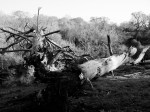
I knew the place as Broken Tree Hill. Just beyond the recreation ground there were two fields – pastures for cows most of the year – both leading down steeply to the woods beyond. The field to the left was the broadest. It passed behind the health spa that had been built back of the manor hotel. You could hear people laughing in the outside pool doing aquarobics, or in the summer see them shielding their eyes on their loungers to watch as you walked by with your dog. There was a group of three pines in the middle of the smaller field to the right. One was still vigorously in leaf, but its two companions hadn’t fared so well. One had been brought down in a storm sometime, no-one knows when. It was still off the ground though, supporting its weight on a lattice of stripped branches. The third pine was dead, too, wormy and rotten but defiantly upright, its stripped branches raking the sky. If the blown pine was a boxer struggling to beat the count, the standing pine was an ancient actor making her melodramatic farewell to the rapturous clouds in the balcony.
I took many photographs of the trio on Broken Tree Hill. It was impossible not to. There was an inherent drama in the scene, early morning, late at night. I spent hours getting it from all angles – particularly the actor pine. She was so compelling, like she was pointing something out, some spot in the ground or the future or both, and if only I was smart enough or stood still long enough I might be able to figure out what it was.
The local gangs had made their marks on the trees, of course. It was a natural hang out. They’d sprayed graffiti on the trunks – a smiling cloud, doobie, a knife. There was a nylon rope with a stub of wood hanging from the living pine. A scattering of bottles and cans in the tangles of blackberry and the rabbit burrows. Lately I’d noticed they’d started chipping away at a hole near the base of the actor pine, trying to bring her down. The heartwood was soft and friable in that strangely geometric way dead wood falls to pieces. They must’ve made it halfway through by now, and I was amazed the old tree had managed to keep standing through the strong winds of the early winter. There was something else keeping this tree up, I thought. She still had something to say.
But this morning when I came through the gate the change was immediate. A gap in the skyline as stark and outrageous as a slap. I hurried over.
The kids had given up on the chipping and burnt it down instead. They’d filled the hole with junk, and a few boxes of what at first I thought were matches but which were actually those little fireworks called throwdowns, the ones you chuck on the pavement that snap like firecrackers. It seemed appropriate. And now the old pine lay stretched out on the grass, the branches that had gestured so beautifully to the sky broken in pieces all around.
Another dog walker came over and we stood there and talked about it. She’d seen the fire and taken pictures of it on her phone, a demonic bolus of red flame around the base, a shimmer of grey smoke.
‘You can get too sentimental about these things,’ she said, putting the phone back in her pocket. ‘Storms take trees all the time. We burn wood in the fireplace. Lightning strikes. And years ago – many years ago – dinosaurs would’ve shouldered them over without a thought. Kids are a natural phenomenon, too. It’s just a shame they get possessed by this destructive instinct from time to time. They shot all the windows out of the youth club out with an air gun, for God’s sake! I mean – where’s the sense in that?’
I had to agree.
‘The creative impulse turned on its head,’ I said.
‘Absolutely.’
I fished my own phone out.
‘Did you see that photo in the paper the other day? Of the black hole? They’ve given it a name now. Powehi. However you say it.’
I scrolled down and we both read what it is and what it means. The adorned fathomless dark creation.’
‘I like that’ she says as I put the phone away again. ‘It’s a good name for something like that. So – basically what you’re saying is that these kids are like a black hole?’
‘Mini ones. But they can turn it around. You have to hope.’
We stood and surveyed the scene in silence for a while.
‘Oh well!’ she said. ‘Must get on!’
And strode away.