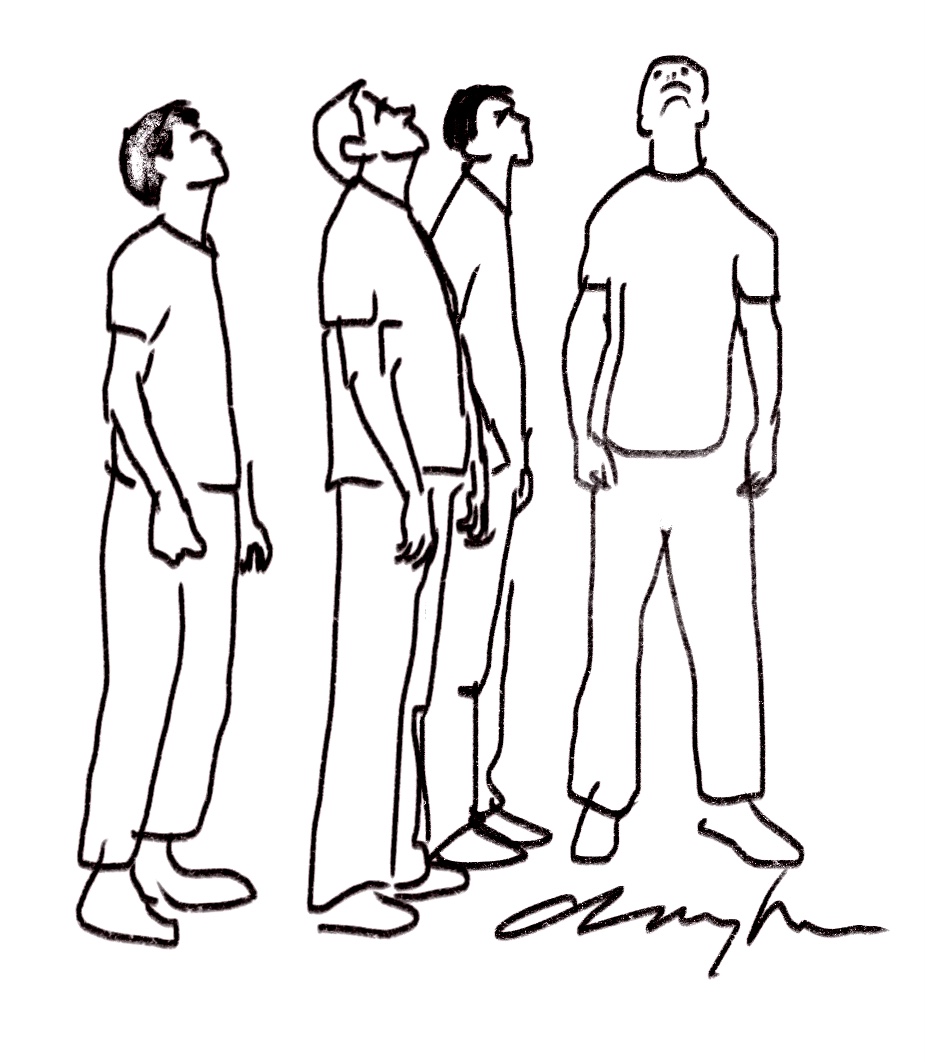
There’s never a good time to have a difficult conversation, but I have to say, despite the Covid measures, the office is as busy as I’ve seen it. I have to scrunch up my shoulders and stick a finger in my ear to have a chance of following what the man is saying to me on the phone.
‘Sorry. Could you repeat that?’
‘I said I’m putting you on speaker.’
‘Oh. Okay.’
‘There!’ he says.
‘Hello!’ says a woman’s voice. ‘Hello?’
‘Hi!’
I flash an irritated look around me.
Social distancing has only made the noise level worse, because although there are half the number of people you’d usually get at the end of a busy afternoon, everyone’s talking twice as loud to make up for it. And to compensate for the loss of half the desk space, people are improvising by putting their laptops on the tops of the low shelves that mark out the various sections. So in the end, it feels and sounds as if I’m completely surrounded, and the place is as hectic as ever, even though the numbers are reduced and the two metre rule is – more or less – being observed. A gang of people is standing close to my desk, laughing and screaming at something Artie just said. I can see that Artie has cut his hair over the weekend. He’s shaved the sides close but left a wild tuft on top, pulled up into a bunch like the leaves on a knitted pineapple. I guess it’s his hair they’re laughing about because when he whips off the grips and shakes the curls out, they all jump back and scream.
‘Sorry?’ I say, leaning harder into the phone. ‘It’s a bad line…’
‘I said it can’t go on like this.’
‘I know it’s difficult,’ I say, scrolling through the notes on screen. ‘I’m just having a quick look at some of the things our carers and clinicians have said so far…’
‘Difficult?’ says the woman in the background. ‘That’s the understatement of the century. We get calls, all the time, day and night. Mum’s done this. Mum’s done that. Mum’s so worried she’s taken to her bed. I can’t keep going over there. There is a limit. I’ve got my own health to worry about. And Stan is at breaking point. He can’t be at work and sort his parents out. I mean – it’s not as if this was a surprise to anyone. Not to anyone who knows the situation. I told them at the hospital, I said to them…’
It’s been a long and tiring day. It also doesn’t help that both the man and the woman talk very quickly and musically, their voices high up in their noses, blending into each other, overlapping, echoing around whatever room they’re in (the bathroom? a swimming pool?), until it starts to feel as if two bumblebees have popped into my head through my right ear, and are turning figures of eight behind my eyes. I have to give myself a little shake to stay on track.
‘So – let me see if I’ve got this right,’ I say, straightening in the chair. ‘Your mum has been discharged from hospital. Your dad isn’t coping. You think they need more help.’
‘You make it sound easy,’ says the man.
‘Thank you.’
‘I can assure you it isn’t.’
‘Oh.’
Artie looks over at me, points at his hair, then scrunches up his face and makes the perfect sign with his fingers.
‘Are you still there?’ says the man.
‘Has he hung up?’ says the woman.
‘No, no. I’m still here. I’m just getting the number of the social workers for you…’
sketches
call me the cat
Frances. Francis.
I always default to thinking es like the er in her / is like the im in him. You’d think it would be quicker than that by now, but either because I don’t come across the name often enough for it to stick, or because I’m a robot and no-one thought to tell me, the fact is, that’s the rubric I’m doomed to run through every time I come across the name. (In a similar way sometimes when I think right or left, I get a strong mental picture of a prefab classroom – a door on one side, a piano by the window – because when I was an infant the teacher told us that was the way to remember it: the piano on the left, the door on the right. Although, thinking about it, did she mean her left or our left? In which case, I’ve been getting it wrong all these years.)
The point is, Frances (es like the er in her) is sitting by the open window, staring out at me as I walk down the steps to the front door.
‘Hi Frances!’ I say, waving cheerfully.
She doesn’t respond.
I’ve been warned what to expect. Before coming out that morning I’d phoned Cara, the next of kin listed on the notes. Cara was worried.
‘Frannie’s dementia’s usually fine. I mean – unless you knew her you’d barely notice. She gets a bit muddled sometimes and she can get a bit riled up. This week, though….’
‘Why? What’s been happening?’
‘Apart from me she has carers going in twice a day. She got cross with them and threw them out. Wasn’t taking her pills. Was getting in a state. Wouldn’t see me. Then she had a fall out of bed. The ambulance picked her up but she refused to go to hospital. And then the next day when I went round I found she’d barricaded herself in. I called the doctor, who said she might have a UTI, so that’s why you’ve been called. She seems to have calmed down a bit, but she still won’t let me in.’
‘Okay. Shall I see you there?’
‘That’d be great.’
*
Frances’ house is opposite a broad, rising sweep of woodland. A faint blush of green is just visible, spreading through the bare trees. Early morning walkers are striding purposefully up the paths, their dogs running on. The morning smells fresh, sunshine on frost and moss and damp tarmac. Everyone seems invigorated. Even though it’s early, a couple of neighbours have brought camping chairs out onto their porches.
‘Is she alright?’ one says, shielding his eyes from the sun.
‘Here’s hoping.’
‘Give her our best.’
Cara hasn’t arrived yet, but I decide not to wait – especially as Frannie has seen me and would wonder what I was doing, hanging around in her front garden.
I walk up to the window.
‘Hey Frances!’ I say. ‘My name’s Jim. I’m with a community health team. Your GP has asked me to drop by and see how you are.’
I pull my ID badge forwards on its elasticated cord. She looks at it, but doesn’t focus.
‘Oh yes,’ she says.
‘Are you able to get to the door, or shall I use the keysafe?’
‘Just a minute.’
‘Okay. But it might be easier if I use the keysafe….’
Too late. I wonder if she’s decided to let me in or strengthen the defences at the front door. Either way, she begins the slow and painful process of getting from the edge of the bed to the hallway. It would be easier to ask one of the trees behind me to lift up its roots and make its way to the door.
‘Are you okay, Frances?’ I shout through the window.
‘Just a minute!’ she snaps, then carries on.
I move to the porch, and wait.
After five minutes, during which the grunting and swearing from inside the house gets progressively louder and more emphatic, there’s a sudden fumbling of latches, things clattering, bolts being thrown. The door judders in its frame a little. Then again. Then nothing.
‘Can you do it, Frances?’
‘No. It’s stuck.’
‘Oh. Well – shall I climb through the window and help you?’
‘Alright then.’
I put my bag and folder down, and walk back round to the window. It only opens so far, and there’s a great clutter of things just the other side. Luckily I find enough of a handgrip to haul myself up onto the ledge, breathing in, squeezing sideways through the gap, then twisting into a desperate, tip-toeing contortion, release my grip, give a last second jump, and land with a thump in the middle of the room.
There’s an enormous cat just ahead of me. It sinks down on its paws in alarm. The cat is ludicrously furry, like a sheep or a huge duster, or maybe one of those rollers you see in a car wash.
‘S’okay! S’okay!’ I say, putting out my hand. Which the cat takes as an attempt to grab it, so it runs away in double-quick time. I can’t see its paws, so it looks more like something being snapped away on an invisible piece of elastic.
Frances is supporting herself against the wall. I help her back to the bed, then return to open the door and get my bag. At the same time, the doorbell rings.
‘Is that Cara?’ I say, struggling with the latch.
‘Jim?’ she says. ‘Is that you…?’
The latch finally gives. I throw the door open.
‘Hello!’ I say.
Cara frowns, tilts her head to one side and points at the unopened keysafe.
‘But… How did you…?’
‘I came through the cat flap.’
‘You what…?’
‘Yeah. Well. Sometimes it’s handy being small.’
jack
I decide I need the exercise so I take the stairs. It’s a shame, though. I like those old style lifts with the iron trellis gates you have to pull apart. Number sixteen can’t be far up though; God knows I need the exercise.
Too late I realise how much I’ve underestimated the design of this ancient block. There are only three flats per landing, and each flat has high ceilings, so you have to walk up two flights per landing. All in all, I seem to be climbing forever, endlessly curving round on creaking, carpeted treads that get wonkier and narrower the higher I go, the angles of everything more eccentrically out of true, as if the block wasn’t built so much as planted, a gigantic concrete pod, dropped in a crater and then left to twist up overnight into a beanstalk of Portland stone and glass.
When I get there, finally, puffing and blowing, the door is half open. I knock and call out: ‘Halloo! It’s Jim, from the hospital…’
The door gets flung aside. A bright, blond woman in yellow marigold gloves and Nordic jumper stands with a sponge out to the side, smiling, as if she’s just giving me the once over before she leans in and sets to work.
‘You’ve come to see David, I take it?’ she says. ‘Lovely!’
She calls over her shoulder.
‘David! The nurse is here…’
I put on my PPE and walk into the flat.
David is lying on top of the bed on his left side, his legs curled up, his back facing me. The woman carries on working, stuffing trash in a black bin liner and pushing her hair back from her eyes with the back of her hand.
‘I’ll take this down and leave you to it,’ she says. ‘Just go through into the lounge. David? David! The nurse would like to see you now…’
He swings his legs over the side of the bed, pushes himself into a sitting position in one smooth movement, then stands and walks with a strange directness and neutrality around the foot of the bed, out of the bedroom, past me and then on into the exact centre of the sitting room carpet, where he waits with his arms slack by his sides.
‘Hello,’ he says, and smiles. The kind of smile you work with levers.
It’s disconcerting to say the least – made even stranger by the intense play of light round his head. It’s so dazzling I have to shield my eyes to look at him, like I’m awed before the visitation of some kind of spooky puppet angel. In sweat pants, and a t-shirt with a duck on it.
‘Hi – David! Lovely to meet you! I won’t keep you long!’
‘That’s okay,’ he says, and smiles again, maintaining his neutrality.
I explain why I’ve been asked to come, filling in the gaps with as much conversational putty as I can manage, the lovely weather, the beautiful view, how unfit I am, yaddah yaddah. I start to hear myself, like I’m talking in an acoustically flat room, my words losing their meaning, becoming the kind of noises you might make if you pretended to speak another language.
David starts to pace around the room, marching to the window, to the white counter of the little kitchenette, to the centre of the carpet again.
‘Would you like to sit down whilst we run through these few things?’ I say, gesturing to the sofa.
Even my gestures feel fake.
There’s a book on the sofa, resting face down on the cushions to keep the place: The No 1 Ladies’ Detective Agency. I wonder if he’s reading it or the blond woman.
David looks at me, at the sofa, at me again, then sits on the sofa, folding neatly and precisely in the middle, his hands flat on his knees.
‘This won’t take long,’ I say.
The moment I’m done and unwrapping the blood pressure cuff, he gets up again and strides noiselessly away. I’m crouching on the floor, resting the folder on my knee as I write the figures down. Suddenly I realise he’s standing immediately behind me looking down, so I gently pivot my body to the side – ostensibly so I can look up at him and continue chatting, but actually because I don’t want to have my back to David for any length of time.
‘There! That all looks absolutely fine!’ I say, closing the folder and slowly standing up. ‘The doctor just wanted reassurance we’re on the right track.’
‘The right track,’ says David, smiling. ‘Yes.’
I put the folder back on the shelf and start gathering my things again.
‘So!’ I say. ‘It’s a lovely day out there! Do you have any plans?’
‘Plans?’
‘Yeah. For the rest of the day?’
‘It’s such a lovely day,’ he says.
‘It certainly is!’
He smiles at me.
‘I think I’ll go for a walk.’
‘Excellent!’ I say.
But I have to admit – my abiding thought as I leave the flat and head back down the stairs again – is: where?
acing it
Brenda has had a busy day – ironic, given she’s supposed to be in semi-retirement. It’s as if keeping busy is just something she naturally does, hard-wired into her DNA. No doubt if you took a sample you’d see it. If you picked a strand of hair from the floor, a strand that had floated clear from her as she rushed past, her arms clutching bags and a note clamped between her teeth. And you respectfully sealed the strand in a ziploc bag, and took it to a laboratory, and slid it under a microscope, or whatever it is you have to do to visualise DNA (I really have no idea). No doubt it would all come into focus, the delicate, molecular twist of it, the multi-coloured ladder curving in on itself, rungs of the base elements: blue for capability, yellow for experience, green for humanity, red for love.
Brenda’s long service was rewarded recently. She got a certificate, a 40 year service pin for her uniform, a voucher for fifty pounds.
‘So that’s 80p for every year,’ I said.
‘It’s not about the money, Jim,’ she said. ‘Which is just as well…’
To be fair, everyone’s had a busy time of it today. The hospital has been discharging patients like wrecked sailors bailing out a lifeboat. Not only that, our existing caseload has plenty of complication to keep us distracted. There are blocked catheters to deal with, deteriorating patients, reports of increased confusion here, cause for concern there, anxious relatives, access issues, cars breaking down. I’ve spent the morning seeing patients and then struggling to make contact with their doctors, who I know are buckling under the strain themselves. Now I’m back at the office, helping coordinate for the rest of the day, which feels like a Battle of Britain pilot being dragged off their plane the moment it lands, put in an operations room, and asked to move figures around on a table with a mop.
By the time Brenda comes back into the office late into the evening, I am fully and fatally in that ‘Answer Any Question’ mode, that marginally insane, input / output, ruthlessly reactive, beep, beep beep state of mind that doesn’t stop at the end of the shift so much as power down and slump.
‘Oh my God! What a day!’ says Brenda, hurrying down the aisle and throwing herself into a chair, tipping her head back, her legs straight out, her arms straight down, like she didn’t just walk into the office so much as drop through the ceiling. Then looking up at the clock, making a cartoon Aargh! noise, plugging in her laptop, snapping up the screen, and furiously typing up her notes.
You could write a book on the different IT approaches you see around the office. The equivalent of a bird spotter’s guide, The Wild Office maybe, a detailed drawing of each individual, their markings and bandings, a note on the variety of calls they tend to make, and then a description of their typing style. Brenda reminds me of Rowlf , the dog who played piano on The Muppets, the way he leant over the keys, enthusiastically pounding away, staring closely at his paws, but periodically looking up to check he was following the notes.
‘Oh…!’ says Brenda, leaning back in the chair and smacking her head.
‘What’s up, Brenda?’
‘I can’t think what it is…’
‘Can’t think what what is…?’
‘That thing! You know! When golfers play golf. They put the ball on a little bit of plastic. What’s it called…?’
I’m blindsided. Has Brenda seen some kind of golfing injury?
‘Tee?’
‘I thought you’d never ask!’ she says, with a huge smile. ‘No sugar…’
signs of life
Maria is sitting in the sunshine at the kitchen table, a newspaper spread out in front of her, a cup of coffee to the right, a pink wafer biscuit on a square of black slate to the left. She’s staring at an article all about the latest Mars landing. There are detailed drawings of the descent, how the boosters deployed, cutaways to explain all the instrumentation carried on the probe. It’s quite a thing.
‘What an amazing achievement, sending something all that way,’ I say, taking a seat opposite.
‘What is?’ says Maria.
‘The Mars probe. The mission to discover traces of life.’
‘Oh,’ she says. ‘Is that what it is?’
Maria could be some kind of alien visitation herself, landed on her chair, her white blouse glowing brilliantly in the sunshine, her lipstick a shock of red, the coloured beads in her headband sparkling red, blue and green.
‘How are you feeling?’ I ask her.
‘Lost,’ she says.
‘It’s understandable. You’ve been through the wars.’
‘Have I? You see – that’s the worst of it. I don’t really remember. I used to be in control. Now I’m not.’
Her husband Klaus strides back from the kitchen with a cup of coffee and a biscuit for himself. He’s as striking as his wife, his long white hair swept back, his blue eyes preternaturally sharp against the liver-spotted leatheriness of his face.
‘Are you sure you wouldn’t like a cup?’ he says to me. ‘It’s very good.’
‘Absolutely. It’s kind of you to offer, though.’
‘Not at all!’ he says, sighing and settling next to Maria. She barely acknowledges him.
‘Don’t forget your biscuit, darling,’ he says, giving the slate a little turn, as if that’s all it need to capture her interest.
‘Thank you darling,’ she says, but carries on sitting as inertly as before.
The house is filled with Maria’s paintings and sculptures. I’m guessing the bronze on the little plinth by the window is Klaus as a young man. The face may be longer and thinner, the hair more tightly curled, but the birdlike intensity of his expression is the same. It’s an unsettling experience, sitting with her amongst these things. It’s as if the artist is gradually fading from the room after decades of creation, leaving only the light and the colour and the breath, a twist of steam from a coffee cup, a glimmer of moisture in the corner of an eye.
‘Could you speak up?’ says Klaus, when I start to ask them about the sequence of events, the tests that were run at the hospital, the things the doctors said. ‘You see – that’s the devil with those damned masks! We’re both rather deaf unfortunately and we rely on seeing the whole face.’
I apologise, and speak up.
He answers my questions, then when I pause to write a few things down, takes a sip of his coffee, putting the cup back on the saucer so carefully it barely makes a sound.
‘Mind you,’ he says, dabbing at his mouth with the corner of his linen napkin, then spreading it out on his lap again, ‘…of course – one gets so much more than that from a face. Take you, for instance…’
He stares at me, leaning slightly forwards.
‘Yes,’ he says, relaxing again. ‘Yes. Your eyes are nice enough. But who knows under that mask? You might have evil lips.’
stronger than honey
It’s something of a miracle the square has survived at all. Driving up to it, especially on a night as dark and damp as this, along a service road ruthlessly lit by yellow street lamps, past a multi-storey car park, a concrete and steel hotel, a loading bay to the back of a shopping centre, everything deserted, everything thrumming with a thrill of brutalist development – it’s an act of blind faith, a hope against hope that things will turn out alright, that when you take a left at the mini roundabout you will actually come to an address, somewhere warm and domestic and settled, somewhere someone could live, maybe, or at least, come back to from hospital, to get better.
No doubt the Regency architects who built Coleridge Square were looking for a romantic endorsement of their wrought-iron canopies and filigree balconies. Two hundred years later and times have changed; there’s more wrought-irony to be had from the fact that Coleridge was a smackhead. The smart townhouses are all on the slide, backstreet hotels, hostels, bedsits, the red neon NO flickering on the sign that says VACANCIES, like it wants us to get closer before it commits.
We’ve come to see Roo, an IV drug user who has been discharged from hospital to one of the hostels in the square.
‘Why d’you think he’s called Roo?’ I say to Brenda, the nurse I’m doubling-up with. ‘What’s that short for?’
‘I don’t know. Rupert? Rooney? Maybe it’s like in Winnie the Pooh. Roo with the pouch, where he keeps his stash.’
‘That’s a whole other version. Might explain Tigger, though.’
We ring the bell.
Nothing happens.
We try ringing Roo’s mobile again; it goes straight to voicemail.
The door’s on the latch, so we go inside.
‘Hello? It’s the nurses!’ says Brenda.
A heavy but loose-limbed guy walks down the stairs, methodically and carefully, one at time, like a marionette with lead boots. If he is a puppet, it looks like they made the head from a potato, two eyes shot into it with a BB gun.
‘Yes?’ he says, stopping before he reaches the bottom, stabilising himself on the gappy bannisters.
‘Oh hi!’ says Brenda.
She’s amazing. I’m sure if she knocked on the gates of Hell and a daemon slid back the latch, she’d be just as delighted.
‘We’ve come to see Roo!’ she says. ‘We don’t have a room number and he’s not answering his phone.’
‘He’s out.’
‘Oh! When did he get back?’
The man shrugs.
‘A couple of hours ago. He didn’t like the room he’d been given.’
‘Oh! Why was that?’
‘It was filthy,’ says the guy. ‘Which – to be fair – it was. So I put him in room two.’
‘Room Two? Is that a nice room?’
‘Nicer.’
‘But he’s not there now?’
‘No. He dropped his things and then went round to a friend’s.’
‘We’ll have to come back another time then.’
‘I’ll tell him you called.’
‘Would you? Thanks again!’
And we turn and leave. The man watches us from the stairs. It’s only when we’re back out in the street does he come all the way down and then slowly close the door.
‘What a waste of time!’ says Brenda. ‘Of course he’s out! He’s been in hospital a week! What else is he going to do?’
We stand in the square, Brenda by her car, me by mine, looking forlornly right and left, at the mist blowing softly across the square like someone quietly erasing a painting in the dark.
‘I don’t blame him though,’ says Brenda, hugging her laptop bag and folder whilst she unlocks her car. ‘You need something stronger than honey on a night like this.’
anything close up looks strange
Wanda is happily sawing away at a breaded cod fillet, arms tucked in, elbows up, her woolly hat pushed at an angle by the pillow back of her neck.
‘Sorry to interrupt your lunch,’ I say, coming into the room. ‘Bad timing!’
‘Sit on the bed,’ she says, pointing in that direction with a ketchuppy knife. ‘This won’t take me long.’
‘There’s a bit of paperwork to do, so I’ll get on with that whilst you finish up.’
She jabs up a nest of chips and only manages to get them in her mouth by moving her head from side to side.
‘Don’t give yourself indigestion,’ I say.
‘No,’ she says, ‘Mind you, I’m a martyr for that,’ half-choking as she struggles to get the words past the chips.
I pass her some water.
‘Thanks,’ she says, gulping it down – then sets back to finishing off the plate.
The ambulance service has referred Wanda to us. She’d had a couple of falls recently, minor injuries, observations fine but needed following up with nursing, therapy and so on. Wanda has some medical conditions that put her at more risk of falls, but at first glance I can’t see any more adaptations that could be made, and she lives pretty independently, so I’m not sure there’s much to be done. So long as everything checks out this visit, it might well be just a referral back to the care of her GP.
‘Done!’ she says, tossing the knife onto the empty plate with a clatter and a broad grin, like some kind of niche circus act.
‘Let me take that for you,’ I say. ‘Would you like to see the dessert menu?’
‘I’ll save that as my treat when you’re gone,’ she says. ‘So what’s this all about?’
I explain who I am, the team I work for and why the ambulance suggested we get in touch.
She sighs and brushes bread crumbs from her lap.
‘I don’t know why I’ve been falling so much lately. I suppose if you have one you’re more likely to have another.’
‘That’s true.’
‘I feel alright, though.’
‘Is there anything troubling you at all?’
‘The beetles,’ she says.
‘What beetles?’
She leans to one side and hauls out a mobile phone.
‘Just a minute…’ she says.
She curses and sighs as she tries to remember her pass code, and then navigate to the photos app. At one point she gets so frustrated she bangs the phone on the arm of the chair.
‘Do you want me to….?’
‘Just give me a minute!’ she says.
And then finally: ‘There!’
She hands me the phone.
It seems to be a close-up picture of tiny balls of carpet fluff.
‘I don’t get it.’
‘Zoom in!’ she says. ‘Slide your fingers!’ She makes a pinchy gesture in the air.
‘I know how to zoom in, Wanda,’ I say.
I zoom in.
‘I still don’t get it.’
‘Beetles!’ she says. ‘Look at the eggs! The legs!’
‘I can’t see it. Honestly – it just looks like fluff to me.’
‘The carpet’s infested. I see them all the time.’
She takes the phone back and shrugs.
‘They’re quite beautiful when they’re grown up, though,’ she says. ‘Blue-green backs, like little brooches. There’s one!’
She pushes herself up out of the chair and bends down to pluck something up from the carpet. I have to plant a hand on her shoulder to stop her from pitching head first into the dresser.
‘There!’ she says, brandishing another piece of fluff. She drops it into my palm, then sits back down again.
I look at it.
‘I’m really sorry, Wanda, but I think it’s just fluff.’
‘Look closer!’ she says.
I do, but it makes no difference.
‘The thing is, Wanda,’ I say, carefully giving it back to her – ‘if you look at anything close up it starts to look strange.’
‘Well maybe you can’t see it but I can.’
‘I’m not an expert on pest control,’ I say. ‘But honestly – it looks fine. Let’s do your observations and make sure everything’s okay in that department…’
It takes five minutes. There’s nothing out of the ordinary.
‘Any medication changes recently?’ I ask as I write down the figures.
She says that the doctor has adjusted a few things.
‘Why was that?’ I say.
‘Because they were worried I was having a psychosis or something.’
‘Oh yeah? In what way? What’s been happening?’
She pulls a face.
‘I’ve been seeing things. Especially at night. I’ll look out the window and there’ll be half a dozen people standing in the garden looking up at the window.’
She pauses to illustrate, tilting her head up but letting her jaw hang slack.
‘Like that!’ she says. ‘And I have to have the mirror on the floor before I go to bed because otherwise they keep peeking over the top of it and annoying me. Last night there was a woman standing out on the landing. And then when I’m sitting reading my Kindle, I’ll have a boy standing looking over this shoulder and an old man looking over the other.’
‘Does that worry you?’
‘Oh no! I’ve gotten used to it. I talk to them. I say What d’you think about that, then?’
She illustrates again, jabbing at her knee and glancing back over her right shoulder.
‘And what do they say?’
‘Nothing! They never talk!’ she says, looking at me again. ‘But I don’t mind. I like the company.’
She balls her fist and taps herself a couple of times on the centre of her chest.
‘Oof!’ she says, puffing out her cheeks. ‘I shouldn’t have had all them chips. I’ll pay for that later.’
the full set
I turn off Elm Road into Birch Grove and park outside Mulberry Court. It’s a shame Edie isn’t called Mrs Hawthorn or Mrs Rowan, or at least be wearing a hat made of leaves. She does come to the door in a rose patterned housecoat, though, so that’s something, and she’s so elderly she looks like a tree, a gnarly old olive you might see growing out of rocks in Greece, magically galvanised into answering the door, and then rooting it awkwardly back to her perch.
We chat whilst I work through the various tests, and then set out my things to take some blood.
‘I get a bit lonely,’ she says. ‘Especially after Eric passed.’
Edie nods at a portrait on the mantelpiece: a smiling old chestnut with a row of medals on his trunk. Edie starts to cry, so I fetch her a tissue.
‘Sorry,’ she says. ‘But when you’ve been together fifty years, it’s a bit of a wrench.’
‘I bet it is,’ I say.
‘He went in June,’ she says, dabbing her nose. ‘I wish I’d gone with him.’
‘I’m so sorry, Edie. How did you meet?’
‘He was the brother of my eldest sister’s husband. They set us up when he came home on leave.’
‘That’s lovely.’
‘Yes,’ she says. ‘He was a dancer. A lovely little mover.’
‘It looks like he was in the navy?’
‘A submariner.’
‘Oof. I don’t think I could’ve been on the submarines. Imagine that – being stuck underwater for days on end.’
‘Me neither. But he seemed to get on alright. He had the head for it.’
‘He was good in tight places?’
‘He was short.’
‘That must help.’
‘I made a bit of a habit marrying service men.’
‘Did you?’
‘My first husband was in the army. We got married very young. Near the end of the war. Only he got wounded and sent home.’
‘How was he wounded?’
‘He got kicked by a horse.’
‘A horse?’
‘Yes. God knows what that was all about. But he never really got over it. Drank to forget I suppose. Then we got divorced and I ended up with Eric.’
She blows her nose. I fetch her a glass of water and she has a sip.
‘Thank you,’ she says, setting it to one side. ‘Sorry to carry on.’
‘You’ve had a hard time lately.’
‘Yes. Well. There’s nothing to be done about it, I suppose.’
She stuffs the tissue up the sleeve of her housecoat and then takes one of those brave, exaggerated breaths that segues from a shrug to a smile.
‘All I’ve got to do now is find myself an airman and I’ll have the full set!’ she says.
Henry who?
No reply on Henry’s landline or mobile, so I call Nancy, his daughter.
‘He should be in,’ she says. ‘Unless he’s gone out.’
‘Shall I just take pot luck and pitch up? Will he mind?’
‘No. He won’t mind. Are you alright with dogs?’
‘Yeah. I like dogs.’
‘Eric’s yappy.’
‘Don’t worry, Nancy. Look – I’ll call you when I’m there and let you know your dad’s alright.’
*
Half an hour later, I’m standing outside the front door, sheltering as best I can from the kind of supersaturating rain that drags along the street in sudden waves like the pleats of a monstrous ball gown dragging through town. There’s no answer at the door. What’s even more worrying is that when I call Henry’s landline again I can’t hear the phone ringing inside the house. Have I got the right number? There’s a keysafe by the door that I don’t have the code to – so the easiest thing is to ring Nancy again. She confirms the address. When I ask about the keysafe she says there’s no key in it.
‘Not that I know the code anyway. He keeps changing it. I’m worried he hasn’t answered the door, though.’
‘Maybe he took the dog for a walk,’ I say, glancing behind me at the rain, imagining the two of them paddling off in a canoe.
‘Maybe, she says. ‘He’s crazy enough. I’ll come over.’
‘Do you live nearby?’
‘About twenty minutes at a trot. I’ll come through the park so I’ll catch him if he’s there. See you soon.’
She hangs up.
I peer through the letterbox and ring the doorbell at the same time. Nothing, not a hint of movement, not the sound of a dog or any other living thing.
I check the back door. That’s locked, too. I peer through the windows but can’t make anything out. The only thing to do is wait for Nancy, so I hurry back to my car. At least I’ll be warm and dry. I can’t see the front door from there, though, so I decide to wait ten minutes and try again. Maybe Henry will have come back. If not, Nancy will pretty much have made it.
*
This time when I ring the doorbell, there’s a furious barking from deep inside the house, followed by what sounds like a basketball bouncing down the stairs and colliding with the front door. A light goes on. Just discernible beneath all the barking, the sound of creaking stairs. After a minute or two, the door chain gets thrown back. A white haired Westie – presumably Eric – head butts my ankles as Henry stands there narrowing his eyes. He’s still in his vest and pyjama bottoms.
‘I was in bed,’ he says, with an edge.
‘Sorry to disturb you!’ I say. ‘The doctor has asked me to come and take some blood.’
‘Has he?’ says Henry.
Eric is pretty much frisking me for evidence so I crouch down to make it easier.
‘Nancy’s on her way over?’ I say.
‘Oh?’ says Henry. ‘What does she want?’
‘She wants to know you’re alright. We were worried because you weren’t answering your phones.’
‘They’re downstairs and I’m upstairs,’ he says, as if that settles it. ‘I suppose you’d best come in.’
Eric gruffs and puffs and snuffs and follows close behind me as I go through into a wood panelled room set up just-so, a high backed chair in front of a television, a fleecy basket between the two, a small breakfast table, a tiny sofa. Henry gestures for me to sit on the sofa.
‘Won’t be a tick,’ he says, then leaves the room.
I sit on the sofa. Eric jumps up and sits at right angles, staring at me.
‘Alright, Eric?’ I say, tickling his chest, which he accepts a little grumpily, like a guard who’ll take a bribe but won’t commit.
The house falls silent again.
Eric continues to stare at me.
For a second I have a dizzy, prickly kind of feeling, like I’ve dreamed all this, that actually I’m Henry, and Eric is my dog, and Eric is just concerned because I’m having another one of my turns.
There’s the sound of a key in the lock. I snap-to and realise with a guilty lurch I should probably have called Nancy to say her dad was home and okay and let me in. But it’s too late. She’s standing in the hallway now, soaked to the bone, frowning at me as she swipes off her hat. And once again I have the disquieting, telescopic feeling that I’m Henry, this is my house, Nancy is my daughter, and I’m going to have to explain to her – once again – why I didn’t answer the phone, and also why I’m sitting on the sofa dressed as a nurse.
It doesn’t help that Eric is still staring at me, unblinking.
‘Hello Nancy,’ I say.
Smile.
Swallow.
the swans
We’re standing round waiting for the enema to work.
‘Anything yet?’
William moves his head tentatively from side to side without lifting it from the pillow, the tube of his nasal specs shifting only slightly, the air compressor in the corner of the room clunking and whirring. Ralph the dog gives a harrumph from under the bed, rests his chin on his paws. Tina the nurse, William’s daughter Bella and I do much the same.
It’s a peaceful scene, all in all – quite a contrast from the cries of pain William made when we rolled him onto his side to administer the enema.
‘Shouldn’t be long now,’ says Tina.
‘That’s what you said when you give me the suppository,’ says William. ‘What’s the next thing on the list? A stick of dynamite?’
Only Fools and Horses is playing quietly on the TV behind me. I glance back at it. Del boy, Rodney, Grandad and Trigger are all sitting on the sofa, looking depressed. It’s a strangely bleak scene for a sitcom. More like a downbeat suburban drama.
William reminds me of one of the other characters, Boysie, the dodgy guy who ran the car showroom, the one who put on airs and graces and wore a mohair coat over his shoulders like a count but was really as rough as the others. His living room is the kind of living room Boysie might have had – plush velvet drapes pleated like cinema curtains, fancy plates wired to the wall, carved gilt chairs, comedy scatter cushions. It’s an expensive house though, overlooking a quiet stretch of the river.
‘Are the swans back?’ he asks Bella.
‘The what?’
‘The swans. Are the swans back?’
‘The white one is. Not the black one.’
‘I like the black one.’
‘Well he’s not back yet.’
‘Where is he?’
‘I don’t know, Dad. Maybe he’s on his holidays.’
‘At least someone’s having a nice time. This? This is suicide.’
It’s a pretty tough situation for William. He went into hospital with a broken arm and came out with a diagnosis of terminal cancer, prognosis four weeks. We’re filling in for the palliative team, but at least he’s got a hospital bed and so on.
‘How about now? Anything?’ says Tina.
‘You’ll know about it when it happens,’ says William.
‘Dad – the whole neighbourhood’s gonna know about it when it happens,’ says Bella.
‘Yeah,’ says William, then appears to fall asleep.
Tina takes her gloves off, checks her fob watch, then sits outside in the hallway to write up the notes so far. The front door bell rings; Bella hurries downstairs to answer it. I stay standing next to William. He opens his eyes and looks directly at me, as if he’d secretly been watching me from behind his eyelids.
‘I mean – landmines,’ he says, as if we’d just been talking about that.
‘I know,’ I say. ‘It’s a terrible thing.’
‘Why would you make something like that? Killing and maiming innocent people. What’s that all about, then?’
‘I’m pretty sure this country still makes them, though. And other stuff. The arms trade is pretty big.’
‘Why can’t we all just get along? If you want to go to a church, or a mosque, or wherever – fine. It’s none of my business. But the next thing you know, we’re at each other’s throats.’
‘That’s a good point,’ I say. ‘Too many wars over nothing at all.’
‘Then of course what happens is – you say one thing – I say another – fine – your lot have a go at my lot – I say what’s going on here – they move over there – I say hang on a minute – and the next thing you know millions are being slaughtered.’
‘It’s complicated.’
‘Is it really so hard for us to share this planet?’
‘That’s true.’
‘But I tell you one thing.’
‘What’s that?’
‘There ‘ain’t half been some evil bastards in this world.’
‘It’s definitely had more than its fair share.’
‘Take that Clinton woman.’
‘Hillary Clinton?’
‘I read a book about her. Now that’s evil on a whole other level.’
‘Hillary Clinton?’
‘If I wasn’t laid up in bed – if I could get outta this bed – you know what I’d do? I’d take a machine gun and machine gun the lot of ‘em.’
Bella comes back in the room.
‘Amazon delivery,’ she says. ‘Any developments?’
‘The lot of ‘em!’ says William.
Bella looks at me and raises her eyebrows.
Tina walks in, snapping on fresh gloves.
‘Alright?’ she says.
Behind me, the Only Fools and Horses theme tune starts to play.