call me the cat

Frances. Francis.

I always default to thinking es like the er in her / is like the im in him. You’d think it would be quicker than that by now, but either because I don’t come across the name often enough for it to stick, or because I’m a robot and no-one thought to tell me, the fact is, that’s the rubric I’m doomed to run through every time I come across the name. (In a similar way sometimes when I think right or left, I get a strong mental picture of a prefab classroom – a door on one side, a piano by the window – because when I was an infant the teacher told us that was the way to remember it: the piano on the left, the door on the right. Although, thinking about it, did she mean her left or our left? In which case, I’ve been getting it wrong all these years.)
The point is, Frances (es like the er in her) is sitting by the open window, staring out at me as I walk down the steps to the front door.

‘Hi Frances!’ I say, waving cheerfully. 
She doesn’t respond.

I’ve been warned what to expect. Before coming out that morning I’d phoned Cara, the next of kin listed on the notes. Cara was worried.

‘Frannie’s dementia’s usually fine. I mean – unless you knew her you’d barely notice. She gets a bit muddled sometimes and she can get a bit riled up. This week, though….’
‘Why? What’s been happening?’
‘Apart from me she has carers going in twice a day. She got cross with them and threw them out. Wasn’t taking her pills. Was getting in a state. Wouldn’t see me. Then she had a fall out of bed. The ambulance picked her up but she refused to go to hospital. And then the next day when I went round I found she’d barricaded herself in. I called the doctor, who said she might have a UTI, so that’s why you’ve been called. She seems to have calmed down a bit, but she still won’t let me in.’
‘Okay. Shall I see you there?’
‘That’d be great.’

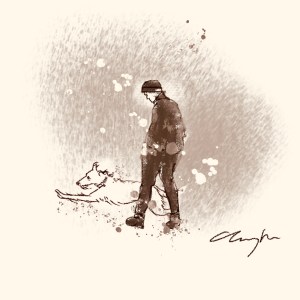
Frances’ house is opposite a broad, rising sweep of woodland. A faint blush of green is just visible, spreading through the bare trees. Early morning walkers are striding purposefully up the paths, their dogs running on. The morning smells fresh, sunshine on frost and moss and damp tarmac. Everyone seems invigorated. Even though it’s early, a couple of neighbours have brought camping chairs out onto their porches. 
‘Is she alright?’ one says, shielding his eyes from the sun.
‘Here’s hoping.’
‘Give her our best.’

Cara hasn’t arrived yet, but I decide not to wait – especially as Frannie has seen me and would wonder what I was doing, hanging around in her front garden. 
I walk up to the window.
‘Hey Frances!’ I say. ‘My name’s Jim. I’m with a community health team. Your GP has asked me to drop by and see how you are.’
I pull my ID badge forwards on its elasticated cord. She looks at it, but doesn’t focus.
‘Oh yes,’ she says.
‘Are you able to get to the door, or shall I use the keysafe?’
‘Just a minute.’
‘Okay. But it might be easier if I use the keysafe….’
Too late. I wonder if she’s decided to let me in or strengthen the defences at the front door. Either way, she begins the slow and painful process of getting from the edge of the bed to the hallway. It would be easier to ask one of the trees behind me to lift up its roots and make its way to the door. 
‘Are you okay, Frances?’ I shout through the window.
‘Just a minute!’ she snaps, then carries on.

I move to the porch, and wait. 

After five minutes, during which the grunting and swearing from inside the house gets progressively louder and more emphatic, there’s a sudden fumbling of latches, things clattering, bolts being thrown. The door judders in its frame a little. Then again. Then nothing.
‘Can you do it, Frances?’
‘No. It’s stuck.’
‘Oh. Well – shall I climb through the window and help you?’
‘Alright then.’

I put my bag and folder down, and walk back round to the window. It only opens so far, and there’s a great clutter of things just the other side. Luckily I find enough of a handgrip to haul myself up onto the ledge, breathing in, squeezing sideways through the gap, then twisting into a desperate, tip-toeing contortion, release my grip, give a last second jump, and land with a thump in the middle of the room. 
There’s an enormous cat just ahead of me. It sinks down on its paws in alarm. The cat is ludicrously furry, like a sheep or a huge duster, or maybe one of those rollers you see in a car wash. 
‘S’okay! S’okay!’ I say, putting out my hand. Which the cat takes as an attempt to grab it, so it runs away in double-quick time. I can’t see its paws, so it looks more like something being snapped away on an invisible piece of elastic.

Frances is supporting herself against the wall. I help her back to the bed, then return to open the door and get my bag. At the same time, the doorbell rings.
‘Is that Cara?’ I say, struggling with the latch.
‘Jim?’ she says. ‘Is that you…?’
The latch finally gives. I throw the door open.
‘Hello!’ I say.
Cara frowns, tilts her head to one side and points at the unopened keysafe.
‘But… How did you…?’
‘I came through the cat flap.’
‘You what…?’
‘Yeah. Well. Sometimes it’s handy being small.’


jack

I decide I need the exercise so I take the stairs. It’s a shame, though. I like those old style lifts with the iron trellis gates you have to pull apart. Number sixteen can’t be far up though; God knows I need the exercise.

Too late I realise how much I’ve underestimated the design of this ancient block. There are only three flats per landing, and each flat has high ceilings, so you have to walk up two flights per landing. All in all, I seem to be climbing forever, endlessly curving round on creaking, carpeted treads that get wonkier and narrower the higher I go, the angles of everything more eccentrically out of true, as if the block wasn’t built so much as planted, a gigantic concrete pod, dropped in a crater and then left to twist up overnight into a beanstalk of Portland stone and glass.

When I get there, finally, puffing and blowing, the door is half open. I knock and call out: ‘Halloo! It’s Jim, from the hospital…’
The door gets flung aside. A bright, blond woman in yellow marigold gloves and Nordic jumper stands with a sponge out to the side, smiling, as if she’s just giving me the once over before she leans in and sets to work.
‘You’ve come to see David, I take it?’ she says. ‘Lovely!’
She calls over her shoulder.
‘David! The nurse is here…’
I put on my PPE and walk into the flat.

David is lying on top of the bed on his left side, his legs curled up, his back facing me. The woman carries on working, stuffing trash in a black bin liner and pushing her hair back from her eyes with the back of her hand.
‘I’ll take this down and leave you to it,’ she says. ‘Just go through into the lounge. David? David! The nurse would like to see you now…’
He swings his legs over the side of the bed, pushes himself into a sitting position in one smooth movement, then stands and walks with a strange directness and neutrality around the foot of the bed, out of the bedroom, past me and then on into the exact centre of the sitting room carpet, where he waits with his arms slack by his sides.
‘Hello,’ he says, and smiles. The kind of smile you work with levers.

It’s disconcerting to say the least – made even stranger by the intense play of light round his head. It’s so dazzling I have to shield my eyes to look at him, like I’m awed before the visitation of some kind of spooky puppet angel. In sweat pants, and a t-shirt with a duck on it.

‘Hi – David! Lovely to meet you! I won’t keep you long!’
‘That’s okay,’ he says, and smiles again, maintaining his neutrality.

I explain why I’ve been asked to come, filling in the gaps with as much conversational putty as I can manage, the lovely weather, the beautiful view, how unfit I am, yaddah yaddah. I start to hear myself, like I’m talking in an acoustically flat room, my words losing their meaning, becoming the kind of noises you might make if you pretended to speak another language.

David starts to pace around the room, marching to the window, to the white counter of the little kitchenette, to the centre of the carpet again.
‘Would you like to sit down whilst we run through these few things?’ I say, gesturing to the sofa.
Even my gestures feel fake.

There’s a book on the sofa, resting face down on the cushions to keep the place: The No 1 Ladies’ Detective Agency. I wonder if he’s reading it or the blond woman.

David looks at me, at the sofa, at me again, then sits on the sofa, folding neatly and precisely in the middle, his hands flat on his knees.
‘This won’t take long,’ I say.

The moment I’m done and unwrapping the blood pressure cuff, he gets up again and strides noiselessly away. I’m crouching on the floor, resting the folder on my knee as I write the figures down. Suddenly I realise he’s standing immediately behind me looking down, so I gently pivot my body to the side – ostensibly so I can look up at him and continue chatting, but actually because I don’t want to have my back to David for any length of time.

‘There! That all looks absolutely fine!’ I say, closing the folder and slowly standing up. ‘The doctor just wanted reassurance we’re on the right track.’
‘The right track,’ says David, smiling. ‘Yes.’
I put the folder back on the shelf and start gathering my things again.
‘So!’ I say. ‘It’s a lovely day out there! Do you have any plans?’
‘Plans?’
‘Yeah. For the rest of the day?’
‘It’s such a lovely day,’ he says.
‘It certainly is!’
He smiles at me.
‘I think I’ll go for a walk.’
‘Excellent!’ I say.
But I have to admit – my abiding thought as I leave the flat and head back down the stairs again – is: where?

The 39 Steps

The 39 Steps, 1935. Dir. Alfred Hitchcock. Watched on YouTube, so you don’t have to.

1.  The credits are all at the beginning. Which seems like a chore, until you think that nowadays you have to wade through a half dozen production company logo animations – and then the same production names in simple black and white – even before you get to the main actors and whatnot, and then the obligatory looking-down-from-a-drone-on-New-York-at-night, even if it’s a film about turtles or whatever. So all in all, I think The 39 Steps wins on that. 

2.  Maybe they put the credits at the beginning because people were still in the lobby buying cigarettes. When it’s over, they wouldn’t wait for the credits, because they’d be rushing out to buy more cigarettes. In the film, EVERYONE smokes. EVERYWHERE. I wouldn’t be surprised to see a baby toss a rattle out of the pram and reach a hand out for someone to pass it a Woodbine. Maybe that could’ve been an early Hitchcock cameo. He’d be a shoe-in for the role of: ‘sinister smoking baby in pram’. 

3.  The production crew is pretty limited, given today’s enormous list. Back in 1935 they made a film with about ten people, including wardrobe, lighting, sound and fish handler (there’s a lot of fish in The 39 Steps). 

4.  I read a little about the film before I saw it. Apparently they blew most of the budget on Robert Donat and Madeleine Carroll, so that explains a lot of the shade and fog, stock footage of trains, people pretending to be sheep &c.  

5.  The film starts in a music hall. Hannay goes in to watch the show in an enormous great coat. He’s GOT to be hot in that, but he doesn’t seem bothered. I’d want to roll it up and stuff it under my seat, whether or not it got covered in ash. No doubt people then were used to things being covered in ash. No doubt at the end of an evening out you’d have to beat yourself off with a carpet brush before you went in the house. Which sounds more fun than it probably was.

6.   Everyone in the film talks either RP or cockney. It’s a handy device. You can tell immediately what class they are. The middle class detectives try to talk proper but no-one’s fooled. They talk poshney, which is basically cockney, but with your chin up.  

7.   Almost immediately the MC comes on the stage with Mr Memory. They’re both dressed and move like robot butlers with worrying, clip-on moustaches. The MC has some banter with the audience, who are rowdy in a beery, knees-up, cor blimey kinda way. 

8.  There’s some chippy shit about whether Mr Memory has prodigious feet, or whether he is capable of prodigious feats of memory. (It’s the latter).

9.  The questions are all pretty low class, about football and horse racing and whatnot. One elderly guy wants to know what causes pip in poultry (I think that’s what he says – I don’t know anything about chickens). His wife digs him in the ribs because she doesn’t want to look common. Too late. They smoke.

10.  Every time Mr Memory answers a question he does a little shoulder-duck, finger-pointy thing and says ‘Am I right, sir?’, which is quite cute and v quotable. You can use a catchphrase too much, of course, although shooting to death is probably an over-reaction.

11.  The gig ends with someone firing a gun and everyone scrambling for the exit. There’s a fight, too. ‘Gentlemen, please! You’re not at home…’ says the MC. Says more about him, I think.

12.  Out in the street, Hannay is just about to light up (because it’s been at least five minutes and he’s gasping; I’m guessing his great coat is stuffed full of cigarettes; he’s like a walking kiosk). He’s grabbed by a Dietrich wannabe who’s mysteriously direct: 
‘May I come home with you?’ she says.
‘What’s the idea?’ says Hannay. 
‘Well – I’d like to’ she says.
‘It’s your funeral’ says Hannay.
They jump on a bus that takes him straight to his front door.

13.  The Mysterious Woman doesn’t like the fact that there are no curtains in Hannay’s flat. I’m guessing he’s decorating, although maybe he’s just an exhibitionist (which might explain the coat). 

14.  ‘Would you think me very troublesome if I asked for something to eat? I’ve had nothing all day.’ says the Mysterious Woman. Hannay gets out a haddock and a loaf of bread. Starts frying the haddock, standing over the pan with a fag on. (Again – they were probably all used to a quantity of ash in their food back then; they didn’t have much in the way of seasoning). 

15.  The Mysterious Haddock-Eating Woman tells him her story, all about spies and stolen secrets, professors with missing digits and whatnot. She says there are some spies down in the street if Hannay doesn’t believe her. He goes back into the lounge to check. There are – a couple of them – standing under a streetlamp, which is like Chapter 1 in the basic handbook for spies. Hannay is smoking (of course). When he comes back into the kitchen to see how The Mysterious Woman is doing with the haddock, and does she need another loaf, he puts the lit fag in his pocket. No joke. I replayed it a couple of times. So of course the rest of that scene I’m waiting for him to burst into flames.

16.  This is a plot point I don’t get. Later that night The Mysterious Woman ends up staggering into Hannay’s bedroom with a knife in her back. Hannay spends the next few scenes wondering how to leave the flat without being caught by the spies. But they’ve already been in the flat! They killed The Mysterious Woman! Why didn’t they get him then?

17.  Hannay has to think quickly. He grabs a milkman down in the lobby (ouch), and tells him the truth – there are spies after him, a woman has been murdered, he’s completely out of haddock. The milkman doesn’t believe him (especially about the haddock – it’s 1935 after all). Hannay changes tack. Says he’s been seeing a married woman and her husband and brother are waiting outside. ‘Why dincha say so!’ says the milkman, giving Hannay his hat and coat. ‘Leave the pony round the corner…’

18.  Hannay makes it to the train station. He’s sitting in a carriage halfway to Scotland (The Mysterious Woman had given him a map with Scotland circled). The other people in the carriage are underwear salesmen, so there’s some gratuitous flashing of bras and corsets for a minute or two, to lighten the tone. Hannay couldn’t act more suspiciously if he was wearing a huge badge on his lapel that says: Looking for a Murderer? Stop me and I’ll Confess. He borrows the salesmen’s newspaper to read about himself, then stares anxiously over the top at them. They stare back. One of them smokes a pipe, which is different. 

19.  About a hundred police and a couple of detectives get on at Edinburgh. They go from carriage to carriage, looking for Hannay. In desperation he climbs out of one carriage and into another where he tries to persuade a glamorous blonde woman that he’s not a murderer by kissing her. Of course, she shops him to the cops. Someone pulls the emergency stop and the train screeches to a halt on the Forth Bridge. Hannay hides behind a girder. The train and the plot moves on. 

20.  Hannay walks about a hundred miles whistling annoyingly till he comes to a crofter’s place. The Crofter, (is Crofter a word? What’s a Crofter? I’ve said it too much now. It’s lost all its meaning). The Crofter is a crazy looking geezer with lowering brows who rolls his eyes suspiciously at everything – especially the croft – but despite that seems quite happy to take a stranger in off the moor at night, no questions asked, all in for 1 and 6. 

21.  The Crofter is married to Peggy Ashcroft, who tells him all about Sauchiehall Street in Glasgow, and how full of life it is there, and how she’d like to know if London women paint their toenails, as she gets out a pan the size of a small paddling pool ready to cook some herring. 

22.  Before they tuck in, The Crofter says Grace like a warlock casting a death spell. Then he goes outside to peer at them through the window.

23.  Hannay tells Peggy Ashcroft everything (in mime). The Forth Bridge is tricky, but he improves with a coat hanger. 

24.  Peggy Ashcroft wakes Hannay up in the night. The police are coming and he has to go. She gives him The Crofter’s coat, because she knew as soon as she saw him that here was a man who appreciates a really big coat. 

25.  About a hundred cops and two detectives chase Hannay across the moors. Mostly in silhouette, mostly speeded-up. Some of the cops fall into streams, some into bogs. It’s fair to say they’re not at their best in the country. No doubt if they were chasing Hannay through Piccadilly they’d be on him in a second. 

26.  Hannay knocks on the door of an isolated mansion. There’s a cocktail party going on where all the women have names beginning with H. It’s quite niche. Maybe a country thing, who knows. 

27.  Hannay talks to The Professor, a sly, slow-talking man who is missing a digit – exactly as The Mysterious Woman had said. Hannay suddenly has the same expression on his face as he had on the train. Think constipated llama. With a tache.

28.  The Professor produces a teeny tiny gun that looks about as threatening as a cigarette lighter, shoots Hannay in the chest, and Hannay falls down dead. Which seems to throw the film off a bit. I mean – what?  

29.  Next thing you know, we’re back in The Crofter’s croft. He’s furious because he can’t find his bible. The bible was in the breast pocket of his jacket. His jacket isn’t on the hook. Peggy Ashcroft admits she gave it to Hannay when he ran away. The Crofter’s eyes pretty much roll out of his head and off down the street. 

30.   Cut to: Hannay in an office saying how the crofter’s bible stopped the bullet. Apparently, after Hannay was shot, The Professor dragged him into another room and left him there whilst he went away to attend to something or other. I don’t know what. I’m guessing The Professor isn’t a Professor of anything medical, because it turns out Hannay was only stunned like a …. like a herring. He came to, jumped in a car and drove to Edinburgh? Glasgow? I’m not sure. The thing is, he went straight to the authorities – which was a bad move, as they immediately called the police. About a hundred cops come through the door with two grumpy detectives. 

31.  Hannay jumps through the window. The next thing you know he’s giving an impromptu political speech at the town hall, which goes down well with everyone but the police. For some reason the blonde from the train – whose name is Pamela – is there, too. Hannay appeals to her to ring the Consulate and warn them about all the spy stuff, but she says no. She’s probably come all the way to Scotland in the hope she might run into him again so she can say No. The police take them both away for questioning in Stranraer (I think – can’t be bothered to check). 

32.  The two cops who take them both away aren’t cops at all but spies. One of them punches Hannay in the mouth for being smart, which confirms his suspicions, although of course normal police will do that, too. When the car gets stopped on a bridge by some sheep – although what the sheep are doing out on a bridge at night in the fog is anyone’s guess. The spies handcuff Pamela & Hannay together. So naturally, as soon as the spies have got out of the car to confront the sheep, the two of them haul it out of there. 
‘Where the devil could they have gone?’ says one of the spies, looking over the side of the bridge. In the dark. In the fog. Surrounded by sheep. 

33.  Pamela and Hannay check into a hotel as Mr & Mrs Henry Hopkinson of The Hollyhocks, Hammersmith. More H’s. Maybe this is a Hitchcockian thing. Haddock. Herring. All these are probably clues but really I’ve no idea. 

34.  After eating an enormous sandwich and drinking some milk and whisky, and after a long and chippy monologue about how Hannay is related to pirates and how he’ll end up in Madame Tussaud’s and whatnot (where’s the punchy spy when you need him?) Pamela ends up totally believing his story. They have to get to London to stop the plan from working! Although I still don’t get how they know to go there. I was never good on plot. Or fish. But in my own defence, I’m not as dumb as The Professor, who shoots a guy then doesn’t bother to check if he’s wearing kevlar, or a bible, or both. 

35.  Back at The London Palladium. Somehow, the police know that Hannay will try something (see no. 34). They’ve flooded the place with about a hundred cops, some of them lounging in the expensive boxes, laughing at the comedy dancers, generally oblivious to the fact that Hannay is sitting in the stalls wearing the giant badge that says: Looking for a Murderer? Stop me and I’ll Confess. With a spotlight on him. Pamela, who’s only just come into the theatre, sees him straight away. So I take back what I said in point no. 25

36.  Mr Memory is brought back onstage – to the tune Hannay has been whistling all this time! Hannay borrows someone’s opera glasses to look up at the top box. He sees a hand on the balcony with a missing digit! The Professor!

37.  Just before the cops arrest Hannay, he shouts out ‘Where are the 39 Steps?’. Mr Memory glazes over (which I totally sympathise with) and starts saying something about secrets, whereupon The Professor shoots him (not that we think he’s any good at THAT), then leaps down onto the stage, where he’s surrounded by about a hundred cops, who finally and miraculously get their man.

38.  Instead of giving poor Mr Memory any kind of first aid, he’s dragged backstage, where Hannay asks him again about the 39 Steps. Mr Memory reveals that he memorised a bunch of plans about a new kind of jet engine, says Am I right, sir? then dies. 

39.  The last scene is a close-up of the handcuff hanging from Hannay’s wrist. I’m expecting Pamela to grab his hand fondly, but she doesn’t. I guess she’s not that fond of haddock after all. 

acing it

Brenda has had a busy day – ironic, given she’s supposed to be in semi-retirement. It’s as if keeping busy is just something she naturally does, hard-wired into her DNA. No doubt if you took a sample you’d see it. If you picked a strand of hair from the floor, a strand that had floated clear from her as she rushed past, her arms clutching bags and a note clamped between her teeth. And you respectfully sealed the strand in a ziploc bag, and took it to a laboratory, and slid it under a microscope, or whatever it is you have to do to visualise DNA (I really have no idea). No doubt it would all come into focus, the delicate, molecular twist of it, the multi-coloured ladder curving in on itself, rungs of the base elements: blue for capability, yellow for experience, green for humanity, red for love.

Brenda’s long service was rewarded recently. She got a certificate, a 40 year service pin for her uniform, a voucher for fifty pounds.
‘So that’s 80p for every year,’ I said.
‘It’s not about the money, Jim,’ she said. ‘Which is just as well…’

To be fair, everyone’s had a busy time of it today. The hospital has been discharging patients like wrecked sailors bailing out a lifeboat. Not only that, our existing caseload has plenty of complication to keep us distracted. There are blocked catheters to deal with, deteriorating patients, reports of increased confusion here, cause for concern there, anxious relatives, access issues, cars breaking down. I’ve spent the morning seeing patients and then struggling to make contact with their doctors, who I know are buckling under the strain themselves. Now I’m back at the office, helping coordinate for the rest of the day, which feels like a Battle of Britain pilot being dragged off their plane the moment it lands, put in an operations room, and asked to move figures around on a table with a mop.

By the time Brenda comes back into the office late into the evening, I am fully and fatally in that ‘Answer Any Question’ mode, that marginally insane, input / output, ruthlessly reactive, beep, beep beep state of mind that doesn’t stop at the end of the shift so much as power down and slump.

‘Oh my God! What a day!’ says Brenda, hurrying down the aisle and throwing herself into a chair, tipping her head back, her legs straight out, her arms straight down, like she didn’t just walk into the office so much as drop through the ceiling. Then looking up at the clock, making a cartoon Aargh! noise, plugging in her laptop, snapping up the screen, and furiously typing up her notes.

You could write a book on the different IT approaches you see around the office. The equivalent of a bird spotter’s guide, The Wild Office maybe, a detailed drawing of each individual, their markings and bandings, a note on the variety of calls they tend to make, and then a description of their typing style. Brenda reminds me of Rowlf , the dog who played piano on The Muppets, the way he leant over the keys, enthusiastically pounding away, staring closely at his paws, but periodically looking up to check he was following the notes.
‘Oh…!’ says Brenda, leaning back in the chair and smacking her head.
‘What’s up, Brenda?’
‘I can’t think what it is…’
‘Can’t think what what is…?’
‘That thing! You know! When golfers play golf. They put the ball on a little bit of plastic. What’s it called…?’
I’m blindsided. Has Brenda seen some kind of golfing injury?
‘Tee?’
‘I thought you’d never ask!’ she says, with a huge smile. ‘No sugar…’

signs of life

Maria is sitting in the sunshine at the kitchen table, a newspaper spread out in front of her, a cup of coffee to the right, a pink wafer biscuit on a square of black slate to the left. She’s staring at an article all about the latest Mars landing. There are detailed drawings of the descent, how the boosters deployed, cutaways to explain all the instrumentation carried on the probe. It’s quite a thing.
‘What an amazing achievement, sending something all that way,’ I say, taking a seat opposite.
‘What is?’ says Maria.
‘The Mars probe. The mission to discover traces of life.’
‘Oh,’ she says. ‘Is that what it is?’

Maria could be some kind of alien visitation herself, landed on her chair, her white blouse glowing brilliantly in the sunshine, her lipstick a shock of red, the coloured beads in her headband sparkling red, blue and green.
‘How are you feeling?’ I ask her.
‘Lost,’ she says.
‘It’s understandable. You’ve been through the wars.’
‘Have I? You see – that’s the worst of it. I don’t really remember. I used to be in control. Now I’m not.’
Her husband Klaus strides back from the kitchen with a cup of coffee and a biscuit for himself. He’s as striking as his wife, his long white hair swept back, his blue eyes preternaturally sharp against the liver-spotted leatheriness of his face.
‘Are you sure you wouldn’t like a cup?’ he says to me. ‘It’s very good.’
‘Absolutely. It’s kind of you to offer, though.’
‘Not at all!’ he says, sighing and settling next to Maria. She barely acknowledges him.
‘Don’t forget your biscuit, darling,’ he says, giving the slate a little turn, as if that’s all it need to capture her interest.
‘Thank you darling,’ she says, but carries on sitting as inertly as before.

The house is filled with Maria’s paintings and sculptures. I’m guessing the bronze on the little plinth by the window is Klaus as a young man. The face may be longer and thinner, the hair more tightly curled, but the birdlike intensity of his expression is the same. It’s an unsettling experience, sitting with her amongst these things. It’s as if the artist is gradually fading from the room after decades of creation, leaving only the light and the colour and the breath, a twist of steam from a coffee cup, a glimmer of moisture in the corner of an eye.

‘Could you speak up?’ says Klaus, when I start to ask them about the sequence of events, the tests that were run at the hospital, the things the doctors said. ‘You see – that’s the devil with those damned masks! We’re both rather deaf unfortunately and we rely on seeing the whole face.’
I apologise, and speak up.
He answers my questions, then when I pause to write a few things down, takes a sip of his coffee, putting the cup back on the saucer so carefully it barely makes a sound.
‘Mind you,’ he says, dabbing at his mouth with the corner of his linen napkin, then spreading it out on his lap again, ‘…of course – one gets so much more than that from a face. Take you, for instance…’
He stares at me, leaning slightly forwards.
‘Yes,’ he says, relaxing again. ‘Yes. Your eyes are nice enough. But who knows under that mask? You might have evil lips.’

stronger than honey

It’s something of a miracle the square has survived at all. Driving up to it, especially on a night as dark and damp as this, along a service road ruthlessly lit by yellow street lamps, past a multi-storey car park, a concrete and steel hotel, a loading bay to the back of a shopping centre, everything deserted, everything thrumming with a thrill of brutalist development – it’s an act of blind faith, a hope against hope that things will turn out alright, that when you take a left at the mini roundabout you will actually come to an address, somewhere warm and domestic and settled, somewhere someone could live, maybe, or at least, come back to from hospital, to get better.

No doubt the Regency architects who built Coleridge Square were looking for a romantic endorsement of their wrought-iron canopies and filigree balconies. Two hundred years later and times have changed; there’s more wrought-irony to be had from the fact that Coleridge was a smackhead. The smart townhouses are all on the slide, backstreet hotels, hostels, bedsits, the red neon NO flickering on the sign that says VACANCIES, like it wants us to get closer before it commits.

We’ve come to see Roo, an IV drug user who has been discharged from hospital to one of the hostels in the square.
‘Why d’you think he’s called Roo?’ I say to Brenda, the nurse I’m doubling-up with. ‘What’s that short for?’
‘I don’t know. Rupert? Rooney? Maybe it’s like in Winnie the Pooh. Roo with the pouch, where he keeps his stash.’
‘That’s a whole other version. Might explain Tigger, though.’

We ring the bell.
Nothing happens.
We try ringing Roo’s mobile again; it goes straight to voicemail.
The door’s on the latch, so we go inside.
‘Hello? It’s the nurses!’ says Brenda.

A heavy but loose-limbed guy walks down the stairs, methodically and carefully, one at time, like a marionette with lead boots. If he is a puppet, it looks like they made the head from a potato, two eyes shot into it with a BB gun.
‘Yes?’ he says, stopping before he reaches the bottom, stabilising himself on the gappy bannisters.
‘Oh hi!’ says Brenda.

She’s amazing. I’m sure if she knocked on the gates of Hell and a daemon slid back the latch, she’d be just as delighted.

‘We’ve come to see Roo!’ she says. ‘We don’t have a room number and he’s not answering his phone.’
‘He’s out.’
‘Oh! When did he get back?’
The man shrugs.
‘A couple of hours ago. He didn’t like the room he’d been given.’
‘Oh! Why was that?’
‘It was filthy,’ says the guy. ‘Which – to be fair – it was. So I put him in room two.’
‘Room Two? Is that a nice room?’
‘Nicer.’
‘But he’s not there now?’
‘No. He dropped his things and then went round to a friend’s.’
‘We’ll have to come back another time then.’
‘I’ll tell him you called.’
‘Would you? Thanks again!’
And we turn and leave. The man watches us from the stairs. It’s only when we’re back out in the street does he come all the way down and then slowly close the door.

‘What a waste of time!’ says Brenda. ‘Of course he’s out! He’s been in hospital a week! What else is he going to do?’

We stand in the square, Brenda by her car, me by mine, looking forlornly right and left, at the mist blowing softly across the square like someone quietly erasing a painting in the dark.
‘I don’t blame him though,’ says Brenda, hugging her laptop bag and folder whilst she unlocks her car. ‘You need something stronger than honey on a night like this.’

Where’s Trump? A look & find book for senators aged 4+

Where’s Trump?

Is he….

….up in the attic, packed in a trunk?

Oh no, no, no! He is not in a trunk
The trunk in the attic is filled up with junk
He couldn’t squeeze in with all the tweets and decrees
So where oh where could that naughty Trump be?

Where’s Trump?

Is he….

…in the marching band where the drums go thump?

Oh no, no, no! He does not make a thump
Or make a trombone play parrump a bump bump
He doesn’t twirl a baton. He doesn’t toot a flute
So where oh where is the man in the suit?

Where’s Trump?

Is he….

…hiding in a garbage can up in the dump?

Oh no, no, no! He is not in the dump
He does not give the dump the official thumbs up
He’s got friends in high places. He’s got pockets of cash
He has not been tossed with the household trash

Where’s Trump?

Is he….

…top of the White House ready to jump?

Oh no, no, no! He’s not ready to jump
He’s a mean old leader but he’s nobody’s chump

Look! There he is! Under the palm tree fronds!
Teeing off with Supremacists and QAnons!
Naughty old Trump! How like him to wander!
How much more looking will we have to do, I wonder?