up on the downs

I took the dog on a walk
we hadn’t done in a while
ten miles south of here
up on the downs

I parked in a lay-by in the lee
Lola ran on ahead
I strode behind
clapping my hands
drunk in the early light and line
glad of everything
taking pictures
trying to leave myself behind
and already – look!
fungus stepped like ears on the stump of an elder;
a twist of fleece on a hawthorn;
graffiti on a beech;
a lifted cover on a mine shaft
on and on, higher and higher
up to a line of golden sheep
staring as I tried for the shot
is one of them wearing a hat?

on the way back down
exploring an unexpected tributary
of the quarry at the bottom of the lane
I came across a wide scattering of junk
everything you could think of, really
fridge, TV, sofa
the only thing lacking
a family to sit on it
I liked the TV best
its screen blown, a tangle of weeds
lolling out in real HD
it was only when I knelt down
to frame the shot
I realised I was surrounded by glass
poor Lola would cut her paws
how would THAT look?
I put the camera away
called Lola (in a softer voice;
hoping she wouldn’t dash after me
quite so crazily)
and walked back to the car

home is due north
it couldn’t be simpler
but for some reason
I put on the sat nav
why, i’m not sure
I liked the warmth
of the car heater
the roll of the road
Lola watchingIMG_6591
from the back
and, I don’t know
maybe I just needed
something else
a few clear words
a sense of direction
to go with all that

the man who found too much

I’m balanced precariously on a limb of the fallen pine at Broken Tree Hill, taking pictures, when I see Stan striding down the slope towards me with Moffat and Briggs, his two brindle greyhounds.
‘Beautiful day!’ he shouts, swiping off his hat and waving it in the air, strands of pure white hair standing up over his balding head, very much like the clouds over the hill.
‘Lovely!’ I wave back. ‘Just beautiful…’
The greyhounds trot over to check me out; I run my fingers over Briggs’ nobbly spine whilst Moffat noses around my pockets; when I reach Briggs’ head, he pushes up against my hand, signalling the end of this particular meeting. The two of them trot off to see what my dog’s up to, and I chat to Stan.
‘Oh – I meant to email you but forgot. I found another tool over the woods.’
‘Another one?’ says Stan, rotating his hat a couple of times, pulling it back on, and then standing heroically, hands on hips. ‘What tool? Where?’
‘Over there…’ I say, gesturing to the southern end of the woods.
‘You’ll have to be more specific,’ he says.
‘A handsaw. Among the sweet chestnuts near the meeting place.
‘A handsaw?’
‘A good one. I hid it under the log pile. Again.’
I can see he’s a little annoyed. I mean – it was only last year we had that strange business with the shrub-cutters.

Stan is part of the woodland posse that meets every Monday to maintain the paths and stiles and so on. They’ve got a little tin shack in the middle of the woods, hidden in the middle of a holly thicket. Just next to the shack is a larger clearing in the middle of which are five log benches, each being a wired stack of timber with a flatter piece on top for the seat. The benches are arranged in a pentagonal shape around a fire pit. They call this the meeting place, and even though I’ve never seen a meeting there, I can easily imagine them together at the end of the day, the flames throwing their shadows back into the trees.
Last year I was over the woods when I found an expensive pair of shrub-cutters. I took them back to the shack, hid them under a pile of timber at the side, thinking I’d email the group to let them know what I’d done. Half way back through the woods I found another pair – which freaked me out at the time. I mean – finding one pair of shrub-cutters was unusual, but two? What did it mean? Was someone trying to tell me something? Feeling strangely observed, I’d retraced my steps, put the second shrub-cutters with the first, and thought some more about that email.

But nothing happened.

Now and again on the morning walk I’d go via the shack to see if the shrub-cutters had been collected. A month later they were still there. Two months. I emailed the group a couple more times. No reply. I’d pretty much given up on the whole thing until I happened to see Stan over the woods again. He’d been away on a long trip, he said. He hadn’t been checking the group email, and none of the others knew how. He thanked me for saving the shrub-cutters, and said they’d better start signing the tools in and out at the beginning of each shift, so they wouldn’t lose anything else.

And yet – here we are with the handsaw. I feel like asking him about the list, but don’t.

‘You’re always finding things,’ he says.
‘I know! I think if you did a DNA screen you’d probably find my great great great grandma was a jackdaw.’
He laughs, but then hesitates, looking at me out of the corner of his eye, like he’s not sure whether there’s something else going on here that he’s not seeing.
‘Anyway – thanks again!’ he says at last, then clapping his gloved hands together, turns and strides off down the hill.

‘Moffat! Briggs! Come on!’

I watch them enter the woods.

sig


crowning

I don’t know what was more painful yesterday when I had my crown done: the drilling, or the squabbling between the dentist and her assistant.
‘What are you doing now?’ she says, glancing up through her spattered face guard at the young girl in the corner.
‘I’m spraying the tray.’
‘Well don’t spray the tray. You don’t need to spray the tray. It makes no difference.’
‘But…’
‘No buts. Just pass me the something-technical. Not that one, the other one. Thank you.’
The way she says thank you. Clamped more tightly than my head.
‘And then something-else-technical please.’ *sigh* ‘No. That’s the other-technical-thing. I want the something-else-technical please.’
Which turns out to be a thunderingly slow drill bit, the kind of thing you might use to scour a tunnel through a mountain, or maybe one of those heavy floor polishers, miniaturised, studded with diamonds.
The dentist frowns at the assistant whilst she snaps it off and snaps on something even more terrifying, dropping the other one into her tray with a clatter.
‘You don’t need to change your gloves,’ she says. ‘Why are you changing your gloves?’
‘I thought…’
‘Keep the gloves. We’re not made of gloves.’
She sighs.
The assistant moves to the other side of the room.
More drilling.
‘Suction!’ says the Dentist. ‘My patient cannot swallow.’
The assistant hurries back over and jabs me in the uvula with the hoovula.
I can’t help gagging.
‘Eeeezzzzy now,’ says the Dentist. ‘There you go! That’s got it!’

dog training

Walking with Lola over the woods today. A stout, bush-hatted, wax-cotton jacketed woman appears, striding stick-first through the rain, accompanied by a black and white collie cross that even from here I can tell is happy to be out despite the weather. As soon as the dog sees us it comes bounding over, instantly nose to nose with Lola, both of them doing that excited dog thing, where they straighten their front legs and make feinting half-jumps, like they’re practising CPR, tails up. I’m happy for them to run around after each other for a while, but the woman starts shouting: Candy! No! Come here, Candy! Come here!
I want to shout back that it’s okay – but I don’t, because I remember when we had our first dog, Buzz, and what a scrappy dog he was, picking fights for no apparent reason, despite the fact we took him to dog obedience classes, where – of course – he was the best behaved dog there.
‘Diamond dog, your dog’ said the trainer.
And all we could take from that was that it was all our fault. Buzz wasn’t scrappy with anyone else. He took his cue from us.
Anyway, the point is, whenever Buzz ran up to another dog, the dog’s owner would invariably shout It’s okay! He’s fine with other dogs! And what we wanted to shout back was Yours, may be…

Candy’s owner has planted her walking stick in the ground and is yelling now.
Candy! Come here! I said – COME HERE! in a surprisingly harsh tone, like a prison guard on a work detail, levering shells into a shotgun.
Even Lola seems cowed.
Candy obviously recognises the change in tone. She looks at Lola, then at me, then at Lola again, and is suddenly away. Seconds later I watch her sit at the woman’s frog-eyed wellies, looking up.
I expect to see the woman lean down and fuss Candy for being such a good dog coming back (and I’m all set to give them both a cheery wave). What actually happens is that the woman wags a finger in Candy’s face: Why don’t you come back when I tell you to? she says, which doesn’t seem at all fair. Lesson over, she pulls her walking stick out of the ground ready to carry on, but then stops again and looks back down at the dog, as if Candy has added something only she could hear.
Because I said so! snaps the woman – and the two of them move away into the gloom.

sig

the sheep rock scenario

On the dog walk this morning I take a route I haven’t used in a while, down an expensive private road on the edge of the village. It’s a different experience along here – grand, detached houses in an odd variety of styles: cod-Tudor, faux-medieval, everything set back behind walls and tall hedges, everything, especially the gates, on a bigger scale than normal. Even the grass verges are wide enough to grow a crop. It seems to be demonstrating a simple economic equation: more money equals more space, needing it in the same way that flowers need sunshine and water, a basic necessity to thrive. Financial potential of this magnitude couldn’t possibly exist in anything smaller.

At the end of the street is a plot of land that’s been in dispute for years. A local pre-school had been using it as a place to play in the summer, but mostly it’s been idle, having its grass mown  in synchrony with the neighbouring cemetery. For years the passage of time has been marked only by the  by the rise and fall of sunlight over the bell tower of the Norman church, and the Hang Seng Index.

I’m used to the expansive views up and down the road. The exotic house names. The teams of gardeners working on the roses. But there’s something else today, something different about the place. It takes a while to realise what it is, but the further I walk the clearer it gets. Today there’s a tall, green hoarding up around the disputed plot at the end. 

I go up to the hoarding to peer through the viewing holes, to see what’s going on. Touching the heavy chain that secures the gates works like the touching of a strand in a spider’s web, because seconds later a sleight and anxious woman is standing by my side.

‘Sorry to jump on you like this,’ she says. ‘My name’s Bunty. I live in that house there, next door to the development.

She points behind me to a long, low, be-chimneyed bungalow with casement windows, a heavy oak porch and a perfectly gravelled drive with a Mercedes parked at the apex. It’s the kind of provincially magical house Gandalf might retire to if he’d quit Hobbiton and spent the last ten years at Lloyds.

‘Lovely,’ I tell her.

‘I just wanted to ask you – have you or your dog ever walked in this field?’

I hesitate, because there’s something legalistic about the way she’s speaking and I don’t want to say anything incriminating. Eventually I decide just to be honest, and say that no, I’ve walked past it many times, but never actually gone in.

‘That’s a shame,’ she says, ‘because I’m trying to get the names of as many people as possible who’ve used the field at one time or another.  I need at least twenty to proceed, and for some stupid reason the school only counts as one.’

I tell her I think it’s a shame, what with one thing and another, but that she shouldn’t give up hope. I tell her I’ll talk to any dog walkers I meet and tell them about her petition.

Bunty launches into a long and complex description of the court proceedings so far. Who was secretly talking to who, the shocking admissions made off record, the corruption at council level, the cynical manipulation of the planning process.

‘I know some people will accuse me of nimbyism,’ she says, ‘But it won’t affect my view of the hills. It’s the principle of the thing. This is a public amenity, in a conservation area. It shouldn’t be allowed.’

I tell her I think the whole thing is disappointing, and I’m sorry it’s come to this.

‘What has everyone else in the street said about it?’ I add, helpfully.

‘That lot?’ she says, batting the air. ‘Oh – they’re happy to have another big house at the end of the street. They think it’ll keep the riff-raff out. But they’re not seeing the bigger picture. And I think that’s so important. Otherwise – who’s to stop anyone doing anything?’

She pauses to take a breath, smiling sadly, the fine lines of her face splashing out across her face like lines from the impact site of an asteroid.

She asks my name, and then the name of my dog.

‘Lovely!’ she says, shaking my hand. ‘Well – sorry to jump on you like this.’

And she’s gone.

*

It’s a relief to make it over the fields.

Lola races on ahead, whilst I take my time.

At the far corner of the field is a stile. The ground dips away sharply there, to a crossing of the stream and then on into the woods. Over the other side I think it might be good to take a few pictures of the ruined stone bridge a little further up. It’s on private land, but there’s no-one about, and the fence is down in one place, so it’s easy to sneak through and creep through the undergrowth.

It’s there that I come across the young deer.

It’s lying on its belly on the earth, breathing rapidly, its legs tucked up underneath. It’s obviously unwell, but I can’t figure out what’s wrong. It hasn’t been shot, as far as I can see; it’s legs all look intact, with no deformity; there’s no blood or vomit or anything else to suggest poisoning. The only thing I can think is that it has stunned itself by running into a tree trying to escape from something. I think it might be kinder and more humane to kill the deer quickly – but quite how I don’t know. It isn’t just that the deer is pretty substantial. I know that I don’t have either the skill or the emotional capacity to commit that kind of violence, so casually. A moment ago I was wandering around, taking sensitive shots of trees and fungi; now here I am contemplating doing something unspeakably violent to a creature that looks as cute as – well – Bambi. The best I can do is hope that the deer will recover its senses and run off. Either that or a predator with much less compunction than me will come across it and quickly put an end to its suffering.

I think about taking a picture of the deer, but that seems cruel and disrespectful, so I don’t. I forget about the bridge, and instead retrace my steps to the stream crossing, and continue on through the wood, debating with myself the tortuous ethical angles of the thing.

Half-way through the wood I meet Stan and his two greyhounds. I tell him about the deer, and what he thinks I should have done.

‘Rung its neck,’ he says.

‘How?’

He demonstrates, planting his feet either side of the thing, reaching down, pulling up and twisting, making a scccrrrrttttch noise.

‘I don’t think I could do that,’ I say.

‘Course you can he says. ‘Don’t forget how much of a problem the deer are in these woods. There’s precious little new growth going on at the moment because they eat it all. It’d be a different place if it weren’t for the deer. They need culling.’

‘I’ll leave it to you,’ I said. ‘You’ve got the technique.’

‘They’re not like sheep, though’ he says. ‘Sheep are a lot squarer and tougher.’

‘More like furniture,’ I say, helpfully.

‘I found a sheep on one of my walks up north once,’ he says. ‘Poor thing. Obviously suffering. Someone had to do something.’

‘So what did you do? Twist its neck?’

‘No. They’re too tough for that. No – I had to go find a rock.’

the goddamn professor

Out early this morning, looking for fossils along the shoreline just west of here.

rockpoolIt takes a while to key-in to the business of looking. It feels less like a hunt and more like a meditation, a slow working down through the normal levels of thinking into something steadier, quieter, more finely tuned to the thing you’re looking for. I remember a description in The Pearl by Steinbeck where he talked about the pearl fishers hearing ‘the song of the pearl’, a distinctive note rising and falling amongst all the other natural voices they swam amongst. Not that I’m claiming to have the song of the fossil in my head. I’m only here a week. But, hey! It’s great to get up early and act as if you can carry a note.

All this is a precious and literary way of diverting attention from the fact I didn’t find anything. Which is an epic fail, considering how fossiliferous the place is. (And that’s just an excuse to use the word fossiliferous – which is quite possibly one of the most ludicrously extravagant words I know, along with concatenation, and maybe bioturbation.) It’s a beautifully dramatic stretch of coastline, though, especially after the storm last night. A real battle zone between land and sea. The forest trees cling to the meagre top soil, whilst the trees at the very edge totter and lean with their roots exposed, overlooking all the sea-worn timbers on the shore. It all feels very liminal and exposed. I could happily beachcomb here all year. Only next time it’d be nice to have Lola along, too.

I just looked up how to spell ‘beachcomb’, to see whether it was hyphenated or not. The definition Google came up with was this: Beachcombing is an activity that consists of an individual “combing” (or searching) the beach and the intertidal zone, looking for things of value, interest or utility. Which is a definition that really seems to fit. Because although I was primarily looking for fossils, I was happy to find other stuff that had been washed up, including worn bits of pottery and glass, and taking photos of things I thought looked good and that I might be able to Tweet. So – absolutely. Beachcombing. With a touch of meditation thrown in.

I didn’t see too many people out this morning. It was still pretty murky and rainy. And everyone I saw had a dog or two with them. We’d wave and say good morning (the people); hold out my hand and say helloooo! as they bounded wetly up, around and on (the dogs). I wondered if they thought I was some kind of expert (the people). Because there I was in the early morning, wearing glasses, a bag over my shoulder, crouching down amongst the rocks at the water’s edge, wearing the right kind of sandals, not caring my khaki trousers were getting wet, holding very still, gently reaching out, picking something up, lifting my glasses, looking at the thing closely, gently putting it down again. I must have looked like a Goddamn professor – when actually I had only the vaguest idea I might find some shark teeth or maybe the odd bivalve, and that about twenty or thirty million years ago this was all something like the Florida Everglades.

Happily, they left me to it.


sig


dogs & what they do

Working three long days straight is a sapping experience, so it was a relief to have the day off today and start with a good long walk with Lola through the woods.

It didn’t start well. We’d barely made it over the park when Lola got a little snappy with a chocolate lab. It had wandered over to have a sniff whilst she was relieving herself against a tree, so she growled and bared her teeth. Luckily the owner, an elderly man who looked so friendly and soft and grey he could actually have been a life-sized cloth puppet, was perfectly easy about the whole thing.

‘Serves him right,’ he said, laughing. ‘He’s got a nose for trouble. D’you know – yesterday – he found this disgusting old rabbit carcass, and he was munching away like a diner enjoying the most delicious meal. But I really couldn’t bear it, so I called him off. And blow me, today, as soon as we were within a mile, he made a direct line back to it and finished the damned thing off.’

more mushrooms

As I was walking I was thinking about my guided meditation that morning (using the Headspace app – thoroughly recommended). In the last few sessions, Andy had been exploring the idea that sometimes we have certain emotions that we come back to again and again, emotions that end up defining us and our way of thinking. Ironically, the resistance we put up to these emotions can end up giving them strength and permanence. He put the idea that it would helpful not only to recognise what these recurrent emotions might be, but also recognising when the usual pattern of resistance was happening, so that we could rob them of their power by letting them go. (I think that was the gist).

He put the question: What would it be like to be free of them?

Depression has been a problem with me for so long I’ve come to accept it as a fact of nature, like the weather. Sometimes worse than others, exacerbated by circumstances, no doubt, but always there, a latent voice, a bad-mouthed genie in a dirty bottle I’m doomed to rub at certain phases of the moon, ready with the same old tropes, scenarios in which I’m the hopeless case, the dreamer with nothing to offer, the bad lot, the waste of space.

What would it be like to be free of all that?

And actually – I could imagine it. Bizarrely. But then where would that leave me? It’s been the way I’ve orientated myself in the world for so long, I had the light-headed feeling I’d be left with nothing.

But wouldn’t that be great? A blank slate. A chance to start over. A chance to be myself without fighting against some wormy, outdated version of myself.

Anyway,  that’s where I am at the minute. I’m definitely carrying on with the meditation, because this is the furthest I’ve got with this, and it feels right, and anyway, it’s less fattening and blurring than SSRIs.

As I was walking and thinking about all this I was taking more pictures of mushrooms. I was particularly looking for raddled old, slug-sculpted specimens. Don’t know why – just seemed appropriate!


new poem

trailer b 2_sm
Trailer B II

I wrote another poem today. It carries on from Trailer B, so I suppose it’s really Verse 2


Thanks for reading!

sig


Friday 04

Alistair is one of those easy-going friends where the conversation picks up where it left off, no matter how many days or weeks have gone before. A geologist by trade, his natural inquisitiveness extends endlessly, to everything, from dinosaurs to the Trump administration, computer hackers to the future of transportation – everything flowing one thing to another as bright and lively and refreshing as a spring from an artesian well. I don’t see Alistair so much these days, more’s the pity. We met dog walking, and that’s what I’ve come to do today, driving out to his new house in the country.

So after getting there early, pulling on our boots and discussing the route, we set off, his collie Ailsa running on ahead with Lola, our lurcher, trying to keep up. Briefly stopping to check on the two new chickens he’s added to his flock, in a pen at the bottom of the garden, we have the usual family updates neatly out of the way by the time we’ve reached a gap in the hedge, and the conversation opens out as we step through into the first field.

Religion

ferns on wall ‘Do you think the whole religion thing just boils down to people being scared of dying?’ I say, stopping to take a photo of some ferns on an old wall.  ‘Or maybe it started off when people painted pictures of animals they hunted and then confused the picture with the real thing.’
‘I don’t know,’ says Alistair, examining a twig. ‘It’s such a world-wide phenomenon. It’s like a function of who we are. I read this book once that looked at religion in the context of societal development. It was a bit turgid, but I think he had a point.’
‘Which was…?’
‘Well to begin with you had groups of people wandering about, following the migratory routes and the seasons, settling in places only so long. You get an idea of how their religions might have looked from old peoples like the Native Americans or the Aborigines, where it’s all very much linked to the land, ancestors, spirit animals and so on. I mean, some things you can imagine. Like worrying whether the sun’s coming back, or thinking that lightning or earthquakes are the world being angry. But then as soon as people start settling in to one place, and they start being able to support themselves, and an artisan class, then the more monotheistic religions come in, which fit with the way society starts to stratify into working and ruling classes.’
‘Be content with your lot because your reward will be in heaven’
‘Exactly. And it sanctifies wars of acquisition, because God’s on your side, even though it’s obvious they’ve got a version on their side, too.’

We come to a pine tree that’s been pushed over by a storm. The roots have been leveredtilted tree up, so the bole looks like the door to the underworld prised open. I stop to take a photo whilst Alistair re-laces his boots.
‘Have you ever been to Jerusalem?’ he says. ‘I went there once – by accident – long story – but anyway, fascinating place. We went to Temple Mount, to see the stone Mohammed was supposed to have launched himself from to meet Allah. I was standing there with the rest of the crowd, and I was trying to get into it all – you know – the idea that here was something magical and divine. But I just couldn’t get past the thought that here we all were, standing round an outcrop of limestone on a bit of a tilt.’

Eyes

‘You’d think with evolution you’d see lots of redundant species,’ I say. ‘But you don’t. Everything seems finished. Although hammerhead sharks are pretty weird.’
‘I think the thing is, evolution happens over such a long period of time, and at a genetic level, it’s hard to comprehend,’ says Alistair. ‘But then – think of the spectacular variations you get in eyes. It’s such a specialised bit of kit, adapted for all kinds of environments. Flounders, lying on the sea bed facing up. Or flies, with compound eyes that look like blackberries.’
‘I think I read somewhere that a hawk has two lenses in each eye, one for distance, one for close up.’railway bridge
‘And dogs. Dogs have way more peripheral vision than we do because they needed it for the plains. And that’s why they tilt their head to look at you. Not because they’re trying to be cute. They’re just trying to get past the end of their nose to read your expression better.’

We come to an overgrown railway bridge, abandoned years ago along with hundreds of other branch lines in the sixties. It’s a poignant scene, and seems to fit with the idea of evolution, redundancy, for better or worse.

Left brain, right brain

‘You know swifts?’ I say, stopping to take a picture. ‘Apparently they live almost their whole life on the wing. When they want to sleep, they fly up ten thousand feet, then half their brain shuts down, with the other half adjusting to the wind currents so they stay in the same place.’
‘The whole sleep thing’s interesting,’ says Alistair. ‘I mean – this idea that you close down for hours, in some kind of suspension. I think there’ve been studies done that show if you hear a regular noise you don’t respond, but if you hear something sudden and out of character, you wake up. So you’re actually monitoring your environment – which suggests you’re never completely out. Which makes sense.’
‘Maybe that’s why your brain’s in two halves, so one half can keep an eye on things while the other rests.’
‘There’s definitely something in this whole symmetry thing. Two arms, two legs, two sides of the brain. I don’t know. It kind of fits with the rest of the design.’
‘Didn’t they debunk that whole left brain, right brain thing?’
‘It’s over-played. You get regions responsible for different tasks, and it all comes together. It’s like eyes again. The two inputs merging to give you a stereoscopic picture. It’s probaly something like that. A kind of rounded, three-dimensional apprehension of whatever it is you’re thinking about…’

You are old, father william

We meet an elderly man at a gate, out walking his large, chocolate labrador. The man looks a country sort – gilet jacket with loops for shotgun shells, and a small pair of binoculars. We stop to chat, but Alistair’s from Edinburgh, and his accent completely flummoxes him. Hmm? he says, and then looks at me to translate. Alistair asks him whether he’s spotted anything interesting whilst he’s been out. The man looks to me again. I point to the binoculars.
‘I’ve got a defibrillating pacemaker,’ he says, as if that’s what I could have possibly meant.
‘Oh?’ I say.
He goes on to describe in great detail absolutely everything pertaining to his heart condition. The number of times surgery was cancelled, even though a wire was actually hanging loose, he says.
‘And picking up a local taxi cab’ says Alistair.
Hmm?
I don’t translate. He carries on… the dose adjustments to his Warfarin, transport arrangements, failures, symptoms out walking, and on and on. It’s an exhaustive and comprehensive account. Ten minutes later and the dogs have given up, going on into the next field to sniff about, and even though I keep glancing in their direction and making slight movements of my body to hint that perhaps we should follow, and it’s all been lovely, the man carries on talking. I start to feel desperate and consider my options, but Alistair seems happy enough, standing with his arms folded, listening to the man, drinking it all in. Eventually, through some miracle not of our making, the man runs aground.
‘…but I mustn’t keep you,’ he says. ‘Cheero!’ and abruptly hooking his labrador to him with the crook of his walking stick, he turns and shuffles off.

‘You see!’ says Alistair, utterly unfazed. But I’ve completely lost the thread, and I’m not sure I do.

the strange case of the branch loppers

There’s a meeting place over the woods. A hexagon of rough benches, each one a stack of four cut timbers capped with a plank and then wired together. I’ve never seen anyone sitting on them, let alone a fire in the middle – which they must light sometimes, as the centre is blackened with a scattering of cold embers. It must be nice to sit there chatting about this and that with the fire burning and the light playing over the perimeter of trees and undergrowth. Like old times.

Yesterday when my dog walk with Lola took us through the woods past the meeting place, I thought I’d stop for a while, sit down on one of the benches and imagine what it must be like. As soon as I sat down, the plank wobbled alarmingly and I got up again to see what the problem was.

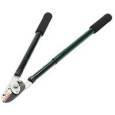
A long-handled branch lopper. I could see what had happened. One of the volunteers who work in the woods must have left it out. And then someone else found it, and hid it under the plank to keep it safe until it was found again. The volunteers have a tin shack nearby with all their tools locked away. The bench was as good a spot as any – or was it? The meeting place is pretty open. I figured it might be better to take the branch lopper and hide it round the side of the shack.

So that’s what I did. There was some timber to the right and I hid it under that. I was a little anxious someone might see me and wonder what I was doing. It looked suspicious, rootling around like that. But if they came close enough I’d explain, and we’d all have a good laugh about it.

When I was happy the branch lopper was well hidden, I set off again with Lola, aiming for the meeting place again. This time I didn’t stop, but walked right through. And it was just when I’d left the hexagon on the north side that I saw them – another pair of branch loppers, lying in the grass.

It was all so unlikely. What was this? Some kind of sign? How many times would I have to repeat the same thing before I realised what was happening?

I picked up the branch loppers and headed back to the shack. Lola took a while to come back – as if even she was uneasy about the way the walk was going. But I dealt with it quickly. I was an old hand already with the whole lost branch lopper thing. I knew exactly where to put it.

As I made my way back to the shack I started to think of a story that might account for this scattering of branch loppers, and what I might find next. And it was then that I remembered years back when I was out walking with a friend and we found a body.

We’d been trespassing on private land. We knew it was private because there were all these crazy signs, red paint on warped boards, saying KEEP OUT and TRESPASSERS WILL BE SHOT. By the look of the place no-one had been around for years, so we thought it was a fair chance we’d be okay. We carried on past the ruined farmhouse and into the overgrown fields beyond, making up a cliché horror story about the guy who lived here and all the people he’d killed. It was only when I pretended to get shot and did a spectacular cartwheel death fall that I noticed the jacket

It was dropped in the long grass just exactly as if someone had taken it off and carried on walking. There were odd things in the pocket – a bus pass, a ball of string, a blood-stained handkerchief.

‘Shit!’ said Rich, glancing back in the direction of the farmhouse.
We started looking around. We came across other things: a shoe, a pair of trousers. And then we saw the body, lying on its right side over by the barbed wire fence at the nearest edge of the field. We both ran over, but as I’d done a first aid course by that time, I went first.
‘Are you all right?’ I said, leaning over and tentatively touching the body on its shoulder. But the face was all rotten and fallen in, and when I jerked back I remembered the trousers we’d found, and realised that the legs were uncovered and blackened. It was winter, though, and there was no smell. I remember a blackbird perched on a post just a little way away, bobbing up and down, chip-chip-chipping in alarm.
‘We’d better call the police’ I said.
‘Has he been shot?’ said Rich. ‘Turn him over and look.’
But I didn’t really want to do that and in the end neither did Rich.
‘We’d better call the police.’

This was before mobile phones. We could see the roof of a cottage over a nearby hedge, some smoke rising. We walked over there. I climbed on a stump and peered over. There was an elderly woman gently prodding around in a flower bed with an immaculate trowel.
‘Excuse me’ I said
She straightened, and looked about, the trowel held out to one side.
‘Over here,’ I said. ‘The other side of the hedge.’
‘What do you want?’ she said. ‘I’m not alone.’
‘No. It’s okay. Only – we found a body and we wondered if you’d call the police.’
‘I will call the police!’ she said.
‘Great. Thanks. We’ll wait on the road by the abandoned farmhouse.’
‘I’m going to call them right now!’
‘Thank you very much’ I said, jumping back down.

There was a long wait, but eventually they came. Two patrol cars, blue lights flashing, no sirens. We took them to the spot, and then whilst one of them made calls on his radio, another drove us back to the police station to take statements. It was only months later I got a call to let me know what happened. An elderly man had absconded from a home for people with dementia. He’d become lost and confused, and the weather was bad, and the likely cause of death was hypothermia.
‘Why’d he take his clothes off like that?’
‘It’s called paradoxical undressing. People do that when they’re very cold. Apparently,’ said the officer on the phone. He sounded like he was in a rush and didn’t want to be drawn into anything. I thanked him for the update.
And that was that.branch loppers

an arrow to point the way

arrowOut with Lola for a dog walk this morning. I was thinking maybe I ought to find some new routes if I’m going to be writing more day-to-day stuff for this part of the blog. But then I thought how changeable things are. There’s always something new to see, different times of year, differences in the light, the people you meet, the way you feel in yourself. No two walks are ever the same. And then, to illustrate the point in a rather blunt kind of way: I found this arrow propped up against a tree…

Lola as Sam Spade (if you see what I mean)

lola looking sneakyLater on I met Mary. She stopped to make sure her black Labrador Charlie had a firm grip on his ball, because Lola has been known to nick it and then run around for ages celebrating / taunting. It was obvious to both of us –  and no doubt Charlie – that Lola was only pretending to be interested in something a little way ahead. Sure enough, as we stood talking, Lola slowly started to circle back, irresistibly drawn to the ball. She really can’t help herself.
‘All she needs is a trench coat and trilby hat,’ I said, thinking about detectives in pulp thrillers.
‘And a pipe,’ said Mary.
She put the slimy ball in her pocket.
I carried on walking.

A complete absence of bird

woodpecker tree

Out onto Broken Tree Hill. Saw a woodpecker on the dead pine there, but the zoom on the phone camera isn’t great, and when I tried to get closer the woodpecker had gone, flying in that funny, dipping way they have, a lazy-kind of blanket stitch along the edge of the field. So I didn’t manage to get a great wildlife shot of a woodpecker tapping around for bugs. You’ll just have to make-do with a shot of the tree, and trust it was ever there at all.


Andy says

I’m a big fan of my smartphone. They come in for plenty of stick, especially re.‘phone zombies’: people walking along staring into them without looking up phone zombieand falling into the sea &c, or sitting scrolling through lunch and not talking to anyone. All these things are true and a bit of a hazard. But there are so many other, positive aspects to them, beyond just the phoning, the googling and the satnav. For example, I love the note function, that lets you dictate things you’d otherwise forget. The camera’s good, too, and the voice recorder. And then there are the apps you can download. I’ve been using Headspace these past few months. It’s a meditation program, which you can tailor to your own needs. Things were getting stressful at work, and I needed something to help me feel more in control & calmer about things. Headspace has really done the trick (which sounds like a blatant bit of advertising, but it’s just a personal recommendation – honest!) I was thinking this morning that it could be seen as something of a cult. ‘Andy’ the charismatic voice guiding you through all these deep relaxation & visualisation techniques. I wonder if the government has approached him with a ton of money to hypnotise a good proportion of the population so that at one key word we all become Andy’s Army (free story idea, right there). Anyway – I thoroughly recommend the app (must serve Andy… must serve Andy….).
New poem:

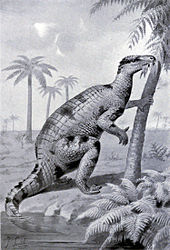
Iguanodon_feeding
mantell piece

sig


p.s. Big thanks to Mark Spencer for recommending Irfanview as a handy photo re-sizer in place of the much-missed Picture Manager. (I downloaded via filehorse, but there are plenty of other place). So far, so good. It works a treat!

pool party

I’m off to France tomorrow
an engagement party
my niece is getting married
no, the other one
we’re all invited to a villa
she’s hired, somewhere down south
i know, sounds heavenly
but you know what?
i’m dreading it
a pool party, for fuck’s sake
what am I going to do?
it’s all right for them
all her leggy friends
striding around
skinny and fabulous
sunglasses on their heads
and their hair like OMG
they’ve got abs, some of them, six packs
and I don’t mean lager
me? my tummy’s as saggy
as an old cushion
the cat ripped up
nails? the last time
I had my nails done
I looked like I had a circulatory disorder
bikini? I’ll have to wear a kaftan
a fucking bathing machine
would show too much

pool party
god! what the hell am I going to do?